
Why I Spend Most of My Free Time Making Tech More Inclusive
We need more diversity in IT, and I am no longer waiting around for it to happen.
I have been one of the elusive women in IT for over 20 years. It was neither planned nor was it a straight path.
I spent my younger years in an analog world. Personal computers in every home were not a thing yet. My first contact with computers was in 1994 working on my Ph.D. at the Institute for Theoretical Chemistry.
We had access to the internet, and I clearly remember how I marveled at our ability to talk to colleagues on the other side of the world. The possibilities of this new technology seemed endless and made me want to dive deeper into this world.
But I also clearly remember the incredulous looks I got when I talked about this and mentioned I had an email address. People asked why anyone would need such a thing. To me, it seemed apparent, but most people thought it was a fad.
No one I knew wanted to be in IT, neither men nor women. It just wasn't cool or interesting.
Working with PCs, learning about programming, and when RedHat Linux came around, frantically compiling new kernels all night to find the correct module to make the printer work was a niche sport.
At the time, I never worried whether this was something women do or thought about gender balance. It was simply something I enjoyed doing. And because I enjoyed it, I became good at it.
Flash forward to the year 2000, I was done with my Ph.D., and the Y2K bug was threatening to throw us back into the dark ages.
Computers had become so pervasive in delivering services that people hoarded money and goods. Fearing that this glitch in how we represented dates would not only turn the time back to the year 00 but bring about the downfall of civilized society.
That didn’t happen. What happened was PCs, Game Consoles, Laptops, Netbooks, Smartphones, and tablets. Technology became ubiquitous and pervasive.
Digitalization has profoundly changed how we live, shop, and communicate. What has not changed is the people who make this technology for us.
Technology is still primarily designed, developed, and sold by men. They make excellent technology. But they make technology for themselves and the problems they are trying to solve.
I want technology made for everyone, representing the needs of all members of society.
For over 20 years, I have often been the only woman in the room—the only black woman, for that matter. Being the odd one out can be helpful, but it can also be tiring in the long run.
It’s been fun, and I have been successful, but I would now love to look up from my computer and see someone like me. When I go to my customers, I want to explain the cool stuff we are developing to other women, not just men.
You have probably heard the repetitive calls for more women in IT. The sad statistics presented about the lack of hirable talent. There are many underlying issues, but one that is not immediately obvious:
When we say, “We need more women/diversity in IT,” we never bother to explain what we actually do in IT.
There is a perception of working in IT centered around a young guy in a hoody, sitting in a dark room, dimly lit by the screen of his computer. Empty pizza boxes scattered around him. Most women don’t want to be that guy.
One of the things we need to do to make the field more attractive is to show other people the cool stuff we are doing IRL.
“How do we begin to covet?” is the question that Hannibal Lecter asks Clarice in “The Silence of The Lambs.” We covet what we see.
To want to dream of doing something, you have to be able to envision it. Role Models, other women doing things before them, are essential factors when making girls and young women feel IT for them, and they have a place here.
“Dream with ambition, lead with conviction, and see yourself in a way that others might not see you, simply because they’ve never seen it before.” — Vice President Kamala Harris
A few months ago, I started going through my network and LinkedIn to find other women in Tech. I created the Women in Technology Spotlight, where I interview women working in IT and let them talk about their journey and what we do in our jobs.
What started as a way to highlight job roles has taken me on an incredible journey. I meet the most inspiring women every week. Every single one of them has taught me something new and made me grow.
They talk about their different journeys into IT — believe me, there are so many different paths. The roles they have are as diverse as their characters. But what unites them is that they all enjoy working in IT.
They speak about their love for technology, the flexibility it gives them, the growth they experience, and the financial independence they achieve working here. And they all tell you that it is not a bad or scary thing to be different or unique at all.
“Recognize and embrace your uniqueness…Being a Black woman, being a woman in general, on a team of all men, means that you are going to have a unique voice. It’s important to embrace that.” — Erin Teague
One thing leads to the other. Womens’ Day 2021 made me start a monthly #ChoosetoChallenge Discussion Panel with two other women working in the space. We invite experts to talk about the strategies we can implement to make IT more attractive for women.
Many women have talked about the importance of mentors in their careers. Either they were having a mentor or being one. Their stories made me volunteer as a mentor for the WoMentor initiative.
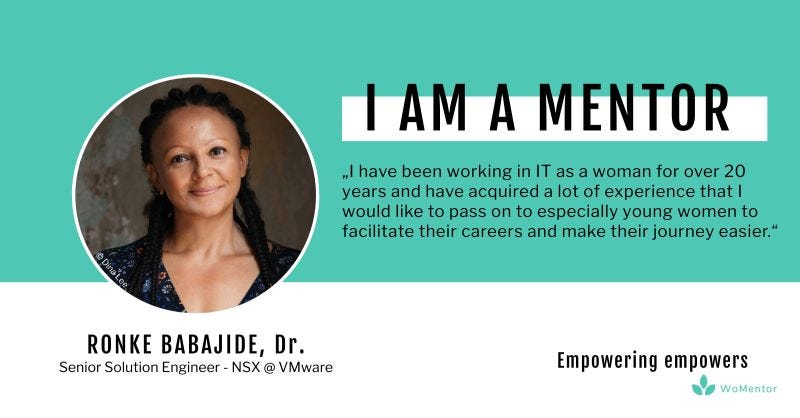
One of them encouraged me to join an #IamRemarkable workshop. It was remarkable (yeah, sorry, mom joke)and made me become a facilitator for the initiative. Because I sincerely believe we need to learn to talk about our achievements.
Now I spend most of my free time working on projects empowering women in Tech and making sure their numbers grow. And I absolutely love it.
Every conversation I have with other women is an enrichment. Every additional woman that starts working in the space makes tech a more inclusive place. Next, we have to work on retainment, but that is another story.
“If we do not share our stories and shine a light on inequities, things will not change.” — Ellen Pao
Want to write for The Pink? We’d love to have you in our community of 100+ writers. Or Follow us on Instagram for more.


