
Why I Have a Massive Crush on Rick Steves
And why you should give him a second glance
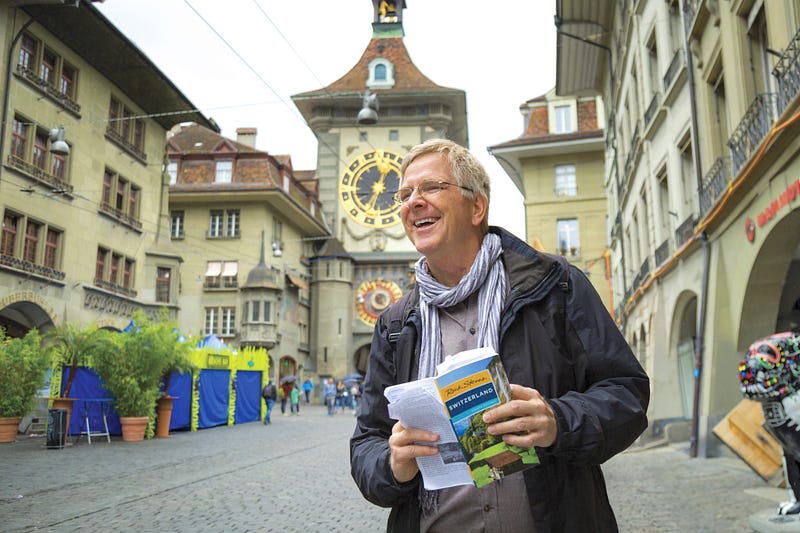
You may know him as a frumpy traveler with a goofy grin kindly encouraging you to visit some of the most popular travel destinations in the world: Paris, Naples, Berlin, Barcelona. You may have seen him wandering the central squares and cobblestone streets of Europe in a rumpled button-down, smoothing down his wind-blown forelock. He stops to gesture at the goings-on in a plaza, purchase food from an amiable street vendor, or gush over prettily winding alleys or fresh produce at a local market.
Rick Steves is one of the biggest names in international tourism. Perhaps you’re familiar with his primary products: his gold and blue bedecked guidebooks, his cheerful public radio show, Travel with Rick Steves, or his alluring television series, Rick Steves’ Europe. Maybe you’re familiar with his commitment to legalize marijuana.
His brand is distinctly his own: familiar, approachable, optimistic, informal. He stays on the beaten track, revisiting the same cities to discover new nooks and crannies. He favors conventional tourist attractions: art museums, castles, historic buildings, and gardens. Although he’s stated many times that his favorite country to visit is India, his business entices Americans to Europe.
Many critics have challenged Steves’ choices, accusing him of contributing to ruining destinations through overtourism (a non-issue in 2020)and ignoring lesser-known places, and many commenters across the internet call him nerdy, preachy, and sanctimonious.
Those who look beneath the surface, though, may find another Rick Steves, a tactical, deliberate man on a mission. And I love him for it.
Rick Steves has a secret.
While Steves highlights the best little cafes in Rome or the hidden gems of Oslo’s quieter streets, his veiled goal is to put Americans in touch with different cultures to expand their worldviews, destroy their stereotypes, open their minds, and create a more peaceful world. Art museums, cafes, and old buildings are just vehicles to broaden people’s perspectives through deeply moving, life-changing cross-cultural interactions. He says,
It really is kind of my mission to get Americans out of their comfort zones and to realize the world’s not a pyramid with us on top and everybody trying to figure it out. There are smart people doing things different than us…. When we travel with a curiosity and an open mind, we challenge the norms that we think are given, and they’re really not.
Rick Steves strategically selects his audience.
Steves also receives criticism for serving wealthier, white Americans who tend to visit Europe only. While he espouses budget travel because it “forces you to travel close to the ground, meeting and communicating with the people,” his company’s tours are quite pricey; a ten-day European excursion averages $3,000 per person. Steves’ team of 100 employees appears to be predominately white.
Could Steves tackle the inequities inherent in travel? Could he address colonialism, slavery, and race? Could he expand his tours to Ghana, India, or Vietnam? Of course, he could.
But Steves knows that he can have his greatest impact on American society by blowing the minds of white, wealthy people who tend to inhabit roles of power and influence at home. In short, Steves targets the decision-makers. And those people travel to Europe.
Worried about refugees? Visit Germany, which has taken in over a million of them since 2015. Concerned about Muslims? Visit Turkey or Morocco or Bosnia. Wonder why Israelis and Palestinians can’t get along? Visit the Holy Land. Think undocumented immigrants are causing problems? Visit Mexico beyond the resorts. Think our taxes are too high? Visit Scandinavia. Threatened by communism? Visit Cuba.
Imagine the choices these decision-makers would select if they traveled “close to the ground” in Turkey or Cuba or Palestine, talking with street vendors, eating in the homes of families, staying in locally-owned guesthouses, or purchasing produce in neighborhood markets.
Rick Steves is sneaky.
One common reason people avoid this sort of immersive travel is that they fear a day without their creature comforts. Abroad, they may not consume familiar foods, lay on a bed of the appropriate firmness, count on the safety of the roads, experience top-notch medical care, or rid their space of all insects, big and small.
Steves makes travel feel easy so that more people will “go beyond Orlando.” Rather than push travelers to eat from dubious street carts or stay in youth hostels, he recommends safe restaurants and comfortable accommodation by American standards. While this tactic removes some of the mystery and serendipity present in a grittier form of travel, it achieves one of Steves’ objectives: it eliminates many of the barriers and excuses about traveling abroad to get us on the road.
Rick Steves harnesses history.
Steves understands that travel is complicated. It’s laced with wealth and power inequities, and most destinations have histories of conflict, dictatorships, shifting borders, or ethnic strife.
Steves’ respects the complexity of destinations around the world, without washing away the detritus. He subtly and gently weaves historical context into his public remarks, tours, and writings along with positive elements of world cultures. By revealing historical underpinnings, Steves helps us deepen our learning, reflect on our place in the world, and enrich our experiences abroad.
Rick Steves builds bridges to generate peace.
I’ve been fortunate enough to live, work, travel, and volunteer in over 40 countries with many other Americans. Each of them, without exception, is open-minded, tolerant, and empathic. They are philanthropic, community-minded, and engaged. None of them is ethnocentric or nationalistic. Travel has irrevocably changed them.
By encouraging travelers to notice their similarities, question their assumptions, and make connections, Rick Steves helps others become better — more tolerant, more open-minded, more empathic — global citizens. He says,
That’s sort of the fundamental thing about travel. We humanize this planet and we come home, not fearful, but we come home celebrating the diversity, and the joy, and the love that just abounds on this planet. And that’s one thing I come home with from when I travel that just the love of a father or a mother for their child is perfectly the same here or Guatemala, or Sri Lanka, or Papua New Guinea, or Norway, or Morocco.
Steves’ impact on Americans is immense. In a typical year, his tours alone illuminate the gifts of Europe to at least 20,000 people, to say nothing of the thousands more inspired to travel the world because of his books, television, and radio programs. For Americans, who benefit from recognizing both the humanizing similarities and the rich, fascinating differences among people across the planet, Rick Steves offers a way to see the world and come back altered.
Now all we travelers must do is put that broadened perspective, that respect for difference, and that opened mind to use at home within our families, at work, and in our communities so that we can all benefit from the life-changing elements of world travel.


