
Why I did NOT Renew My PMI, Agile & Scrum Certifications (2023)
Some Agile and Scrum certifications expire if not renewed every 2 years, which is simply a money-making racket. Learn why I let my certifications expire.
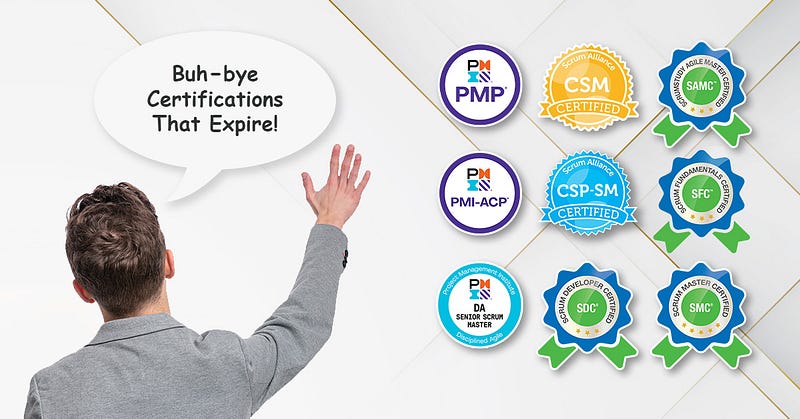
A few years ago, I made a decision to stop renewing my professional certifications that expired. It was difficult to let go and see those hard-earned certifications expire, particularly those I had achieved 30 years ago. It was a difficult and emotional choice. And the right choice.
So why did I do it? Read on to learn more.
I had a lot of Agile and Scrum Certifications
I had a lot of Agile and Scrum certifications, more than most people. Just prior to the pandemic in early 2020, I set out on a quest to achieve one new certification per week. And I did really well, racking up 14 new agile and Scrum Certifications by April 2020. But the cost and the time investment started to look foolish as we learned about the pandemic and our clients canceled their training and coaching engagements.
Before I chose to end the experiment, I had achieved a total of 23 agile and Scrum certifications. I also had the PMP certification from PMI from my days as a PM for a grand total of 23 certifications.
PMI and Scrum Alliance Certifications Expire
I was always aware that the PMI certifications expired and had to be renewed. I obtained my PMP in 1995 and faithfully renewed it every 3 years. That meant getting PDUs and paying the certification renewal fee.
Getting the PDUs to re-certify was always easy for me since I delivered so many training courses and attended many as well. I wrote books targeting project managers, spoke at PMI chapter events, and volunteered with the local PMI Chicagoland Chapter. So getting PDUs was easy and I only had to enter them into the form at PMI to get the credit.
I was surprised to learn that my Scrum Alliance Certifications would also expire. I was first certified as a Scrum Master (CSM) in 2014 and as a Scrum Professional(CSP-SM) in 2015. At the time, I thought the Scrum Certifications were valid for life. As it turns out, they expire like those from PMI.
I first heard about this from a friend who has his CSM. He reached out to me, alarmed that he had just discovered he was no longer certified as a Scrum Master. He couldn’t find himself in the Scrum Alliance online certificant directory. (You may want to check for yourself.)
The colleague has been acting as a Scrum Master for nearly 7 years. He had achieved his Scrum certification like most of us — by sitting through a 2-day certification course taught by a Certified Scrum Trainer from Scrum Alliance. When he took the class, he was not even required to pass the token quiz — that was added later.
Did he become any less competent as a Scrum Master once his certification “expired”? Actually, it is probably the opposite. So why should the certification expire?
Agile and Scrum Certifications Are a Money-Making Racket
That’s right, Agile and Scrum Certifications are a money-making racket. Through the use of Certified Scrum Trainers and PMI Registered Education Providers and Authorized Training Partners, they operate like a multi-level marketing scheme.
The Scrum Alliance approach has always felt a little like a puppy mill — churning out those “Certified Scrum Masters” certifications to anyone who paid for a 2-day training class. They created a virtual monopoly on Scrum certifications and controlled it through the limited number of Certified Scrum Trainers that they controlled. As long as people paid and attended their 2-day training, they got their Certified Scrum Master (CSM) certification.
Despite widespread criticism, Scrum Alliance hasn’t changed its approach much. They did add an end-of-course exam for some of their certifications, but that is about it. This leads me to believe it really is only about money. The Scrum Alliance charges money to give you what I increasingly consider a meaningless certificate. I’ve met too many “certified” Scrum Masters who went through the 2-day class and still know little or nothing about Scrum.
I am not sure that the PMI approach is much better. They do require professional development units (PDUs), but those PDUs are pretty easy to obtain, and there is no verification of continued learning. It really seems to be about the money.
So I Decided to Let My Certifications Expire
Once I realized how foolish certifications were, I decided to let them expire.
I admit that initially, it felt a little risky and feckless. It was emotional.
First, I felt like I was losing my investment. Like all my hard work to pass the exam in the first place was going to be thrown out if I did not renew. The reality is, that the investment is a sunk cost and should not factor into future decisions.
The second reason it was emotional was that it felt like it would put at risk my path to future agile and scrum certifications from the Project Management Institute and the Scrum Alliance. Would this block my future success somehow? I seriously doubt it.
As of March 2023, the following certifications have lapsed:
- Certified Scrum Master (CSM), Scrum Alliance
- Certified Scrum Professional (CSP-SM), Scrum Alliance
- Agile Certified Practitioner (PMI-ACP), Project Management Institute
- Project Management Professional (PMP), Project Management Institute
⭐️Thanks for reading this article! Leave a comment below if you have any questions, and subscribe to receive the latest updates in Agile and Scrum.
Anthony Mersino is the founder of Vitality Chicago, an Agile Training and Coaching firm devoted to helping Teams THRIVE and Organizations TRANSFORM. He is also the author of two books, Agile Project Management, and Emotional Intelligence for Project Managers.


