
The Circus of Agile Certifications
Are Agile Certifications a scam or are they meaningful and valuable? Make sense of the 200 agile certifications and decide which might be best for you.
Previously I wrote about the three most popular entry-level agile certifications and I referenced a great 2016 article from Bob Galen. I was surprised — shocked actually — to learn that Bob had cataloged 113 possible certifications for agile people. The list was overwhelming and I put it aside.
In 2019, Tom Cagley and I created a hiring guide for Scrum Masters and Coaches. We thought it would be helpful to hiring managers if we included a reference table in our guide, listing all the possible agile certifications out there, sorted alphabetically.
Little did we realize how challenging that would be since there are many more certifications than we previously knew. Let’s look at that circus of agile certifications.
But first an aside about my relationship with Agile Certifications.
My Love-Hate Relationship with Agile and Scrum Certifications
You may recall my rant a year ago when I found out that my certifications from the Scrum Alliance would expire. I was already questioning the rigor and value of the certifications from Scrum Alliance. They only required me to sit through a 2-day class taught by one of their Certified Scrum Trainers and then answer 35 easy questions.
But then I learned that the certifications would expire and have to be renewed. The renewal is simply an opportunity to have you pay again; it has nothing to do with learning, experience or demonstrating technical competency. (Though as some have commented, SEUs are required.) This is the way other certifying bodies like the Project Management Institute operate.
I decided I wasn’t going to re-certify anymore because of that. If they expire, they expire. And I posted a great image of my certification badges melting down on my blog. And then I had to remove it when I received a sternly worded cease and desist notice from the Scrum Alliance. So yes I guess I have a bit of a love-hate relationship when it comes to agile certifications.
A Proliferation of Agile Certifications
So back to the present, Tom and I spent some time going through the list that Bob Galen created in 2016. Not surprisingly, we found a few that had become defunct. We also found a slew of new agile certifications. Even the oldest certifying bodies have introduced more certifications.
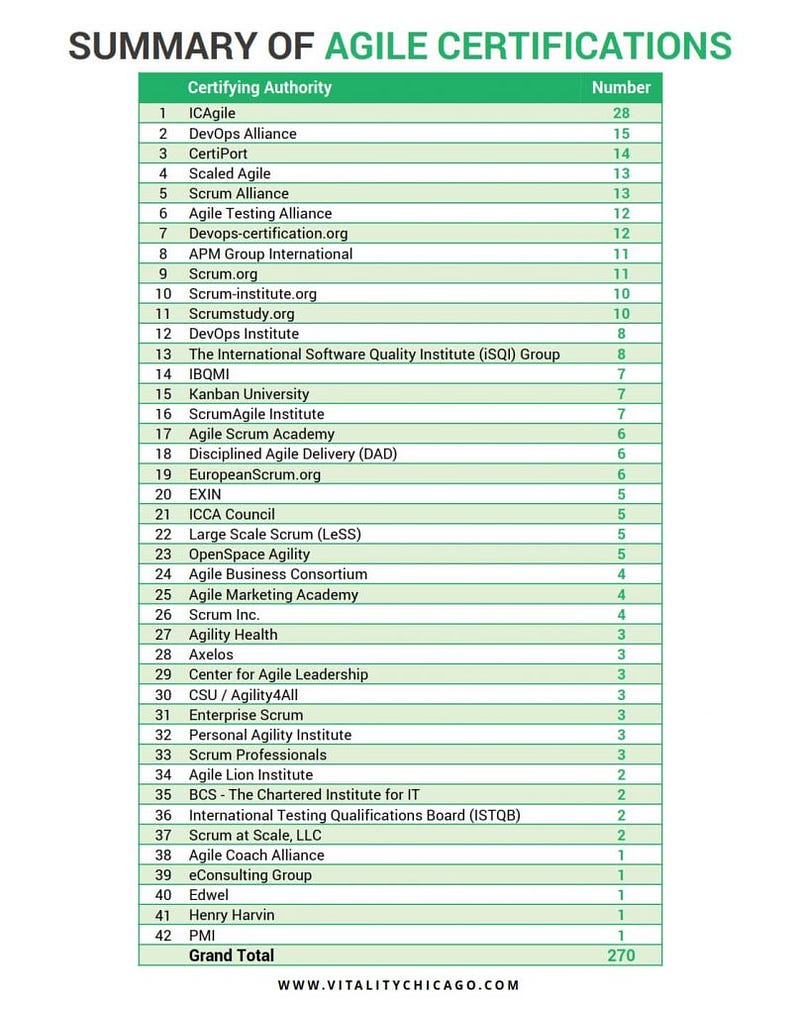
In total, the 113 certifications in 2016 have expanded to over 270 in 2019 and likely even more today. That’s right, over 270 possible agile certifications from a total of 40 different certification bodies. (And we probably have missed a few!) A summary table of the 270 agile certifications is included below, listed by certifying authority. In addition, we have created a post that has details about all the certifications here.
What is the Value of Those Agile Certifications?
Initially, I tried to assign some attributes for each certification. I considered cost, exam requirements, experience, relevance, difficulty to obtain, and popularity for each certification. Unfortunately, data about each of the certifications is inconsistent and, in some cases, not readily available.
What I really thought would be most helpful to others was value. I thought it would be helpful to have some measure of the value of the certification to the holder or in the marketplace. Unfortunately, the value turns out to be quite subjective.
There are some certifications that I am familiar with and can provide my own perspective. I currently hold a paltry 8 of the 200 certifications from 4 different certification authorities:
- 3 from Scrum Alliance (CSM, CSP-SM, and CAL)
- 3 from Scrum.org (PSM, PSPO and PAL-E)
- 2 from the Project Management Institute (PMP and PMI-ACP)
- 1 from AgilityHealth (AHF)
An Agile Certifications Challenge (pre-Covid)
Funny story. Back in late 2019, I decided to challenge myself to explore as many of these agile certifications as possible. I wanted to gain as much first-hand experience as I could. My plan was to get at least one certification from each of the 32 certifying authorities. I wasn’t sure it was even possible but I wanted to achieve 52 new certifications in one year. That is one per week.
I promised to post my findings about each of the certifications and the numerous certifying authorities. I wanted to crowdsource information about them and invite as many perspectives as possible. At the top of my list of certifications were ones on LeSS, DAD, Kanban, and SAFe. These were also some of the more costly ones.
Unfortunately, the year I picked to do this agile certifications challenge was 2020. You remember, COVID? So 8 weeks into the challenge, I had achieved many new certifications but decided to shift my focus to keeping my business alive. So the certification challenge was never completed.
Bottom Line — Agile Certifications
There are many agile and scrum-related certifications which indicates that certification is big business. I recommend that you only take a certification if it is going to help your career or if you will learn and grow as an individual. I recommend that you take them from reputable sources since there are many non-reputable providers out there.
⭐️Thank you for reading. If you enjoyed this article, feel free to hit that clap button 👏 to help others find it.
Let’s connect on Twitter or find me professionally in Linkedin.
Leave a comment below if you have any questions, and subscribe to receive the latest updates in Agile and Scrum.
Anthony Mersino is the founder of Vitality Chicago, an Agile Training and Coaching firm devoted to helping Teams THRIVE and Organizations TRANSFORM. He is also the author of two books, Agile Project Management, and Emotional Intelligence for Project Managers.


