

Why ‘Eat Less Move More’ for weight loss never works — The Body’s Fat Thermostat Part 4
“Obesity is a disorder which, like venereal disease, is blamed upon the patient” Astwood 1962
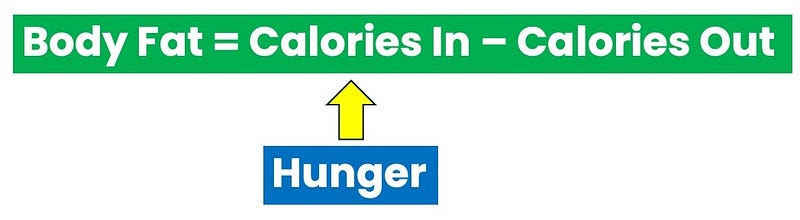
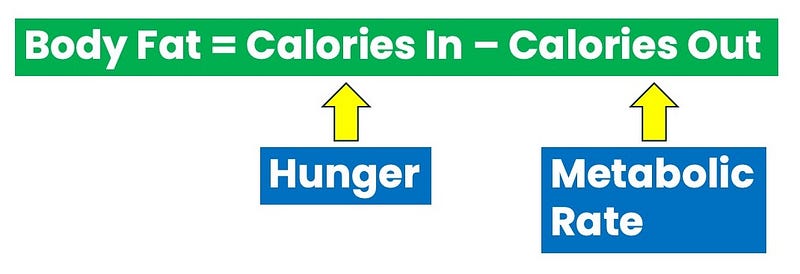
The energy balance equation, which is always true says

If you don’t think about it too hard, it seems that to lose body fat, you only need to eat fewer calories or exercise more. That’s only been tried about a few million times and fails just about always.
The reason is that Body Fat is regulated like a thermostat — as we discussed in Part 1. If the fat thermostat is set too high, then your body will change the hormonal profile to either reduce energy expenditure (Calories Out — see Part 2) or increase hunger (Calories In — see part 3).
Thinking deeper upon the problem of excess calories, ask not “IF Calories In> Calories Out” but “WHY are Calories In> Calories Out?” The simplistic answer is that people choose to eat more or exercise less. But that’s completely wrong. Nobody who is obese chooses to eat more.
People eat more because they are hungry.
Hunger, which is a hormonal state and not a choice, drives eating behavior (as we discussed here in my article on What Ozempic teaches us about Weight Loss). If your hormones increase hunger, you’ll eat more. You can choose what you eat, but you can’t choose to be less hungry. That is, hunger is the root cause of the increase consumption, so merely telling somebody to eat less is not effective if you are not controlling the hunger.
Drug Induced Weight Loss and Appetite
Decades of research shows that the body fights against weight loss below the Body Set Weight (BSW) by making you eat more and this is even true if you use drugs to lose weight. In the study “How strongly does appetite counter weight loss? Quantification of the feedback control of human energy intake”, researchers looked at type 2 diabetes patients taking the drug canaglifozin, which makes you pee out glucose and reliably causes a small amount of weight loss. At a dose of 300mg/ day, patients excrete about 90 grams of glucose (348 calories) through their urine.
Patients, on average, lose about 3.5 kg (8 pounds) over a few months and then weight stabilizes. Using mathematical modelling, researchers could calculate how people responded in terms of their energy intake (calories eaten) in order to maintain this equilibrium.
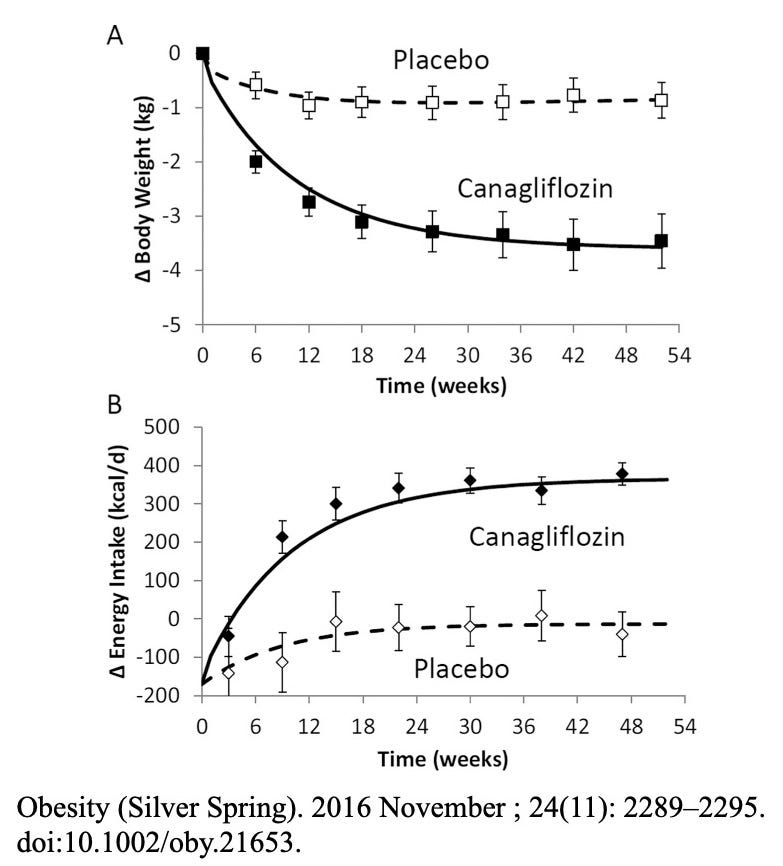
As people lost weight, they ate more. It didn’t matter how much willpower you had. It didn’t matter how much weight you needed to lose. It didn’t matter how much if they wanted to lose weight or not. Eventually they ate 300–400 calories more per day than they did previously.
This eating behavior was not a conscious decision to ‘eat more’ or ‘eat junk’. No, how much people eat is determined primarily on how full they get when they eat (satiation) and how long they stay full for (satiety). This is determined by a multitude of hormones (see part 3 for more details).
For every kg of body weight lost, people ate about 100 calories more, which is worse even than the expected increase in calories seen in normal weight loss (about 30 calories more per kg of weight loss).
This idea that ‘If you cut 500 calories per day, you’ll lose 1 pound of fat per week’ is demonstrably false. The canaglifozin group was reliably losing 348 calories every day, but could not consistently lose weight past the initial stage.
In fact, when researchers modeled the typical “Eat Less to Lose Weight” trajectory, this is what they came up with.
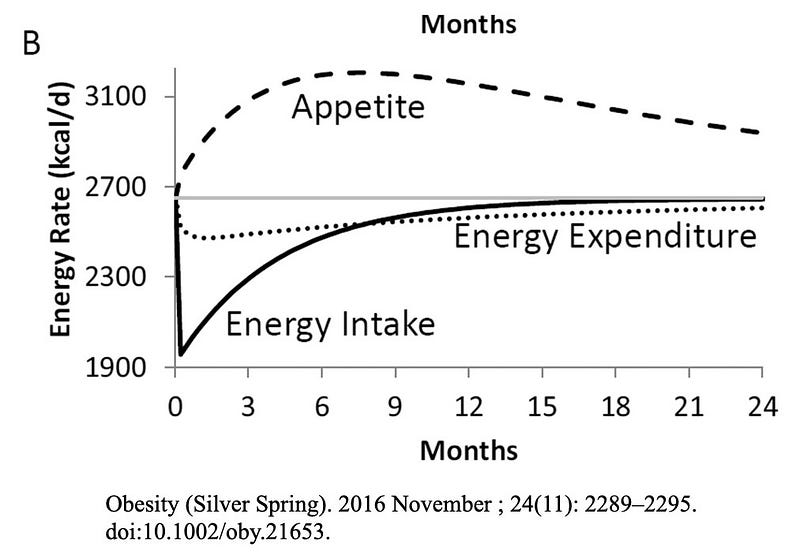
You will lose weight for about 3–6 months as you decrease reduce your calories. But then your appetite will increase so that you eat more, which eventually causes your weight loss to plateau. After that is the dreaded weight regain.
Does this sound familiar? It is, to anybody who has ever tried to lose weight by just cutting a few calories.
Oh, but the news gets worse.
The Biggest Loser… is your metabolic rate
If you somehow maintain, through sheer willpower that calorie restriction in a dogged effort to maintain weight loss, your body will simply reduce how many calories it burns until you STILL regain that weight (see part 2 for more details).
In the study “Persistent metabolic adaptations 6 years after The Biggest Loser competition”, researchers followed contestants who had lost significant weight during an American reality show called The Biggest Loser using primarily the ‘Eat Less, Move More’ strategy.
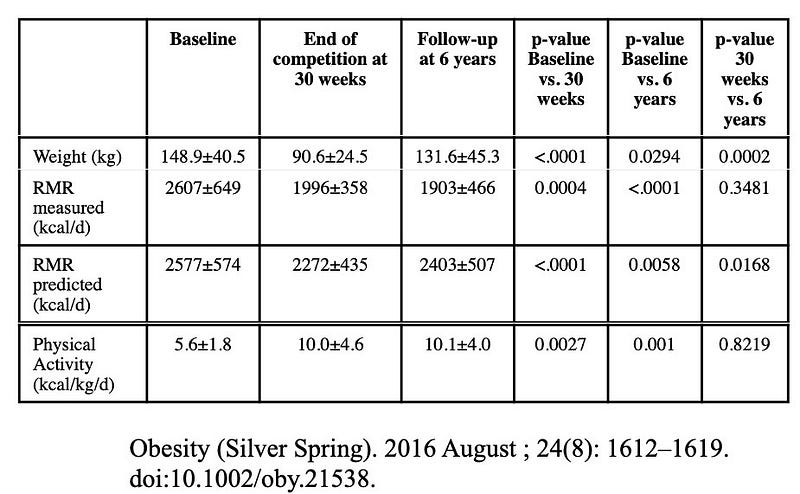
The average contestant started off weighing 148.9 kg (328 pounds). After 30 weeks of the show, contestants had lost, on average, a rather staggering 58kg to weigh 90.6 kg (200 pounds). Were they able to keep that off? Well, no. By 6 years, they regained most of that and weighed 131.6 kg (290 pounds), although still significantly better than before. But was it really?
Why was it so hard to stop the weight from coming back? Did they stop exercising? No. During the competition, they increased their exercise from 5.6 kcal/kg/day to 10.0, and kept it up 6 years later. They were still sweatin’ with the oldies.
Their resting metabolic rate (RMR) sheds some light on this. Before weight loss, contestants burned 2607 calories per day. By the end of the competition, they only burned 1996 calories per day. Their bodies were burning 600 calories per day less than before — a massive hurdle to long term weight loss, as the body’s fat thermostat tried to move the weight back up.
But surely, this massive disadvantage would slowly fade right? Exactly wrong. It didn’t get better, it got worse. Even as contestants were regaining some of that 90 pounds (on average), their bodies continued to ramp down how many calories they burned. At 6 years, the RMR dropped further to 1903 kcal/day — a full 500 calories less than the metabolic rate expected for somebody of their age and weight.
Consider the Energy Balance Equation carefully. It does not say that increased body fat is CAUSED by Calories In> Calories Out. No.
Increased Body Fat IS Calories In > Calories Out. They are equivalent.
So the question becomes what caused Calories In > Calories Out? Ie. what caused obesity? The hormones that increased hunger or decreased metabolic rate. Yes, you can choose what you are eating (conscious control — amenable to willpower) but you cannot choose to be less hungry or have a higher metabolic rate (unconscious control — not amenable to will power)
Because of this persistent false belief of that Calories In/ Calories Out causes obesity amongst ‘experts’, obesity has become a ‘lack of willpower’ problem, rather than a metabolic problem of disordered hormones, making experts cast blame rather than look for solutions.
WILLPOWER WAS NOT THE PROBLEM!
Telling somebody to ‘Eat Less’ to lose weight is about as effective as treating depression by telling somebody to ‘Just cheer up’. That has help almost 0% of people with depression. You must find the root cause of the increased Body Fat Thermostat and fix it. That will be the subject of some of our upcoming articles.
Dr. Jason Fung

For more, check out my YouTube channel, online community and coaching programs at TheFastingMethod.com and my books


