
The Body’s Fat Thermostat — Part 2 — The Science
Why simply Eating Fewer calories doesn’t cause Weight Loss
My last article, The Body’s Fat Thermostat — Part 1, discussed the concept of homeostasis and how body fat is regulated like a thermostat rather than simply the end product of Calories In — Calories Out. The level set by the thermostat is determined by multiple hormones (like most everything else in our body), rather than the number of calories we eat. It is true, however, that the types of food and the amount of food will influence those hormones, but different foods, even with the same calories, have different hormonal effects. This is why calorie counting is such an unsuccessful weight loss strategy.
Is there scientific evidence to show the existence of this Body Set Weight (BSW)? Totally. Virtually every study done over the last 50 years shows this. It’s rather stunning that so very few people discuss the mechanisms of this fat thermostat because it has massive implications for weight loss. Massive.
How the Body Fat Thermostat Works
The Body Set Weight (BSW) is like a thermostat. Our body sets a certain level of body fat and then defends it according to the energy balance equation Body Fat = Calories In — Calories Out, which is always true.
If Body Fat goes too high, then our body brings it back into range by activating multiple mechanisms to:
· reduce appetite (so that we eat less)
· increase energy expenditure (so that we burn off some of the stored calories (body fat)
If Body Fat goes lower than the BSW (as we lose weight), then our body will also bring it back to its original state by activating mechanisms to
· Increase appetite (so that we eat more)
· Reduce energy expenditure (so that we store more calories (body fat))
This is CRITICAL for weight loss because it means that successful weight loss depends on fixing the Body Fat Thermostat that is set too high, not reducing Calories (Eat Less) because that will simply cause the body to increase appetite and reduce metabolic rate.
We will look at the evidence and mechanisms that hunger is adjusted in our next article. Today we will review the evidence that our body adjusts how many calories we burn daily (total energy expenditure or TEE) when weight goes up or down.
Energy Expenditure
Noted obesity researcher Dr. Rudy Leibel published an elegant study called “Changes in Energy Expenditure Resulting from Altered Body Weight” in the prestigious New England Journal of Medicine in 1995. This understanding of BSW is close to 30 years old and has been reconfirmed multiple times since then.
Researchers gave participants a liquid formula diet (45% carbs, 40% fat, 15% protein) and adjusted the amount to cause weight gain or weight loss. Then they measured the total daily energy expenditure (TEE) or the number of calories burned.
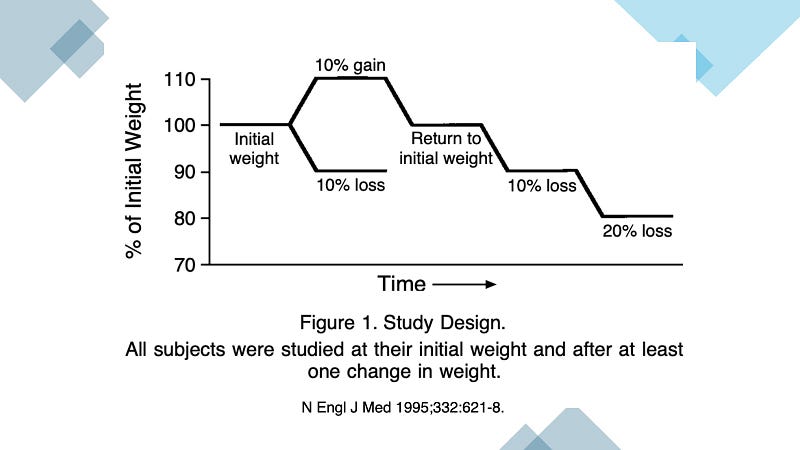
First participants ate enough to gain 10% body weight, which required a rather massive increase in calories — somewhere between 5000–8000 calories per day! This alone is good evidence of the existence of the BSW — that the body is fighting off the excess caloric intake and resisting the change in body weight.
Next, their weight was allowed to return to baseline. After that, calories were restricted to 800 per day until they achieved a 10% weight loss. TEE was measure after each stage. What happened?
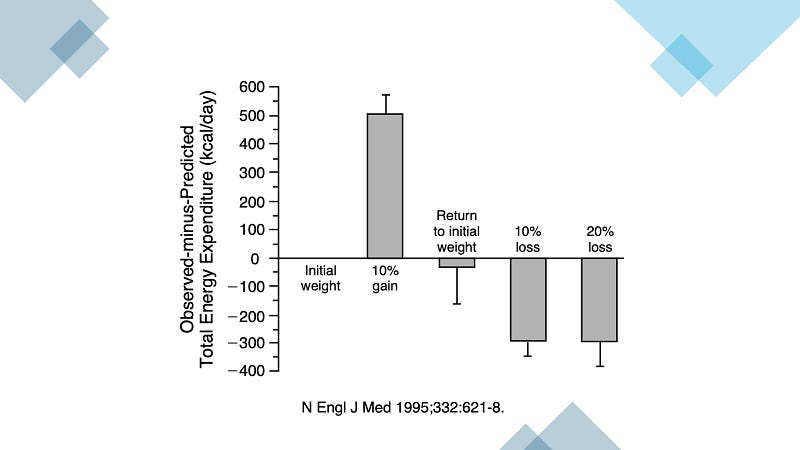
When people gained 10% body weight, their TDEE increased by 16%, or almost 500 more calories per day increase from baseline. The body actively resists any change to the BSW, the Body Fat Thermostat. When people ate 8000 calories per day and gained weight, the body tried to burn those calories off.
When people returned to their baseline weight, their TDEE also returned to baseline. There was no longer any need to compensate for excessive calorie intake, so our body sensed our weight and therefore adjusted how many calories were burned.
What happens physiologically when you lose weight?
When people lost 10% of their previous body weight, the TDEE decreased by 15%. When people lost weight, the body compensated by reducing the number of calories it was burning, which would tend to make us regain the lost body weight. Exactly what we don’t want!
Most people assume that most of the calories we burn daily is used for exercise, but this is wrong. About 50% of TDEE is used to maintain core body temperature (CBT). In other words, most of the calories we burn goes to generating body heat. During underfeeding, also called semi-starvation in this study, but actually a 1500 kcal/day diet, CBT dropped significantly.
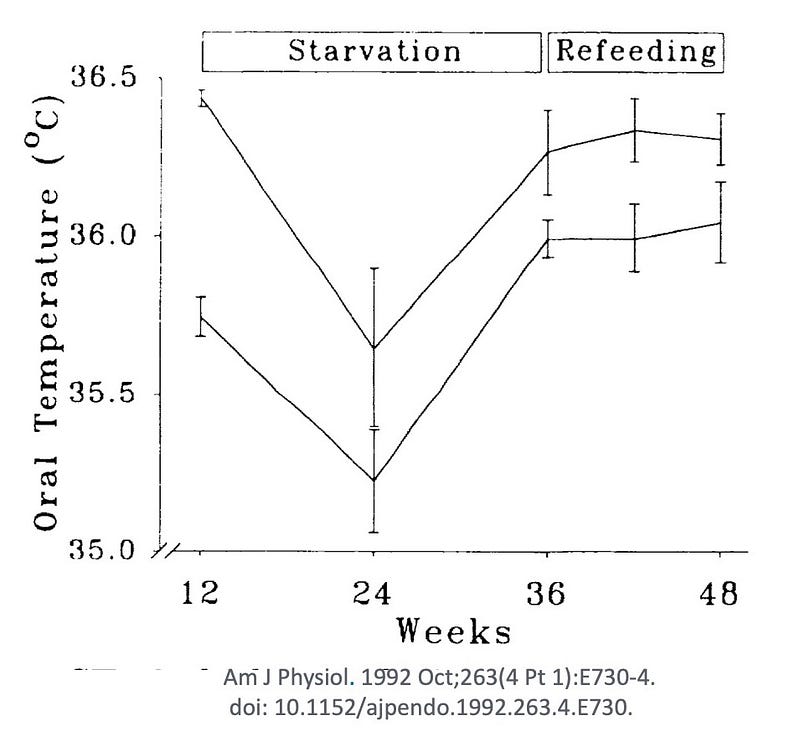
The implication is clear — if you lose weight by eating less, you will lose weight. Initially. But then, body temperature goes down along with TDEE, which will stop further weight loss and promote weight regain. If you Eat Less (Calories), you will burn less calories. And Body Fat returns to its original BSW. Just like a thermostat.
The key is not to focus on the calories, but the hormones that control the Body Fat Thermostat or BSW.
Physiologic Response to Slimming
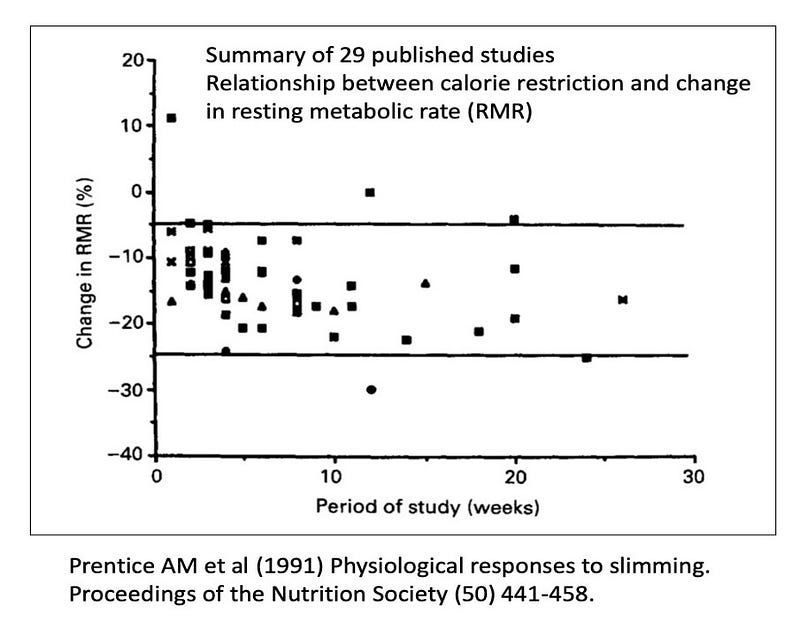
The fact that if you simply eat less, you will also burn less (and limiting body fat loss) has been known in scientific studies for decades. A meta-analysis of 29 studies in 1991 (more than 30 years ago!) showed the in response to calorie restriction, the Resting Metabolic Rate (RMR), like Basal Metabolic Rate, a measure of how many calories you burn, went down mostly between 10–20%.
The Energy Balance Equation says:
Body Fat = Calories In — Calories Out.
So guess what? If you eat 10% fewer calories in your darndest effort to lose weight, but your body burns 10% fewer calories, then your body fat level stays the same. ‘Experts’ who keep insisting that it’s all about ‘energy balance’ and eating less simply don’t understand the nutrition science of the last 50 years. Eating less (to create a ‘negative energy balance’) leads to burning less, which negates the ‘negative energy balance’. No, we need to find a way to understand and adjust the Body Fat Thermostat (coming in future articles).
Here’s the conclusions of this meta-analysis:
The first statement which can be made with some certainty is that a decrease in energy expenditure is a universal response to energy restriction
In other words, it is guaranteed that eating less (energy restriction) will reduce how many calories you burn (decrease in energy expenditure). Practically every scientific study shows the same thing.
Oh, but the news gets worse.
The Metabolic Disadvantage persists for Years and probably Forever
The reduced metabolic rate can last for years.
In the paper “Diminished Energy Requirement in Reduced Obese Patients”, published in 1984 (so not exactly news), Dr. Leibel measured the metabolic rate of people who had lost a significant amount of weight even up to 6 years ago.
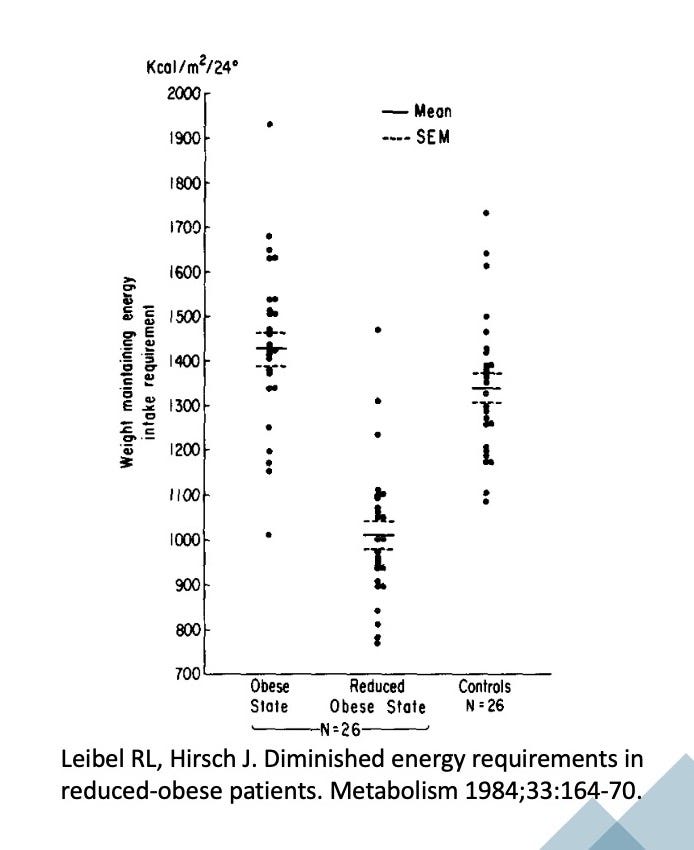
The obese subjects at maximum weight averaged 152.5 kg (336 lbs) and ate 3651 calories daily to remain weight stable. After weight loss, they weighed 100.2 kg (221 pounds) and burned 2171 calories per day.
OK, but if your body weighs more, there is more tissue, and therefore will require more calories to sustain itself. You can correct this by looking at the calories per kg of body weight per day.
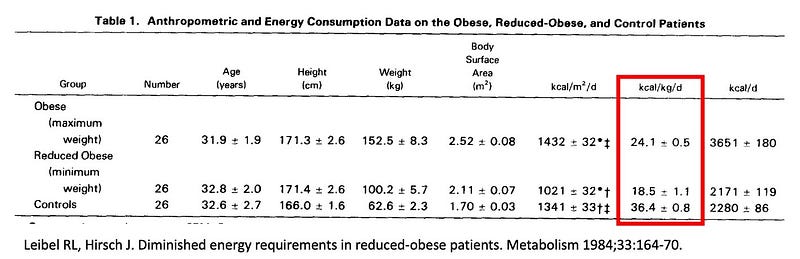
Non-obese controls were burning 36.4 cal/kg/day. At maximum weight, people burned 24 calories/kg/day — their bodies weren’t trying to burn it off at all. After weight loss, it was even worse. They only burned 18 cal/kg/day.
How to interpret this? Non obese people burn 36.4 cal/kg/day. Much of this is body heat and energy for your heart, liver, lungs, brain etc.
People who are obese have their BSW cranked way too high. Even at 336 pounds, their body wants to maintain this higher weight. So they crank down the energy expenditure (how many calories they are burning) to 24 kcal/kg/day so that it’s easier to stay at that higher weight. With weight loss, to 221 pounds, their body panics and cranks down the energy expenditure even further to only 18 kcal/kd/day in order to get body weight back up. And this response persists for years and years and years. It doesn’t ever get better.
The Problem with Calories Out
The main problem with the people who obsess about Calories is that it assumes that the Calories Out (or metabolic rate) is stable. Nothing is further from the truth. Look at the Energy Balance Equation again
· Body Fat = Calories In — Calories Out
There are 3 variables (Body Fat, Calories In, Calories Out) that must balance. If you reduce Calories In, you can balance the equation by reducing Body Fat. That’s what people hope.
But the last 50 years of nutrition science tells us THAT’S NOT WHAT HAPPENS IN THE HUMAN BODY. (see my video lecture for health professionals here)
No, the virtually ‘guaranteed’ response to eating less calories is that your body will burn less calories and body weight stays the same.
You can decide to Eat Less and use willpower, but you can’t decide that your body will burn more calories — ie. generate more body heat, increase work of breathing (lungs), increase the hearts stroke volume or ejection fraction, increase work of kidneys, increase brain metabolism etc.
Fix the Thermostat, not the Calories
To be successful, you must understand that Body Fat is controlled by a Body Set Weight, or thermostat, and the problem with maintaining weight loss is not reducing calories, but how to increase the body’s fat thermostat to the proper setting (see my YouTube video — Weight Loss Lies for more).
If you are overweight, then the question is not to look at the calories. The question is why the thermostat is broken. (see my article — What Ozempic teaches us about weight loss) We’ll look at the question of hunger in the next article.
Dr. Jason Fung

For more, check out my YouTube channel, online community and coaching programs at TheFastingMethod.com and my books


