
avatarJJ Lim, PhD

Free AI web copilot to create summaries, insights and extended knowledge, download it at here

3873

Abstract

/h2><p id="c392">Have you ever felt like eating more when you are studying hard or working on challenging data analysis? A group of researchers recreated this situation in the lab and found that <b>women ate 253 kcal more after completing tedious computerized tasks</b> when compared to after completing nothing in a seated position. The women also had a <b>higher cortisol level</b> when they were cognitively challenged [<a href="http://www.ncbi.nlm.nih.gov/sites/entrez?Db=pubmed&amp;Cmd=ShowDetailView&amp;TermToSearch=18725427">3</a>].</p><figure id="762f"><img src="https://cdn-images-1.readmedium.com/v2/resize:fit:800/0*d82Q0KfEhfkWLfEc"><figcaption>Photo by <a href="https://unsplash.com/@austindistel?utm_source=medium&amp;utm_medium=referral">Austin Distel</a> on <a href="https://unsplash.com?utm_source=medium&amp;utm_medium=referral">Unsplash</a></figcaption></figure><p id="d137">Brain and muscle cells utilize calories differently: brain cells primarily burn glucose during activity, whereas muscle cells burn more fat during light to moderate exercise [<a href="https://www.sciencedirect.com/science/article/abs/pii/S1751499111000060">4</a>]. Muscle activity is undoubtedly more beneficial when it comes to managing body fat content.</p><p id="f106">The brain is hungry. This challenge is further complicated when we spent most of our time at home. The attractive snacks on the shelves of our house keep trying to defeat our willpower to control food intake. It is hard not to grab a snack and feed our hungry brain.</p><p id="cdb2" type="7">Having a normal weight does not give us a free pass to eat whatever we want and be sedentary.</p><h2 id="f91c">Second, being sedentary hurts blood glucose metabolism and insulin sensitivity.</h2><p id="5fa6">A lean person doesn’t usually eat a lot, but that doesn’t mean they can live a sedentary lifestyle without adverse consequences. One day of sedentarism is sufficient to result in<b> lower insulin secretion in response to carbohydrate consumption</b> [<a href="http://www.ncbi.nlm.nih.gov/sites/entrez?Db=pubmed&amp;Cmd=ShowDetailView&amp;TermToSearch=21067784">5</a>]. Without adequate insulin secretion, glucose stays in the blood longer. This situation is dangerous as high post-meal blood glucose may damage our blood vessels. I have addressed this issue in one of my previous stories:</p><div id="a695" class="link-block"> <a href="https://readmedium.com/why-is-diabetes-causing-complications-from-head-to-foot-science-explains-ec473c474d1a"> <div> <div> <h2>Why Is Diabetes Causing Complications From Head To Foot? Science Explains.</h2> <div><h3>Understanding how eye damage, cardiovascular disease, kidney damage and nerve damage is related to one another in…</h3></div> <div><p>medium.com</p></div> </div> <div> <div style="background-image: url(https://miro.readmedium.com/v2/resize:fit:320/1*yO6PHq1-zVFLCqAR-YKyvA.png)"></div> </div> </div> </a> </div><p id="c7ea">When a group of <b>physically active men and women</b> were put to work on a bed for 7 days, their insulin secretion becomes insensitive to the changing levels of blood glucose at the end of 7 days [<a href="https://physoc.onlinelibrary.wiley.com/doi/full/10.1113/JP273282">6</a>]. As a consequence, <b>the body becomes unable to regulate blood glucose appropriately</b>, manifesting a symptom of diabetes. Nevertheless, a transient change in glucose metabolism won’t make you a diabetic, unless this altered metabolism becomes a long-term disorder. Diabetes is not a disease for overweight people only.</p><p id="6d81">The consequences are worse if you allow yourself to increase calories intake to satisfy the hungry brain.</p><p id="18a8" type="7">The bod

Options

y becomes unable to regulate blood glucose appropriately.</p><h2 id="a1ba">Third, being sedentary has harmful effects on muscle maintenance among older people.</h2><p id="fa98">It is much easier for elderlies to lose muscle mass than gaining muscle mass. When following a sedentary lifestyle, low activity of muscle inhibits the process of muscle building, but the process of muscle degradation is not inhibited, resulting in a net loss in muscle mass. Regaining the lost muscle mass is also harder for elderlies than young adults [<a href="https://journals.sagepub.com/doi/full/10.1177/2042018819888824">7</a>].</p><p id="f90d">Muscle mass declines at about 10% per decade over the age of 50 years [<a href="https://journals.sagepub.com/doi/full/10.1177/2042018819888824">7</a>]. Those who are sedentary and have a lower protein intake will lose more muscle mass than those who are able to maintain physical activity and have a higher protein intake.</p><figure id="5f23"><img src="https://cdn-images-1.readmedium.com/v2/resize:fit:800/1*t7c4L4yLD6d4t_4GbhMvGA.png"><figcaption>Hypothetical loss in muscle mass. Prepared by JJ Lim, BSc (Hons)</figcaption></figure><h1 id="c3b1">Take-Home Message: Break the sedentary activities into chunks and be more active</h1><p id="08d3">We now know sedentarism or physical inactivity have adverse consequences beyond gaining weight. Although weight is a proxy of health, that doesn’t mean we cannot be unhealthy at a normal weight. Here are some of the tips to break your sedentary activities into chunks, especially during the time of self-isolation due to the pandemic:</p><p id="7c83"><b>1.</b> <b>Take a break at every hour of work. </b>A prolonged period of sitting is the worst, break it down into chunks [<a href="https://www.frontiersin.org/articles/10.3389/fpubh.2018.00258/full">2</a>].<b> </b>If you work from home, that means to save some of your simple housework and do it during the break. For example, you can wash dishes, put clothes into the laundry machine, organising your desks, etc. You have more flexibility when you work from home. If you work in your company’s office, that means take some time to walk around, providing your employer allows… The purpose is to shift your concentration away from the screen, give your brain a break.</p><p id="bccc">2. <b>Perform simple weight-bearing exercises when watching TV.</b> If you are watching TV, try not to sit back and enjoy. A recommended exercise is doing bouts of squats during the intermission time. Any exercise that is a weight-bearing exercise may help with maintaining muscle health. I love squatting as I can watch my TV as I do it and it doesn’t require any instruments. If you have a dumbbell, that is great too.</p><p id="b9fc"><b>3.</b> <b>Having extra time? Exercise, you must! </b>There are plenty of useful exercise tips on Medium which I will link one of them down here. Don’t forget that if you have baby or children, babysitting and childcare are training your muscles too!</p><p id="88a3">A very good fitness guide by <a href="undefined">Benny Lim</a>:</p><div id="ef2a" class="link-block"> <a href="https://readmedium.com/5-exercises-you-can-do-while-being-stuck-at-home-4c6224e0ea60"> <div> <div> <h2>5 Exercises You Can Do While Being Stuck At Home</h2> <div><h3>Covid-19 keeping you away from the gym? Do these instead</h3></div> <div><p>medium.com</p></div> </div> <div> <div style="background-image: url(https://miro.readmedium.com/v2/resize:fit:320/0*NnMcjzXb5ulTcE-F)"></div> </div> </div> </a> </div><figure id="34e6"><img src="https://cdn-images-1.readmedium.com/v2/resize:fit:800/1*oK_6-IoNOGdkyc1t0Uv2QQ.png"><figcaption></figcaption></figure></article></body>

Photo by Nicole Wolf on Unsplash

NUTRITION & METABOLISM

Why Eating Less and Being Sedentary Is Not Ideal for Health? Science Explains.

Maintaining physical activity is more important than ever during periods of self-isolation.

The World Health Organization recommends us to have a balanced diet and perform 150 minutes of moderate physical activity per week for good health [1]. How convenient is not spending extra time to exercise and simply eat a few hundred calories less to compensate for the lower calorie expenditure? If the sole purpose of being physically active is to prevent us from becoming overweight, then eating fewer calories appears to be quite efficient, considering we have many life commitments. Unfortunately, eat less and be sedentary is not ideal for health.

Many of us probably spend 6 to 8 hours of waking time on sedentary activities. During the current pandemic, most of us are practising self-isolation in our house and working from home. Hence, sedentary time is likely to increase. Consequently, maintaining our physical fitness is more important than ever.

This article will discuss:

  1. The basic concept of sedentary and physical inactivity.
  2. The problems of being sedentary in the context of metabolism.
  3. How to break the sedentary lifestyle, especially when staying home?

The Basic: Concept of sedentary behaviour and physical inactivity

Being sedentary and physically inactive have been traditionally associated with weight gain. However, when we compensate for the low physical activity with fewer calories intake, being inactive may not necessarily lead to weight gain.

Recent advance in the study of human metabolism highlighted the metabolic differences between sedentary behaviour and physical inactivity [2]:

  • Sedentary behaviour typically refers to prolonged sitting time with our brain actively performing cognitive tasks. Examples of sedentary behaviour include using a computer, reading complicated texts, watching TV, solving puzzles, etc. In this situation, adrenal gland secrets cortisol (stress hormone), and the brain cells are draining calories in response to cortisol, but our muscle cells are mainly at rest.
  • Physical inactivity is a state when our muscles are not actively performing any work. Physical inactivity includes all sedentary activities, but it is a broader term that also consists of the physical state when our brain is at rest, such as sleeping or relaxing.

If the sole purpose of being physically active is to prevent us from becoming overweight, then eating fewer calories appears to be quite efficient.

The Problem: Being sedentary puts a toll on the metabolic health of lean individuals

Metabolic health is everything that has to do the body utilisation of glucose, amino acid (basic units of protein) and fat. These are in turn governed by some key hormones. Insulin and cortisol are the two hormones that are of relevance to this topic. Having a normal weight does not give us a free pass to eat whatever we want and be sedentary.

First, performing sedentary cognitive tasks increases our appetite.

Have you ever felt like eating more when you are studying hard or working on challenging data analysis? A group of researchers recreated this situation in the lab and found that women ate 253 kcal more after completing tedious computerized tasks when compared to after completing nothing in a seated position. The women also had a higher cortisol level when they were cognitively challenged [3].

Photo by Austin Distel on Unsplash

Brain and muscle cells utilize calories differently: brain cells primarily burn glucose during activity, whereas muscle cells burn more fat during light to moderate exercise [4]. Muscle activity is undoubtedly more beneficial when it comes to managing body fat content.

The brain is hungry. This challenge is further complicated when we spent most of our time at home. The attractive snacks on the shelves of our house keep trying to defeat our willpower to control food intake. It is hard not to grab a snack and feed our hungry brain.

Having a normal weight does not give us a free pass to eat whatever we want and be sedentary.

Second, being sedentary hurts blood glucose metabolism and insulin sensitivity.

A lean person doesn’t usually eat a lot, but that doesn’t mean they can live a sedentary lifestyle without adverse consequences. One day of sedentarism is sufficient to result in lower insulin secretion in response to carbohydrate consumption [5]. Without adequate insulin secretion, glucose stays in the blood longer. This situation is dangerous as high post-meal blood glucose may damage our blood vessels. I have addressed this issue in one of my previous stories:

When a group of physically active men and women were put to work on a bed for 7 days, their insulin secretion becomes insensitive to the changing levels of blood glucose at the end of 7 days [6]. As a consequence, the body becomes unable to regulate blood glucose appropriately, manifesting a symptom of diabetes. Nevertheless, a transient change in glucose metabolism won’t make you a diabetic, unless this altered metabolism becomes a long-term disorder. Diabetes is not a disease for overweight people only.

The consequences are worse if you allow yourself to increase calories intake to satisfy the hungry brain.

The body becomes unable to regulate blood glucose appropriately.

Third, being sedentary has harmful effects on muscle maintenance among older people.

It is much easier for elderlies to lose muscle mass than gaining muscle mass. When following a sedentary lifestyle, low activity of muscle inhibits the process of muscle building, but the process of muscle degradation is not inhibited, resulting in a net loss in muscle mass. Regaining the lost muscle mass is also harder for elderlies than young adults [7].

Muscle mass declines at about 10% per decade over the age of 50 years [7]. Those who are sedentary and have a lower protein intake will lose more muscle mass than those who are able to maintain physical activity and have a higher protein intake.
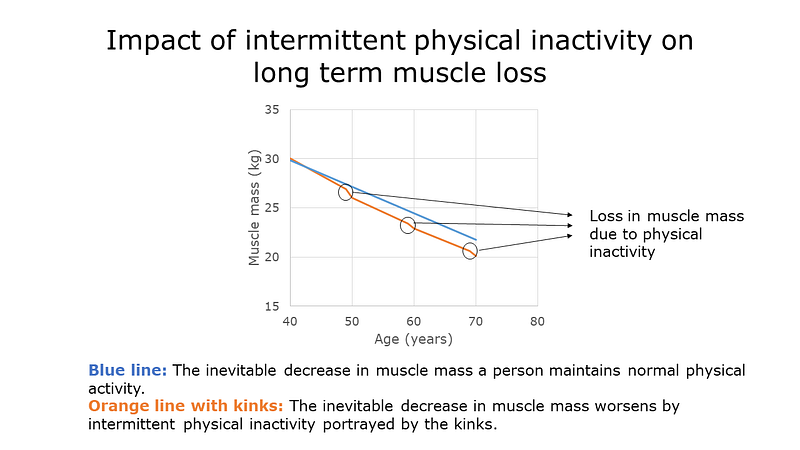
Hypothetical loss in muscle mass. Prepared by JJ Lim, BSc (Hons)

Take-Home Message: Break the sedentary activities into chunks and be more active

We now know sedentarism or physical inactivity have adverse consequences beyond gaining weight. Although weight is a proxy of health, that doesn’t mean we cannot be unhealthy at a normal weight. Here are some of the tips to break your sedentary activities into chunks, especially during the time of self-isolation due to the pandemic:

1. Take a break at every hour of work. A prolonged period of sitting is the worst, break it down into chunks [2]. If you work from home, that means to save some of your simple housework and do it during the break. For example, you can wash dishes, put clothes into the laundry machine, organising your desks, etc. You have more flexibility when you work from home. If you work in your company’s office, that means take some time to walk around, providing your employer allows… The purpose is to shift your concentration away from the screen, give your brain a break.

2. Perform simple weight-bearing exercises when watching TV. If you are watching TV, try not to sit back and enjoy. A recommended exercise is doing bouts of squats during the intermission time. Any exercise that is a weight-bearing exercise may help with maintaining muscle health. I love squatting as I can watch my TV as I do it and it doesn’t require any instruments. If you have a dumbbell, that is great too.

3. Having extra time? Exercise, you must! There are plenty of useful exercise tips on Medium which I will link one of them down here. Don’t forget that if you have baby or children, babysitting and childcare are training your muscles too!

A very good fitness guide by Benny Lim:

Nutrition
Body
Health
Lifestyle
Fitness
Recommended from ReadMedium