
Why Don’t My Articles Make More Than $10?
My views on what it takes to earn the big bucks on Medium.com

I received some interesting comments on a recent post that guesstimated how many articles are published on Medium every month (1.4 million).
Manu Chatterjee wrote a wonderful reply to me that included a few points about:
- A lack of transparency in earnings and statistics on Medium
- How there are many articles on the platform geared for other writers (instead of readers)
- How he hasn’t achieved the coveted $10 mark for any single article yet.
Here’s my long-form response to that comment, as I figure it might be interesting to other writers here (and yes, I’m definitely part of the problem with #2 haha).
1. Transparency on Medium
Medium is not a transparent company — on purpose.
If we were to compare them to a liar — for the sake of analogy — they would be the kind that lies by omission rather than saying outright unfactual.
If you’re familiar with the platform, you’ll probably agree that these areas on Medium leave a lot to be desired:
- Statistics pages — There are some basics shown, but if you’re a numbers person, this is severely lacking (Example: What’s the difference between internal and external views? Hint: It’s not a member vs non-member view — it’s where they clicked to go to your page)
- Earnings distribution — They used to send more information in the monthly writer emails, but these days it’s usually down to 4 statistics — % of total writers that earned something, % that earned over $100, and highest earning author + article)
- FAQs — I’ve checked plenty of Medium FAQ’s over the past year, and although I find the language and format nice and easy to read — I often don’t find the answer to my question.
- How much do they pay out in total, % of memberships, per read, etc (I read in an article 2 years ago that Ev wants to get to an 80% payout ratio — eventually)
- Planned developments and a public forum for a feedback loop — Wouldn’t it be nice for Medium to actively discuss in a forum upcoming changes and take suggestions outside of random tips through email?
- Which publications are official partners and what does that mean?
- Membership program — Did you know there are 4 layers to Medium? And that you can write stories (and get paid) without paying for a membership? I didn’t for several months — it’s not stated clearly anywhere
- Regular external viewer (Can read 3 articles a month, free)
- Join Medium as a basic user (3 articles a month, can post unpaid stories, free)
- Join MPP (3 articles a month, can write paid stories, free)
- Medium membership (unlimited reads, can write paid stories, $5 / mth)
All of the above are painpoints I see while using Medium everyday. Do I expect them to change everything? Of course not. Could they? Absolutely. Other companies take varying degrees of transparency with their clients, partners, and users — I believe Medium is definitely lacking in this area.
Bottom line — I’d definitely love to see more transparency from Medium.
But I’m sure they have their reasons.
As a former head of product at a huge SaaS company, I take a bit of enjoyment out of reverse engineering products I use a lot — in this case Medium.
And my hunch is a lot of their product guidelines are based upon a mantra of some sorts.
I think their lack of transparency is definitely on purpose and possibly driven by a desire to keep people writing ‘pure’ here.
As in writing for the sake of writing and not to earn money.
You can see that with their (lack of) stats, the semi-manual curation system which I believe is inherently flawed to a degree (while still finding myself being curated often enough), and many of their company policies if you’ve had time to read through them.
These are just my guesses though— and they’re a private company who are one of the few providing a Youtube of writing — so I can’t complain too much! (despite appearances in this article)
And I’m sure, just like Youtube, they can’t reveal too much about how their algorithms and methodologies work lest people start gaming the system (even more than certain writers I’ve noticed currently do).
2. Medium’s Audience
Some authors gripe about their articles not having made more than $10 individually — and I hate to say this — but perhaps your topics aren’t matching a large enough audience on Medium?
I’ve done a lot of research and testing here to see what works well vs what doesn’t, and have several more ‘experiments’ I’ll be running over the next 6 weeks before going back to something more focused.
I’m hoping to share the results if I find anything significant — that’s half the reason I do these kinds of articles (outside of satisfying my insatiable curiosity).
For article success on this platform — and I’m far from being one of the mega-earners on here, but I’m still over $500 a month consistently — you can often see patterns depending on the subject.
Usually if something doesn’t earn a lot of reads (especially internal reads), there’s 1 of the follow aspects involved:
- Lack of audience internal to Medium that wants to read about that subject (Afterall, Medium has its own demographics vs the wider web, with their own specific subset of interests)
- The story wasn’t great (I’m often guilty of this myself, especially when looking back over my older articles)
- Title, image, subtitle, hook — one of these had something lacking or just wasn’t ‘the one’
- Lack of engagement incentives— The articles that do well here have lots of claps and/or comments — what in your article would inspire me to clap or write a comment (whether good or bad?)
- Lack of distribution — Are the publications large? What time did you/they post your article? Are the tags proper according to Medium’s algorithms? Did the publication feature your article? Did it get curated? Did a publication send out your article in their newsletter? etc
There’s many more aspects as well, one of the biggest factors being long-term consistent writing of high-quality content (of course), but this last point has probably the biggest effect on earnings over the years.
Go look at 90% of the biggest earners, they have posted 3–7 times per week for years.
They built an audience, improved their writing, found that perfect cross section between what interests them and what interests Medium’s audience.
And on top of that, most of them have become very good at points 1–5 above.
I assure you, if you are able to cover all of those points while putting in consistent effort over 1–3 years — you’ll be in the top earning 1% of writers here (which I suspect I currently am)
3. Medium’s Earnings
I used to think Medium payments and reads would follow a very similar pattern to the SEO distribution of article views on Google (ex. Look at short-tail vs long-tail keywords, a form of power-law)
A graph you’ll often see describing this may look familiar:
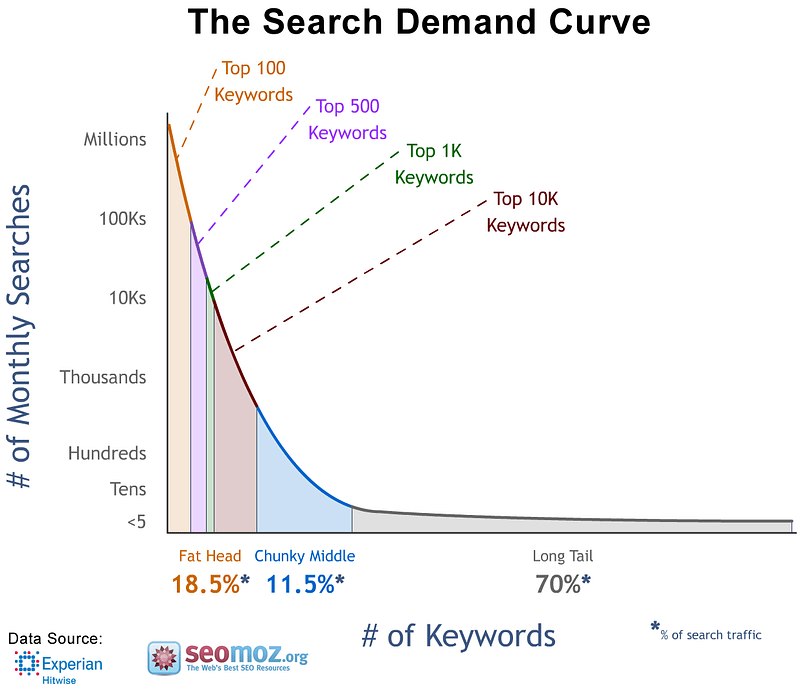
In the above graph, a huge 70% of all Google searches are considered ‘long-tail’ (ie. really long searches, like “Why can’t I make $100,000 on Medium and retire on a private island with a martini machine?”)
But after having done some rudimentary (and admittedly flawed due to lack of data) analyses based on recent public statements from Medium (you can check them out here and here), I believe the curve looks more like this:
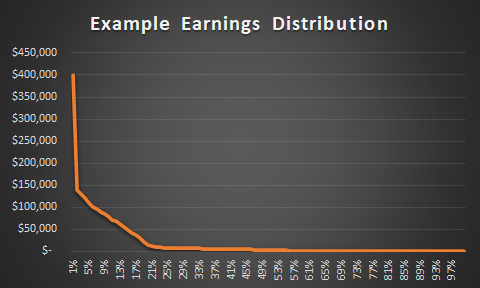
Note the above has no actual values behind it, I just spent 30 minutes tinkering with the known values from Medium to see how it could fit in terms of distribution.
My conclusion?
The highest earners are starting to earn more individually while the remainder of the curve is lessening.
Does this mean writers are earning less?
Yes and no.
Remember, Medium’s writer base is very likely growing (as their readership definitely is) — so there’s more writers writing every day.
There’s also more money to distribute to those writers — but what is the balance?
If you spend the time collecting all the previous earnings statements from Medium’s emails to writers every month, you may have noticed a pattern:
- The % of writers earning over $100 a month is slowly decreasing (it’s currently around 6% whereas a year ago it was over 11%)
- The highest earning amounts for a single article are increasing (August’s highest earning one was just shy of $10,000!)
- The highest earning writer is earning more and more each month (regardless if it’s the same person — in August someone made almost $50,000 versus $20,000 a year ago)
To me this points out three things:
- The 1% are getting richer while the poor are getting poorer (sound familiar?)
- The power law curve (like in the graphs) is becoming more skewed to the left (ie. more earnings as a % of the whole are going to the top writers on the platform) — PS. if anyone wants me to explain my reasoning for this, please ask in the comments, it’s complicated
- More people are earning money every month as these numbers are percentages — but each individual outside of the top 6% are earning less per person
Is this a bad thing?
Well, if you’re in the 94% it might seem to be. But it can also be used as a source of hope and goals.
If you believe what I wrote in section 2, then you could certainly find yourself in that top 6% one day.
It’s also not Medium’s fault — per se.
Sure, their algorithms, official publications, and curation systems are directly responsible for distribution and heavily influence the read time of the audience (more distribution = more potential reads).
But who do they distribute more?
- The writing they deem to be worthy enough — through curation, newsletters, and official publications
- These writers often end up being the same people over and over again — because they know how and what to write for Medium’s audience
- If you want to be in that group — you need to learn baby, learn
At the end of the day, the reader chooses what they want to read. Medium’s product choices in terms of algorithms, publications, curation, etc get to choose who your work is in front of (internally), but they can’t force someone to read it.
Just look at the ‘outrage’ around December last year when Medium was heavily pushing their new official publications’ articles on everyone. Constant complaints asking them to stop, and they finally did.
But their new publications now had over 100,000 followers each for the most part.
Have you tried making a publication in the last year? Hell, to hit 100,000 I’d have to start my own Medium.com (which I’d obviously one-up them and call it Large.com).
Wrapup
Anyway, this is a bit of a left-field for my usual kind of articles. I hope my viewpoints can be of use to someone out there reading this.
If you’d like to see more, I post all of these kinds of articles in my own (non-100,000 follower) publication called Feedium.
I suppose my last wrapup of this article is:
- Treat Medium like Youtube — an imperfect company trying to follow their company mission
- Learn what the Medium audience is if you want to make money on Medium (but don’t forget, you can use the platform to help you make money in other ways — like driving traffic to a blog, a newsletter, a company, an affiliate, etc etc)
- Enjoy your time here! What’s the point of having a side hustle (or full on hustle for the 1%) if you’re not enjoying it?
Thanks for reading, until next time Mediumites.
Speaking of newsletters, here’s my free one, come join!


