
Why Do We Praise Male And Female Authors Differently?
Agatha Christie is called ‘the queen of crime fiction’ when Arthur Conan Doyle isn’t known as ‘the king’
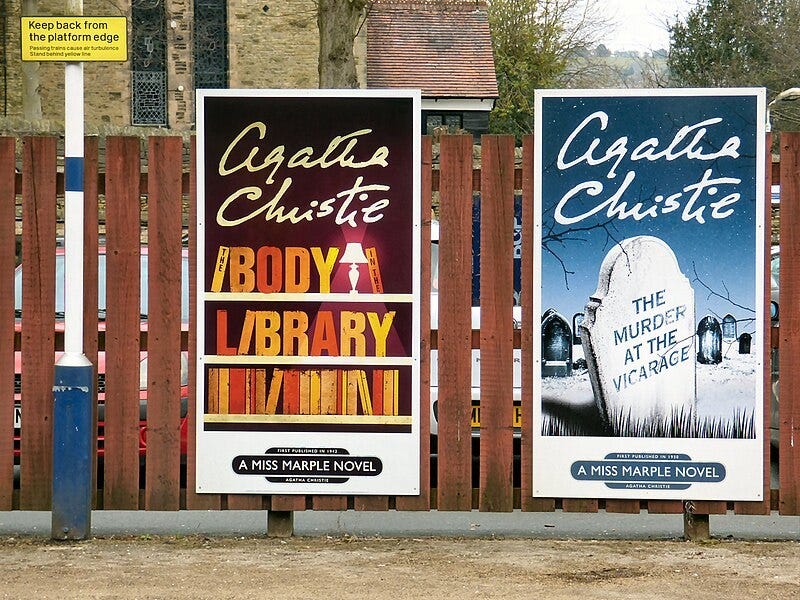

This week, I’ve been preparing to give a talk to a book club on P.D. James, the much-admired suspense novelist. I’ve noticed in my research that James was routinely called “the queen of crime fiction,” a title she inherited when Agatha Christie died.
The Guardian caught the tone of many stories with the headline on its 2014 obituary:
“PD James, queen of crime fiction, dies aged 94.”
That got me thinking: Why do we label female authors that way? I can’t recall having seen Arthur Conan Doyle called “the king of crime fiction.” Nor have I seen that label applied to Edgar Allan Poe or Georges Simenon or any of the other men who might have qualified.
Something similar occurs with the phrase “grande dame.” Mary Higgins Clark was called the “grande dame of suspense” by her publisher as well as her fans.
It’s not just crime novelists like James, Christie, and Clark who get that treatment. Nor does it come only from reactionary throwbacks to the Eisenhower era.
The Guardian is liberal, and so is the Washington Post, which announced the death of a literary pioneer with the 2018 headline:
“Ursula K. Le Guin, grande dame of science fiction, dies at 88.”
The clunky first sentence of the obituary that followed showed how inapt its words were for one of the first novelists to explore feminist themes in science fiction:
“Ursula K. Le Guin, who beginning in the 1960s upended the male-dominated genres of fantasy and science fiction, crafting novels that grappled with issues of gender inequality, racism and environmental destruction — while featuring magical or extraterrestrial characters whom she described as ‘real people’ nonetheless — died Jan. 22 at her home in Portland, Ore.”


Obituary-headline writers strive to sum up lives in neutral terms and to put any value judgments in quotation marks, as the New York Times did after “Iron Lady” Margaret Thatcher died. But Le Guin’s send-off by the Post involved a subtle editorializing when others have used the phrase “the grande dame of science fiction” for Andre Norton and Octavia Butler. The paper was, in effect, choosing sides.
Why do we keep pigeonholing acclaimed female writers, like Le Guin, with terms like “queen” and “grande dame”?
As a former newspaper reporter, I appreciate the challenges of summing up lives in headlines. But the Post could have called Le Guin a “trailblazer” instead of a “grande dame” in the same number of characters. The Guardian might have described James as “a titan of crime fiction” or “crime-fiction royalty” instead of “the queen.”
Like all such language, “queen” and “grande dame” can subtly downgrade women’s achievements. They can also mislead. You might take “queen of crime fiction” to mean: “She’s the best woman in the field, but not the best overall — that’s the king” or “She’s tied for that honor with the king.”
But it should be obvious by now that a woman can stand alone at the top. Before P.D. James, Agatha Christie was known as “the queen of crime fiction” (or “of detective fiction”) and, to many, she still is. Yet she outsold every male mystery novelist of her day.
What should you use instead of the potentially misleading terms?
Charles McGrath, a former editor of the New York Times Book Review, found a way to avoid bias in a review of James’ Death Comes to Pemberley, a book that appeared late in her career.
James, he wrote, “is the greatest living writer of British crime fiction, and probably that genre’s most talented practitioner ever.” Why not leave it at that and avoid reminding everyone that she has ovaries, too?
@JaniceHarayda is an award-winning critic and journalist who has been the book columnist for Glamour, the book editor of a large daily newspaper, and a vice president of the National Book Critics Circle. Her reviews or other articles have appeared in many major print and online media, including the New York Times, the Wall Street Journal, the Washington Post, Newsweek, and Salon.
You might like my story about how much publishers paid Agatha Christie, Mary Higgins Clark, Arthur Conan Doyle, and others for their books: