avatarDark Energy Articles

Free AI web copilot to create summaries, insights and extended knowledge, download it at here

2272

Abstract

en benthic diatoms saw a rapid increase in population, while planktonic diatoms declined. The diatom community survived until 1300 AD when, during a small ice age, lake levels began to rise again.</p><p id="151b">Data were compared with other paleoenvironmental indicators from the Tibetan Plateau, confirming that climate changes were felt throughout the region, not just in the studied lake.</p><figure id="bd29"><img src="https://cdn-images-1.readmedium.com/v2/resize:fit:800/1*NucKvBMEtngoq040fNU-WA.jpeg"><figcaption>Himalaya composite — [Photo: <i>This file is in the <a href="https://en.wikipedia.org/wiki/public_domain"><b>public domain</b></a> in the United States because it was solely created by <a href="https://en.wikipedia.org/wiki/NASA">NASA</a></i>, via <a href="https://commons.wikimedia.org/wiki/File:Himalaya_composite.jpg">Wikimedia Commons</a>]</figcaption></figure><h1 id="289a">The World’s Highest Empire</h1><p id="a9fd">During the formation and peak of the Tibetan Empire, the region experienced warm and humid conditions. Such a climate favored agriculture, crop production, and the creation of wild pastures for animal grazing. Horses, goats, and yaks were crucial to Tibet’s economy.</p><p id="ca2b">The situation began to deteriorate with a severe drought that coincided with the empire’s decline. Researchers suggest that environmental disruptions may have led to crop failures, social unrest, and conflicts of both religious and political nature.</p><figure id="9289"><img src="https://cdn-images-1.readmedium.com/v2/resize:fit:800/1*QruejGicf9HLD7ijzbILww.png"><figcaption>[Photo: 素子だし, <a href="https://creativecommons.org/licenses/by-sa/4.0">CC BY-SA 4.0</a>, via <a href="https://commons.wikimedia.org/wiki/File:Campaigns_of_the_Tibetan_Empire.png">Wikimedia Commons</a>]</figcaption></figure><h1 id="2583">Climate Changes and Life in Tibet</h1><p id="260d">Twelve centuries later, the Tibetan Plateau remains sensitive to climate changes due to its high altitude. Temperature and precipitation variations here differ significantly from Earth’s averages. These factors have significant consequences for lake levels and the organisms that inhabit them. Interestingly, the lake studied by the researchers in the current climate is frozen f

Options

rom November to April.</p><p id="5d8e">Today, agriculture and animal husbandry generate more than half of Tibet’s annual income. Understanding the impact of climate on communities living in challenging conditions helps ensure not only their survival but also their development.</p><p id="db78">The fall of the Tibetan Empire is not the first case of a civilization’s collapse due to climate change. A meticulous analysis of the 800-year existence of the Mayan civilization also indicated that the beginning of its end coincided with a severe drought. A similar reason was behind the downfall of the Hittite Empire.</p><div id="a66c" class="link-block"> <a href="https://readmedium.com/crusaders-in-jordan-archaeologists-on-the-trail-of-warrior-knights-residence-ffb1d45f1a0b"> <div> <div> <h2>Crusaders in Jordan: Archaeologists on the Trail of Warrior Knights’ Residence</h2> <div><h3>Among the medieval ruins on the outskirts of Jordan’s capital, archaeologists have discovered a block with a cross…</h3></div> <div><p>medium.com</p></div> </div> <div> <div style="background-image: url(https://miro.readmedium.com/v2/resize:fit:320/1*h8MMvnRO0LAkIZKv5dDPOQ.jpeg)"></div> </div> </div> </a> </div><h1 id="c498">Attention all readers!</h1><p id="1197"><b><i>As content creators on Medium.com, we face minimal compensation for our hard work. If you find value in my articles, please consider supporting me on my “<a href="https://www.buymeacoffee.com/oconnel">Buy Me a Coffee</a>” page. Your small contributions can make a big difference in fueling my passion for creating quality content. Thank you for your support!</i></b></p><figure id="fd80"><img src="https://cdn-images-1.readmedium.com/v2/resize:fit:800/0*RR5yFR_Y7XCa_o2S.png"><figcaption><a href="https://www.buymeacoffee.com/oconnel">https://www.buymeacoffee.com/oconnel</a></figcaption></figure><figure id="0246"><img src="https://cdn-images-1.readmedium.com/v2/resize:fit:800/0*7aHKmhjMWUgUukZe.png"><figcaption><a href="https://www.buymeacoffee.com/oconnel">https://www.buymeacoffee.com/oconnel</a></figcaption></figure></article></body>

Why Did the Ancient Tibetan Empire Fall? Researchers Point to Reasons

The Tibetan Empire thrived from 618 to 877 AD. It was home to approximately 10 million people. Why does the history of this great empire abruptly end in the 9th century? Researchers have a theory.
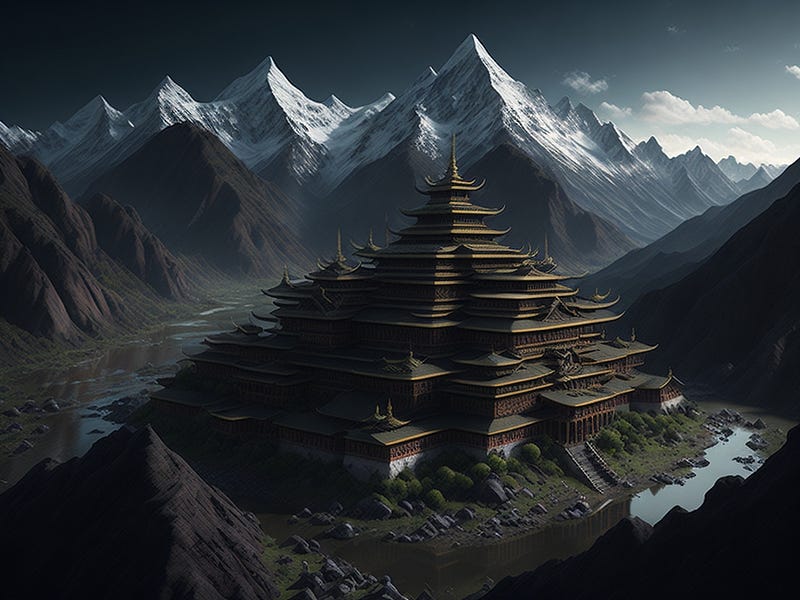
[Image generated by AI, Free to use]

While the Tibetan Empire may not have played as significant a role in world history as the Roman Empire, it still left its mark. It was the world’s highest empire, located at an elevation of over 4,000 meters above sea level.

At its height, the Tibetan Empire ruled over approximately 4.6 million square kilometers in East and Central Asia, with its borders extending into northern India. Considering the low oxygen levels in the air in these regions, it’s fascinating that it was inhabited by as many as 10 million people.

So, what led to the downfall of the empire? According to research published in the scientific journal “Quaternary Science Reviews,” climate may have played a significant role.

[Image generated by AI, Free to use]

When Did the Tibetan Empire Fall?

The answer to why the Tibetan Empire did not endure may be hidden in the geological records of lake sediments. Researchers from the Institute of Tibetan Plateau Research in China analyzed these sediments to determine how the environment changed 1,200 years ago.

A significant discovery was the presence of microscopic single-celled algae remains. Scientists noted that over time, planktonic varieties, which typically float closer to the water’s surface, gave way to benthic varieties, which are typical of lakebed areas. They argue that this indicates a period of drought and a decrease in water levels.

The critical point occurred around 800 AD when benthic diatoms saw a rapid increase in population, while planktonic diatoms declined. The diatom community survived until 1300 AD when, during a small ice age, lake levels began to rise again.

Data were compared with other paleoenvironmental indicators from the Tibetan Plateau, confirming that climate changes were felt throughout the region, not just in the studied lake.
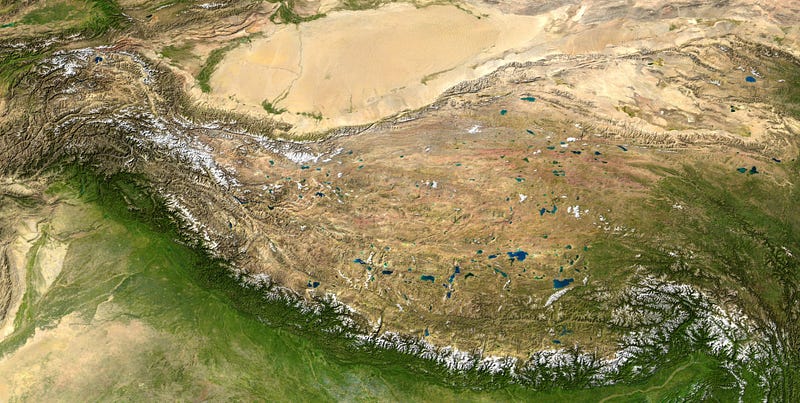
Himalaya composite — [Photo: This file is in the public domain in the United States because it was solely created by NASA, via Wikimedia Commons]

The World’s Highest Empire

During the formation and peak of the Tibetan Empire, the region experienced warm and humid conditions. Such a climate favored agriculture, crop production, and the creation of wild pastures for animal grazing. Horses, goats, and yaks were crucial to Tibet’s economy.

The situation began to deteriorate with a severe drought that coincided with the empire’s decline. Researchers suggest that environmental disruptions may have led to crop failures, social unrest, and conflicts of both religious and political nature.
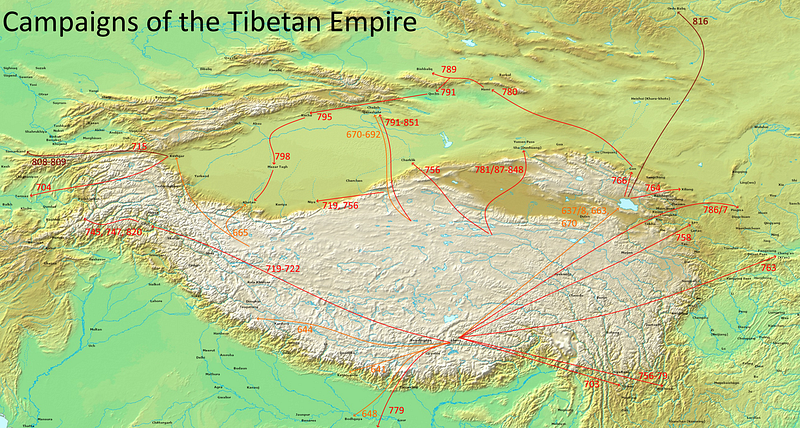
[Photo: 素子だし, CC BY-SA 4.0, via Wikimedia Commons]

Climate Changes and Life in Tibet

Twelve centuries later, the Tibetan Plateau remains sensitive to climate changes due to its high altitude. Temperature and precipitation variations here differ significantly from Earth’s averages. These factors have significant consequences for lake levels and the organisms that inhabit them. Interestingly, the lake studied by the researchers in the current climate is frozen from November to April.

Today, agriculture and animal husbandry generate more than half of Tibet’s annual income. Understanding the impact of climate on communities living in challenging conditions helps ensure not only their survival but also their development.

The fall of the Tibetan Empire is not the first case of a civilization’s collapse due to climate change. A meticulous analysis of the 800-year existence of the Mayan civilization also indicated that the beginning of its end coincided with a severe drought. A similar reason was behind the downfall of the Hittite Empire.

Attention all readers!

As content creators on Medium.com, we face minimal compensation for our hard work. If you find value in my articles, please consider supporting me on my “Buy Me a Coffee” page. Your small contributions can make a big difference in fueling my passion for creating quality content. Thank you for your support!


https://www.buymeacoffee.com/oconnel
History
Culture
Science
Life
Research
Recommended from ReadMedium