
Why Derren Brown’s Stoicism Is The Solution to Happiness You Didn’t Know You Were Looking For
How pessimistic thoughts lead to rich lives

Derren Brown is a celebrity magician and philosopher. Counterintuitively, to live a happy life he recommends that you should become a pessimist.
To explain, suppose that you enter a raffle and win a new car. Suppose further that it just happens to be your dream car. Picture that car. Imagine its color. Imagine how it feels as you drive it. Imagine how envious others will be watching you drive it (I’m joking). Now how much happier will you be? For how long?
When answering those questions, did you consider how much it would cost to maintain? How expensive the insurance might be? How, eventually, it won’t look as shiny and sexy as the new models?
Some pessimistic people are mildly depressed. But contemporary research supports the view that the mildly depressed are better at predicting how they will feel in the future than their jauntier counterparts. In academic jargon, they are better affective forecasters.
One reason the mildly depressed might be better than the rest of us in predicting how they will feel in the future is that they are less likely to suppose that getting some item or achieving some goal will change their life.
More recent research on affective forecasting suggests that the positive bias most of us have actually boosts our resilience. As a result, it may have evolutionary advantages. If that’s right, a certain amount of delusion is good for us as a species. But that doesn’t mean it’s good for you as an individual, and it’s almost certainly terrible news for your ability to figure out what you really want.
And that brings us to Brown’s philosophical point. If we define “happiness” as getting what you really want, then a streak of pessimism proves a reliable path to discover what that is.
The reason Brown is a Stoic philosopher, and not just a pessimist, is that Stoicism has a set of tools to identify whether what you really want is valuable. It can also help you in taking steps to get there.
My practical purpose here is to explain how you can learn to use Brown’s pessimistic Stoicism in your own life. It is the solution you didn’t know you were looking for, because your biases, like mine or anyone’s, make you think you are after something else.
My philosophical purpose is to explain why anyone would try to merge a philosophy from ancient Greece — Stoicism began roughly in 300 BCE — with one that finds its most notable proponent in a German philosopher — Arthur Schopenhauer — from the 1800s.
Let’s begin with the philosophical points since they’ll set the framework for the practices to follow.
Why We Need New Stoicism
Not everyone who is attracted to Stoicism is an agnostic or atheist, but many are. Often, they come from post-Christian backgrounds and are looking for a rational way to lead their lives without the stuffiness of their religious upbringing. Massimo Pigliucci, a philosopher, scientist, and author of How to Be a Stoic, is one such person.
The revival of Stoicism, then, has been in part fueled by the changing demographics of American society (and the world more broadly).
But this same demand for a rational way to live makes the old Stoicism not so helpful. Zeno of Citium, the founder of Stoicism, argued that our cosmos is a rational animal in the following way:
“The rational is superior to the non-rational. But nothing is superior to the world. Therefore the world is rational. And similarly with “intelligent” and “participating in animation.”… Therefore the world is intelligent and animate” (Long & Sedley, 54F).
If you puzzle over his argument, you’ll recognize that his claim that “nothing is superior to the world” is doing all the work. And it’s a dubious claim.
The problem, in a line, is that the old Stoicism got by using physical arguments that contemporary science invalidates. This results in three serious challenges.
- First, if God can’t be considered the soul of the cosmos, then we have no grounds to think that everything happens for a reason. As a result, it is no longer rationally plausible to believe in divine providence.
- Second, the absence of a providential guarantee for the meaning and purpose of our lives also entails that you and I shall have to do the hard work of setting our own goals.
- Finally, since there is no guarantee for rational providence, we should look for additional strategies. Maybe we could pursue non-individualist methods, or learn to live better lives with the help of others.
It is in response to these problems that you’ll find many kinds of New Stoicism: Buddhist Stoicism, Aztec Stoicism, and, of course, Derren Brown’s Pessimist Stoicism.
Brown is focused on point two: how to choose your goals in the first place.
Pessimist Stoicism
The basic problem in choosing a goal is that, in Brown’s words, when you start thinking about goals you start to think that you must
“study these [topics] … in order to go to this university, to study this subject, to get this job, to get this promotion …. Meanwhile, our lives are relegated to something that happens, to borrow Schopenhauer, ad interim: in the meantime; unattended” (Happy, 47).
Setting goals risks turning the majority of your life into a pointless exercise of preparation. Let’s call this the ad interim problem.
What are we to do about it?
Brown’s answer is to adopt Schopenhauer’s philosophy. This initially surprised me.
Schopenhauer (1788–1860) is generally regarded as the pessimistic philosopher and he was a cantankerous misanthrope. As a university Lecturer, he had so few students that he lost his post. He never married. And his only companionship was a string of poodles whom he all named “Atma,” borrowing the notion of one’s true inner self from Indian philosophy.
Despite all that, Schopenhauer was surprisingly good at advising us on how to set realistic goals that lead to good, happy lives.
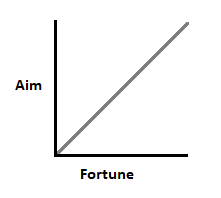
Schopenhauer’s keenest idea is likely this one, which Brown calls Schopenhauer’s Diagonal. We tend to think that if we just set goals and have a plan, then we’ll be able to execute well. But that approach envisages forward motion in life only along one dimension. It fails to respect the role of fortune in our lives.
What actually happens is that fortune is like a wind blowing us off course. So while we think we’ll go in one way, we really end up splitting the difference and our life follows the diagonal path between our aims and the say of fortune (the grey line in the image).
Anyone who has tried to accomplish a goal will probably agree. In my own case, I wanted to pursue philosophy but did not anticipate getting an academic position in UpState New York, multiple time zones away from my family.
What Brown’s use of Schopenhauer gives us is a reasonable way to think about our goals such that they reflect what is within our control.
The Stoic “tweak” to the Schopenhauerian idea is that you should focus on those areas of your life where you have more control. That way the diagonal of your life bends more toward your aims.
Stoic philosophy develops two complementary practices to help you accomplish this, both of which might be considered features of Stoic mindfulness.
How to Love What You Have
Epictetus (50–135 CE), the Stoic philosopher who was born a slave and became a distinguished teacher during the reign of the Roman emperor Hadrian, delivered lectures that took up eight books called the Discourses. The abstract of these made up his duly famous Handbook.
In the Discourses, he argues that a chief reason we ruin our happiness is that we do not appreciate what we already have. In his words:
“Do not spoil what you have by desiring what you have not; remember that what you now have was once among the things you only hoped for” (Brown, 174).
There are really three parts to Epictetus’ wisdom on this topic. The first concerns the need to appreciate what you already have, to be grateful.
The remaining two parts concern how to put this wisdom into practice. In this statement, he tells us to think on our lives before our best relationships. In another one, he tells us to think of our life after them. Let’s go through those separately.
Practice 1: Think of Life Before
A first step in loving what you already have is to recognize that you used not to have those things or relationships. Try to remember what life was like before, then, and try to think about why you wanted them in the first place. Let me explain with a story.
Jason is one of my two best childhood friends. He too majored in philosophy at university and is the source of the Dr Pepper Argument — a humorous and deliberately terrible form of logical reasoning.
Now he puts his philosophical training into practice as a small business owner, running a Dojo in Seattle. He’s also been planning a wedding with his partner.
At one point, I asked him how much he loved her, and in typical jocular fashion, he replied: “At least $250,000 a year.” That’s how much his business’ revenue had grown since they decided to work together.
But he explained that the figure really symbolized all the ways that his life had been going better with her.
- He had discovered that he was a Type 1 diabetic, and so now had the appropriate health treatment.
- He’d lost 70 pounds and began exercising regularly for the first time since he was a competition fighter.
- He finished writing a children’s book and an online course for parenting young children.
- He was able to provide a supportive environment for his youngest sibling who had just come out as a trans man.
- Above all, he felt loved and appreciated.
Good people in our lives often help us to live up to our potential. To recognize that, you only need to remember what life was like before they entered yours.
Practice 2: Think of Life After
Alternatively, if remembering your initial motivations is difficult, Epictetus points out that you only need to imagine what life might be like if you lost these things or people (Handbook 14).
A few years ago, my wife had an episode that required serious medical attention. She came home from work and mentioned that her jaw had gone numb. She also had trouble speaking earlier that day when she taught her classes (as a professor).
Deciding to err on the side of caution, we drove to a local care center. The doctor there sent us to the emergency room in an ambulance. And in the emergency room, they tested her for multiple sclerosis.
I couldn’t stay with her during the night. So I returned alone to our house to ponder and ruminate over our future: how things might change, what this would mean for the length of her life, and every other possible bad scenario.
It was a sleepless night, but in the end, it turned out to be a (quite rare) form of allergic reaction. What the experience did for me was to clarify all the ways — large and small — that I valued our relationship.
Epictetus’ point is that you only need to think about this sort of possibility, not experience it, to gain a renewed appreciation for what you have.
Why The Examined Life Is A Better Life
An odd feature about human life is that you don’t have a choice about whether you’ll be a philosopher. You can choose to be a physicist or car salesperson. But whatever you choose, you’ll be deciding on what kind of life you think is worth leading.
And making that decision — about what is best for you — is preeminently a philosophical decision.
The only choice you do get to make, then, is whether you will lead a philosophical life well or poorly. I wager that you’ll do better if you stop to think about it— if you choose to lead an examined life.
Brown’s book Happy is an attempt to do just this. He synthesizes pessimism with Stoicism, and though the proposal is needed for theoretical reasons, the result is one that can help us live better lives. It teaches
- how to think about the direction of our lives,
- how to bend that arrow more closely towards our aims by selecting what is under our control,
- how to practice gratitude by thinking on our life before our best relationships, and
- how to love what we have by reflecting on what our lives might be like without the people who populate it.
An emerging sub-genre of philosophy has argued that in modern times philosophy is “dead” or on the way out. But that seems to be impossible as a statement about the human condition. It’s also inaccurate about the cultural institutions that support taking a reflective approach to life’s problems.
What does seem to be happening is that philosophy is changing form. That Derren Brown, a celebrity, would take the time to do philosophy — and do it well — is an indication that the practice is moving out of the ivory tower.
But the essential purpose of the philosophy remains the same: it helps us to select and lead better lives.
I’ll lead you with a final quotation from Epictetus about wanting the right things in life:
“Remember that it’s not only the desire for wealth and position that debases and subjugates us, but also the desire for peace, leisure, travel, and learning.
It doesn’t matter what the external thing is, [so long as it is outside our control] the value we place on it subjugates us to something else” (Discourses, 4.4).
Thank you for reading and I hope you learned something.
For more philosophy as a way of life, using all of the world’s traditions, join my newsletter.
Sebastian Purcell’s research specializes in world comparative philosophy, especially as these ancient traditions teach us how to lead happier, richer lives. He lives with his wife, a fellow philosopher, and their three cats in upstate New York.