
HE’S SO WITTY OH SO WITTY
WHY CHARLES DICKENS ENDURES
Five things I am learning while reading David Copperfield
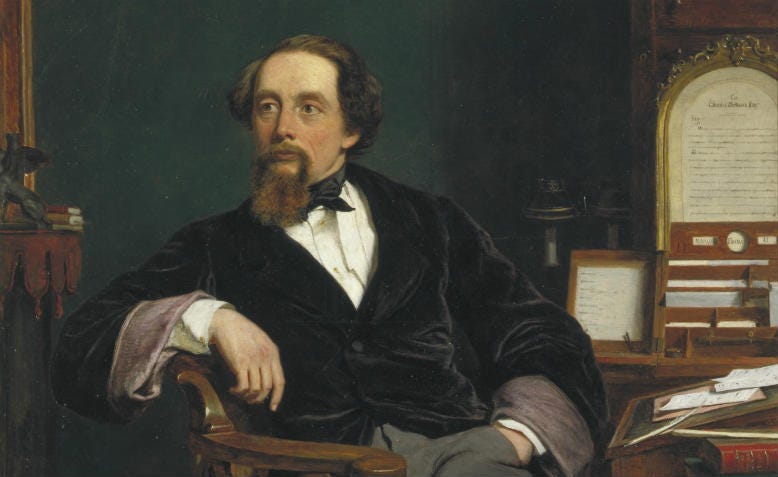
One of my first medium stories bombed. I assumed it would be funny to have Charles Dickens offer writing advice with a cockney accent. That story was too obscure and time-consuming for readers — who had to decode it — and poorly titled.
A handful of people graciously read it, including my bright, funny stepdaughter. She commented — Trisha, are you in there?
I doubt she has ever read Dickens novels. His writing style does not seem, at first glance, relatable for many people He has been accused of being dull, wordy, and antiquated with overly elaborate details. Fair enough. He was paid by the word count. Dickens published his first article when he was 21, and 3 years after that began writing installments of his first novel.
In the 1800s and beyond the Victorian era, he was quite popular. His beloved readers, who received installments of Dickens’ in-progress novels, were impatient for each new episode to arrive. That’s hard to imagine these days when a slough of stories are readily available via books, magazines, online sites, and on-screen.
But consider this — Dickens and his fantastic stories may still be relevant to current culture. Dickens believed in the importance of social justice, including securing funding for a program for orphan kids and championing the humane care of people with mental illness.
When the young Dickens’ father was sent to debtors prison, his mother soon followed, leaving young Charles to fend for himself. Dickens quit school to work in a dismal shoe polish factory when he was 12. Later he wrote about the poor, the marginalized, and the working-class people with whom he felt a deep kinship.
My admiration for Charles Dickens has been recently fortified. I signed up in January for a virtual David Copperfield Book Club. Without the enthusiasm of the group members and the leader, I doubt I would have made it to page 10. Each week group members are assigned to read three chapters of the 800-page David Copperfield. On Monday evenings group members — I counted 113 people yesterday — gather for two hours on Zoom.
A close friend invented and is the facilitator of these groups. He calls them The Quarantine Book Clubs — launched in response to pandemic-driven isolation. Joan Didion, Toni Morrison, Herman Melville, F. Scott Fitzgerald, James Baldwin, and Virginia Woolf’s books were discussed in previous book clubs. The groups are anything but boring.
My friend prepares by finding supplementary texts, including author biographies, diaries, and collected letters to share and enhance our reading experience. Plus, he selects thematic music and encourages audience participation. In the meantime, an engaging and often comic chat stream rolls along in the background.
Reading in a small community helps make David Copperfield and Dickens seem more accessible and less overwhelming. My partner mocks my slow progress through the book, commenting that I could use the heavy tome in other ways — for biceps curls or a perch for my laptop.
She has a point, but I like the slower pace. I can get a better handle on what makes Dickens so inspiring. Here are five reasons:
Firstly, Dickens creates memorable characters, fashioned after people of various social classes he had encountered. Many people are familiar with the classic Scrooge character from A Christmas Carol or Bill Murray’s film depiction. You might know the pickpockets and their wily leader, Fagin, from Oliver Twist, the novel, or the 1970s musical. Reading David Copperfield, I am being introduced to even more imaginative characters.
Secondly, Dickens is a master of language. If you take a few minutes to read aloud sentences from any of Dickens’ books you can hear and see for yourself. His skills in phrasing, vivid lyrical descriptions, and subtle shifts in tone make his sentences powerful. I often underline or star 1 or 2 clever and fresh sentences per page, and that’s a modest accounting.
Thirdly, as I noted above, decades before digital communications gradually altered our attention spans and content choices, Dickens was perfectly attuned to his audience. Readers lined up on docks and platforms, waiting for ships or other modes of transportation to deliver Dickens’ book installments. His audience craved his stories.
The fourth thing was also mentioned earlier. Dickens understood the struggles of the poor and the challenged. What’s more he appealed to readers who did not share his social justice-informed compassion. Dickens backed by a benefactress, set up a home for orphan children. His writing focused on the poor, the marginalized, and the working class. In David Copperfield, it becomes clear that his vision for a humane world included compassionate care for people with mental health issues.
The last thing is Dickens’ sense of the comic. He infused humor even in characters’ names and their quirks. Uriah Heep is as slithering, sly, and damp as his snake-like character. A light-hearted female character, Miss Peggity, seems to dance in and out of chapters. Dickens can move between humor and tragedy in one seemingly effortless paragraph after another.
Whether you read Charles Dickens in solitude or with a playful, curious group of people, his work is definitely worth any investment of time you can spare.