
Why Black Girls Need Black Stories
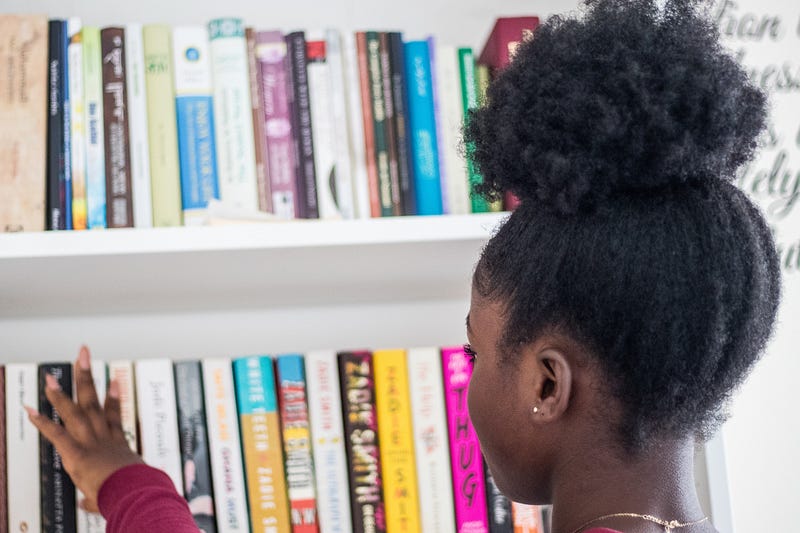
When I used to teach, all of my students were Black, and the majority of them were girls. All of them were struggling readers, and a few had dyslexia.
I worked as a Reading Specialist with children ages 6–9 years old. I remember spending an entire academic year teaching a first grader the alphabet.
As most teachers can likely attest, even in the best of circumstances, keeping children motivated and focused on a task that specifically causes them frustration and anxiety is something of a Herculean feat. I spent over 40 hours each week trying to teach them the rules of a language that’s infamous for breaking its own guidelines.
Yet even beyond the resentment towards grammar, a lot of my kids weren’t interested in reading as an activity or stories as a form of enjoyment. One little girl in particular had nothing but impatience for the task. She was a third grader — I’ll call her Tiana. Her progress was the slowest of any of my students, and each day with her felt like someone was tap-dancing on my very last nerve.
The only thing that helped me keep my cool in the face of her constant attitude was knowing that it came from a place of self-consciousness. Reading was hard for her, and she didn’t think she’d ever be good at it. She knew she was behind the other students in her class — most of the students in her grade, honestly. It was disheartening for her, on top of being completely uninteresting. And I had no idea how to combat that. I had been provided with a small collection of books to fit with our curriculum, and I gave her as many different stories as I had access to — stories about heroes, princesses, spies, adventurers, dancers, regular kids doing regular things. She didn’t care about any of it.
Then one day I happened to bring one of my own books to read on my break.
When Tiana entered my classroom she stopped short, hovering at my side rather than making her way to her seat.
“What’s that?”
Her eyes were transfixed on the novel on my desk. I had a copy of Queenie by Candice Carty-Williams with me. I could immediately see that the image of black braids illustrated in such detail on the cover that had caught my eye in the bookstore was having the same effect on her. Braids piled high in an up-do…like the ones she currently had in her hair.
Around this time, I attended a lecture by Dr. Tonya Leslie, an educational consultant and children’s book author with over 20 years of experience in publishing. She gave a presentation entitled “Mirrors and Windows: Diversity in Children’s Literature.” Much of her work focuses on the need and methods that schools can use to incorporate more diverse and inclusive texts into their classrooms. Sitting in the audience listening to her speak immediately shed light on so much of what I was witnessing with my students.
For non-white children, the inability to find themselves reflected in stories has an immense impact:
“When children cannot find themselves reflected in the books they read, or when the images they see are distorted, negative, or laughable, they learn a powerful lesson about how they are devalued in the society of which they are a part.” (Source)
I imagine that for children with dyslexia and learning disabilities, these feelings are amplified. How dehumanizing is it to feel so invisible while you struggle?
I’d be lying if I said I didn’t shell out a few of my own bucks to get books in the class with beautiful little Black girls on the covers. I also made a habit of continuing to bring my own books to school with me. It didn’t stop Tiana from mixing up her B’s and D’s, but it gave her some motivation to want to improve. Just knowing that there were stories out there that she would find interesting and relatable, that would make her feel visible, helped take reading from a chore to a challenge.
I don’t teach anymore, but I hope whoever has taken my place has realized and understands this. I hope the school they work for believes and supports this. Our Black girls need Black stories — we have to make sure they get them.
More on books and Blackness:
Sign-up for my newsletter if you’d like to get more of my stories.