
Afrofantasy and the Need for Black Escapism
Afrofantasy authors are offering Black people the chance to rest and recover from racial trauma.

Afrofantasy describes a sub-genre of speculative fiction in which the myth, lore, and magic that make up the world are based on, or inspired by, African cultures and the Black experience.
To be Black at this particular point in American history is to be equal parts exhausted, enraged, and afraid. The heightened degree of emotional labor it takes to interact with the world can easily overwhelm. As someone who reviews books by Black authors almost exclusively, the prevalence of Afrofantasy novels crossing my desk these days has been a welcome relief from the regular onslaught of dystopian news. It is among my greatest acts of self-care to relax with a good book for a few hours and immerse myself in a world entirely devoid of white people and Western colonialism.
In the process, I’ve realized how much of my previous thoughts about fantasy were tied to the Eurocentric cultural staples that comprise most of the genre. Mainstream conceptions of fantasy are almost exclusively the products of Eurocentrism, from the settings to the magic systems to the fantasy “races” that often rely on the same repetitive tropes that even non-readers can recognize. I used to think I didn’t care for fantasy. I have instead come to realize that what I don’t care for are the stale re-imaginings of European folklore.
Yet even as I’ve come to read stories with similar ideas and inspirations, I find nothing stale or overdone about Afrofantasy.
Afrofantasy is not to be confused with Afrofuturism, which weaves Black cultural elements heavily into futuristic and technology-driven sci-fi stories. It should go without saying that many works can and do incorporate elements of both Afrofantasy and Afrofuturism. Both genres are inherently about examining and re-imagining the world through a Black lens. Yet the terms are not interchangeable.
Through Afrofantasy, we get extensive depictions of Black cultures and concepts of beauty that celebrate traditional African features. We get magic systems that honor the relevance of folklore and depictions of gods and goddesses. We get characters whose power and abilities are enhanced by their heritage and ancestry rather than limited by it. Above all, we get the overwhelming mystical and otherworldly notion that absolutely anything is possible.
Despite the unique and valuable space Afrofantasy occupies in the landscape of Black media, one thing has become glaringly clear in the last few years:
There is a notable lack of distinction in the way that we talk about genres of Black fiction.
From historic literary titans like Octavia E. Butler to present-day powerhouses like N. K. Jemisin, Afrofuturism has been around for a good minute. But it was the release of Black Panther in February of 2018 that coincided with a massive spike in online searches and activity related to the term “afrofuturism.” In fact, Google Trends indicates that February 2018 was the month of “peak popularity” for the term.
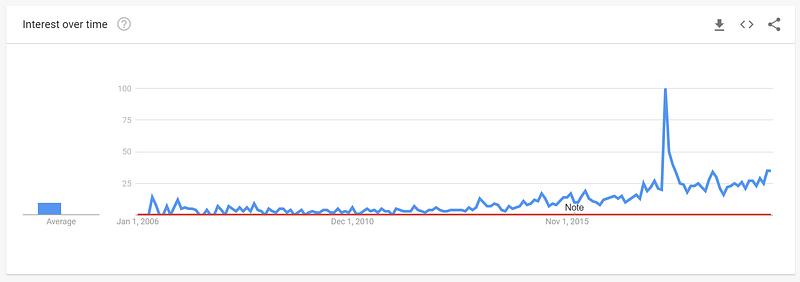
In March of 2018, just a short month later, Tomi Adeyemi broke literary records with Children of Blood and Bone, her debut novel about a girl seeking to restore the magical heritage of her people against a West African cultural backdrop. Despite shaking the publishing world to its core with a seven-figure bidding war for the book and the almost immediate sale of movie rights, the web saw no spike in searches for “afrofantasy.” The term does not even generate enough data for Google to make anything of it at all.
Magic and the culture of magic are the central axis on which this story revolves, and news outlets almost immediately began dubbing Adeyemi (despite her protests) “the next J.K. Rowling.” Yet articles pertaining to her work read like this:
“If Rowling’s Harry Potter was a precursor to the current boom in YA fiction, then Children of Blood and Bone is a harbinger of another prominent movement: Afrofuturism, fantastical stories rooted in African culture and myth.” (Refinery29)
Even in this quote, Refinery29 links the term “Afrofuturism” to another article on their site that describes the growing prevalence of Black women and women of color in the sci-fi genre.
We have got to stop lumping all the Black stuff together under one name. Adeyemi wrote an amazing and resonating Afrofantasy story, and yet it is constantly labeled Afrofuturism. This is something I have had to become better about myself as I continue to discuss and review Black works. Just as mainstream sci-fi and fantasy are distinguished and widely understood to cater to different audiences, so too can we acknowledge the variations in Black writing.
No one would ever mistake Harry Potter for a science fiction series.
Personally, at a time where I am constantly plagued with issues of privacy, security, ethical uses of technology, and the real-world dystopian effects of living under a growing surveillance state, many sci-fi elements are less appealing to me than the magical alternatives of fantasy. While I do love reading anything and everything Black, Afrofuturism does not offer me the same reprieve as Afrofantasy.
This is not to say that Afrofuturism is not powerful and transformative; just that it functions and presents differently as a genre than Afrofantasy. Subsequently, it fulfills different needs for different readers with different tastes. There are most certainly times when I gravitate to the revolutionary stories of worlds centuries more advanced and technology-saturated than our own.
Yet in these times, I am drawn to the free and expressive depiction of Black characters who are uplifted by the inherently magical forces of their cultures. Where dark skin is embedded with protective charms that create safety. Where curls and coils are enchanted in ways that other characters find enviable. Where spiritual connectivity is often the root of all power.
When my psyche is bombarded with the trauma of being a Black woman in America, these are the worlds I like to escape to. As so many Black people are expending every ounce of their energy into transforming the real world that we occupy, Afrofantasy authors are offering us the chance to rest and recuperate. They are stoking our imaginations, pride, and joy in ways that make real-world activism more sustainable.
The least we can do is properly acknowledge their contributions.
More from me:
Sign-up for my newsletter if you’d like to get more of my stories.


