
Why Big Data needs ELT
Modern Approaches like Data Lakehouses need ELT based Data Integration

In the area of Big Data, three particular factors are important in data integration: Performance and Scalability, Flexibility and Data Formats, Ease of Use. Here, the ELT process is usually the more effective one. If you’re wondering what Big Data is all about, this article might be of help.
Factor 1: Performance and Scalability
Large amounts of data consume a lot of computing power when they are transformed. It is often no longer possible or necessary to distribute the data in the transport, when the data is first stored raw in a Data Lake, for example. From there, they can be transformed for further use cases. For example, Self Service BI, ML and others. This would be a typical ELT approach.
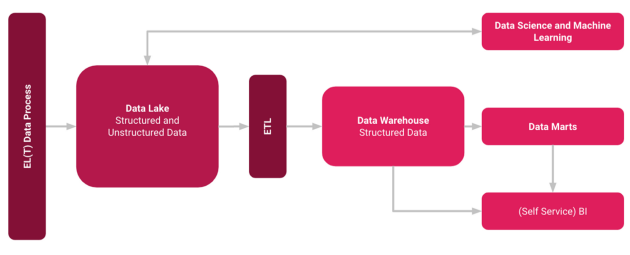
This approach is called a Data Lakehouse. The Data Lakehouse should combine the advantages of Data Lakes and Data Warehouses into a hybrid concept. Read more about the Data Lakehouse concept here[1].
Factor 2: Flexibility and Data Formats
Non-structured, semi-structured and poly-structured data must be easily processed, stored and analyzed. In order to extract these different formats from the source systems, the software must be flexible and be able to open up all possible interfaces. There is the possibility to program pipelines yourself or to buy ETL/ESB software or a special connector.
Factor 3: Ease of Use
If it is a small or medium sized company, a purchased solution may make sense. If several different systems and possibly ESB and API use cases are to be implemented in addition to ETL, software such as Talend or Alteryx may make sense. If only a few data sources are to be accessed, for example for a Data Warehouse, a special connector makes more sense. If possible, the data preparation processes should be able to be graphically designed by comfortable integrated development environments. The use of script languages only makes sense if (long-term) developer know-how is available [2].
Summary
ELT is on the rise and is replacing ETL more and more, especially in the Big Data environment it is a prerequisite anyway. Only in this way, data can be transformed and processed quickly enough. Approaches such as Data Lakehouses are a suitable concept for making the raw data available for the further analysis process. If you want to get further into the topic and know what project phases are involved in Big Data projects, please click here:
Sources and Further Readings
[1] Christian Lauer, What is a Data Lakehouse? (2021)
[2] Bitkom, Big-Data-Technologien — Wissen für Entscheider (2014)


