
Why Be Afraid When You Can Just Be?
It’s natural to worry. But it’s not helpful.
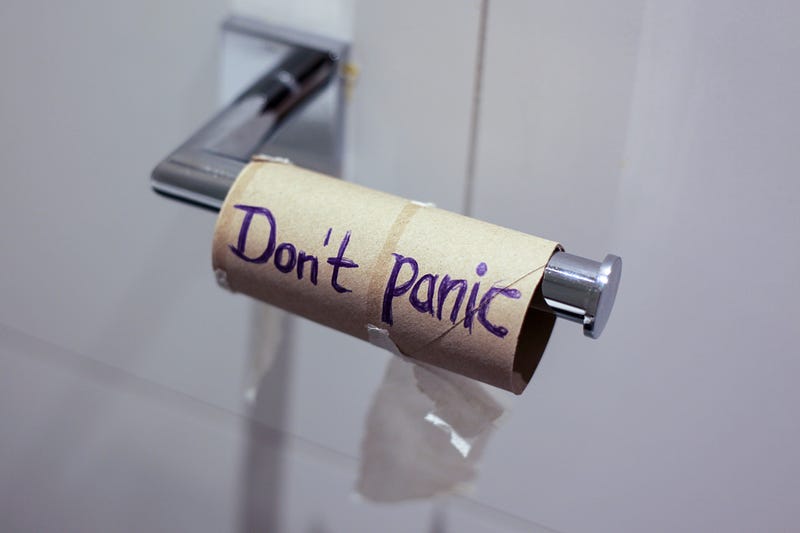
I lost my job today.
Well, that’s not entirely true. As a freelancer, I never really lose my job. But I lost the client that, more than any other, has supported me for the last 18 months.
I knew it was coming, of course. I’m lucky it lasted as long as it did. Every business is curling in on itself, the petals folding back as the darkness approaches. The day after we’re born, we learn that the sun can’t shine forever.
It’s not shining today. Pathetic fallacy is a hackneyed old tool, though still a useful one. But I didn’t invent this rain. The fine drizzle has been drumming on the roof all day, singing in the gutters, turning the grass clippings I never rake up to darker mounds against the lawn’s brilliant green. I’m lucky to have a yard, a place to go beyond the four walls of the house that seems to shrink noticeably by the day.
The umbrella is meant for the sun. All last summer, it stood up to the glare. The top side is now a thin and faded pink, while underneath it remains as red as a matador’s cape. And the sound of the rain on the taut fabric is very beautiful.
The furtive pricking of a hundred timid needles, like invisible mice repairing what the weather tears down.
It’s just as well I have a yard, because the parks are closed to us now. The gorgeous beaches and sunlit coves and mountain trails are gone, left to weather and wildlife as though we never existed.
Up in the mountains that the rain clouds hide, bears are waking from hibernation, tasting the damp air and wondering why it smells cleaner than usual.
No petrol fumes. No campfires. No deodorant. No blue clouds of weed smoke drifting slowly through the trees. Somewhere in the valley, an unseen train blows a mournful whistle, the only thing still moving around here. That and the rain.
Lovely and lonesome. The way every beautiful thing has a melancholy edge, a kind of displaced nostalgia that reaches back from a loss we haven’t yet endured.
Fear starts in the amygdala.
A tiny nut-sized knot of nuclei buried towards the bottom of the brain. When a threat is perceived, the amygdala’s fear response activates areas of the brain that control the motor functions of the body. It’s getting you ready to run or to fight.
Meanwhile, stress hormones flood the brain. The heart rate rises. Breathing quickens. Processes that are not essential for immediate survival risks, such as digestion, shut down.
Fear is a fact of the universe. It existed long before our bizarre brains emerged from the forest. And it’s a useful process. An animal that can’t feel fear won’t last long in a dangerous world. But the amygdala can’t tell whether we’re facing a lion or a layoff, a panther or a pandemic.
The things that keep us up at night in modern society aren’t the kind of things we can run from. Nor will they be settled by a stout stick or a sharpened stone. Unrelieved fear creates stress and anxiety that cause long-term damage to anyone that feels it.
It’s easy to be afraid.
It’s our superpower. We’re not the only animals with the ability to plot and scheme, to project ourselves into the future and shoot around corners at whatever’s coming. But we are the best at it.
It’s a trick I’ve taken to heart, one that’s served me well in the meandering course of my life. A strength that’s simultaneously a weakness. The engine that builds a palace out of a prison and then tears it down again. Thankfully these days, I’m getting better at switching the engine off than I used to be.
There’s lots I can do. I can find more work. I can reach out to new clients, however many are left. I have a long list of projects to work on, now I have the time. My phone screen is glowing beside me as I write this, a notepad app filling up with a list of my next moves.
I won’t qualify for government assistance, and that’s fine by me. Since I left my father’s home decades ago, I’ve only ever needed to rely myself. Once you’ve built a home with rubble and wreckage, your hands don’t forget how to do it again.
Julia E Hubbel has it exactly right in this article, when she urges us to allow for flux. To expect it. Change is an even more fundamental law than fear, and it comes to us all, ready or not. What matters, as Marcus Aurelius would have it, is how we respond to it.
Here’s one way I’ve learned to deal with fear.
In 1944, Truman Capote was working as a copyboy at the New Yorker. He sorted cartoons and organized newspaper clippings. It was by no means a glamorous job, but it supported the 20-year-old Capote and allowed him to live in New York City. However, at a reading by Robert Frost, Capote got up to leave in the middle of a poem. Angered by what he took to be disrespect, Frost hurled a book at Capote. The young man was fired the next day.
Out of work and unable to support himself, Capote moved to Alabama to live with his family and began work on his first novel.
We can never know where the roads we don’t take would have led us. But it’s possible that Capote might have stayed at the New Yorker longer and worked his way up to a better job. With his talents and intelligence, he could easily have become a writer or an editor. Maybe that’s where he would’ve stayed, and we wouldn’t have In Cold Blood or Breakfast At Tiffany’s.
I always planned. I believed what I was told. Get good grades, get a degree, escape the dull hell of poverty that swallows everyone who doesn’t go to college. But when I finally went to university, I quit after a week. I could see even then that it was a waste of time. Another empty game. Buzzing hallways filled with self-absorbed little bees, every grade so fatally important. Until the next one.
I dropped out with no idea what I was going to do. I drove a forklift truck for a while, riding my bike across town to show up for the evening shift. After a couple of months, that job evaporated and left me with nothing. So I emigrated. All the good things in my life came directly from that decision. If I’d stayed in school, I have no doubt I would’ve lived a greatly diminished existence.
Crisis and opportunity are not the same thing. But they can look awfully alike. Perspective increases with age, and the further back you look, the more you see that setbacks can end up being springboards. That the rubble and ruins can make a foundation for a masterpiece. That many of our best decisions seem at the time like disasters.
In the forest that stands silent behind locked gates, every day is a struggle.
Everything that lives wants to live one more day, and that existence comes at the expense of something else. Even the trees aren’t pure. They grow on the wrecks of their parents while worms burrow beneath their bark. Then woodpeckers drill out the bugs. Then hawks eat the woodpeckers.
Chains have no top. They just go around in circles. Our ability to plan has lifted some of us out of the cycle of predator and prey. But when some virus decides to use our bodies as a place to reproduce, we remember at once how powerless we are.
For now, the plans can wait. For now, I’m switching off my phone. I don’t need more notifications, more bad news.
All I need to do now is breathe. And listen to the rain.