
Post Critical Theory
Why Are There Zombies Among Humans?
And where they come from.
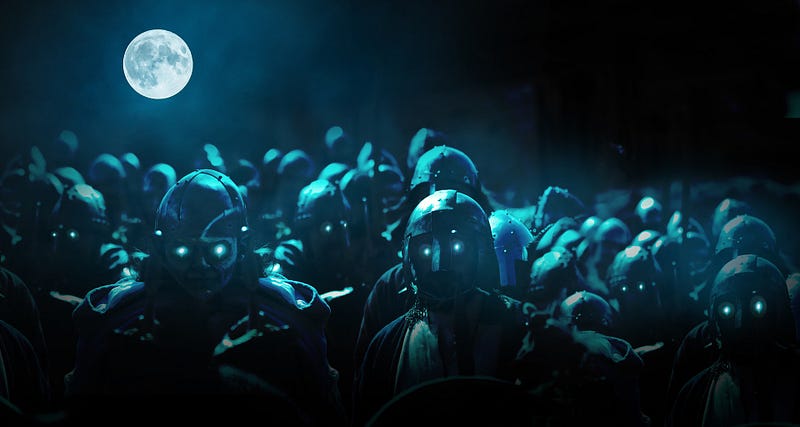
Zombie around you
If it seems to you that there are zombies all around you, don’t be so quick to dismiss such feelings. It may soon turn out that:
- Your observation is not a hallucination.
- You are not one of them.
- You won’t be able to think about people the way you used to.
This discovery can be painful and uncomfortable and seriously affect your worldview. The author hopes this article will help you deal with such a crisis.
We use the term ‘zombies’ here not in a derogatory but epistemological sense. We will discuss the details later, but for now, let’s agree to consider ‘zombies’ as individuals whose collective behavior appears purposeful but unconscious. Thus, this behavior is perceived as a process that follows its internal logic and can contradict the individuals’ interests if we consider the latter as rational agents.
Zombie of action
Manifestations of such behavior can be observed everywhere; not all are noticeable, but some signal a genuine disaster.
Let’s take, for example, the phenomenon of Black Friday. Many people perceive this day as an extraordinary event and prepare for it in advance, even though, as it may seem, something like a discount, even up to 90%, is not significant for ordinary consumer goods. It’s not high art or elite real estate, so the advantageous acquisition of such items can be considered pleasant trivialities of life, but certainly not pivotal moments of human existence.
But the perception of zombies exists in a different coordinate system. Black Friday triggers a pattern of extreme behavior in their minds as if it were a matter of acquiring magical artifacts without which human existence is threatened. Transforming into an exalted crowd, the shoppers lose entirely their human appearance and even their spatial orientation. The overcrowding leads to stampedes and severe safety issues: zombies push each other, try to jostle and trample one another, causing injuries and even death.
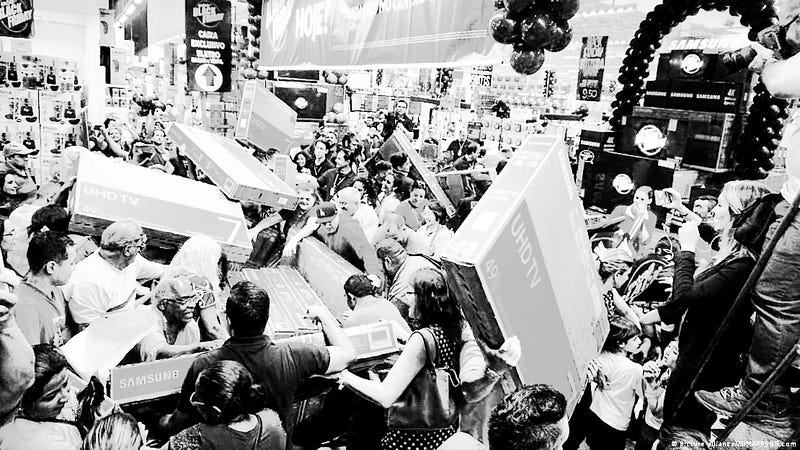
Fortunately, such excesses do not always occur, but they still happen regularly.
Another trigger for launching the zombie behavior pattern is political events, such as the presidential race. Undoubtedly, we owe a lot to D. Trump, who has contributed greatly to helping us all see zombies in all their glory. Truly, he has risen to become the champion among American politicians who have ever appealed to the zombie instincts of the crowds. While his deliberately rude and provocative slogans have pushed away many conservatives and right-wingers, they have had the opposite effect on his fans: The Orange Man instantly became a cult figure whom the exhilarated crowds seemed ready to follow even into hell.
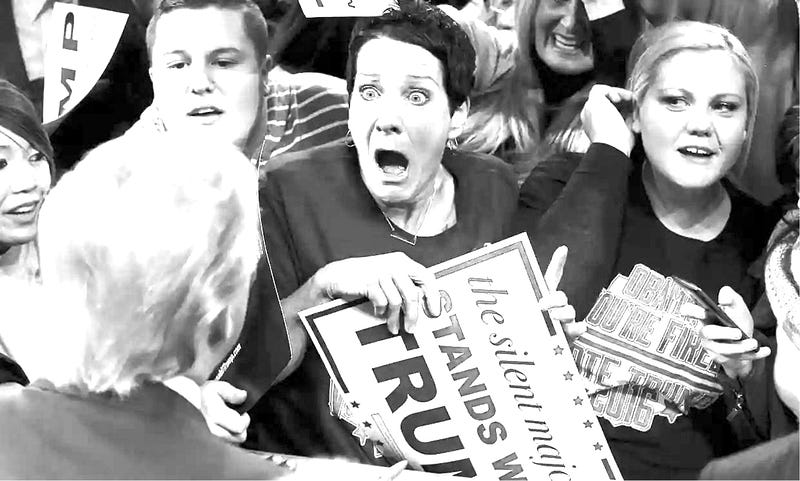
Those who anticipated a zombie apocalypse were not mistaken in their premonitions. On January 6, 2021, having lost the repeat elections, with his inflammatory speech against the ‘enemies’ who ‘stole the presidency’ from him, he managed to provoke his fans into storming the Capitol building.
Now we know this day in the history of the United States as the January 6 insurrection, an event as absurd as it is tragic.
The problem with the behavior mentioned above is not so much the seriousness of the consequences but rather the fact that the individual cannot comprehend their actions before, during, or after their execution. Each time, they simply follow the behavioral zombie pattern without gaining any experience that would allow them to adjust their actions in the future.
Thus, the behavioral pattern of zombies is simultaneously irrational, predictable, and irreversible.
Zombie of docility
However, the zombie pattern manifests not only in crowds’ agitated or violent behavior. It can be quite the opposite when expressed in their unquestioning obedience, the consequences of which can be equally devastating. This obedience is necessary for the most horrifying human calamity — war.
War is happening right now, in the 21st century, in Europe. Putin staged this war in the most brutal manner, without any legitimate grounds whatsoever.
Could anyone have imagined this just a couple of years ago? No one could, except for a few madmen. But the madmen turned out to be right. Why did this become possible?
Someone might say it’s because the leader of a nuclear-armed country turned out to be a complete sociopath and villain and, unfortunately, clever enough to subjugate others under his power. That is true, but we should not overestimate the power of his leadership. It would be powerless if it didn’t rely on a zombified majority.
These are many of those “normal” people you see around you daily. Most are not villains; they simply do what they are told.
Think about it for a moment — they simply do what they are told to do.
They are told to go to the slaughter, and that is precisely what they do — like a flock of sheep mindlessly wandering to where they will be turned into fertilizer.
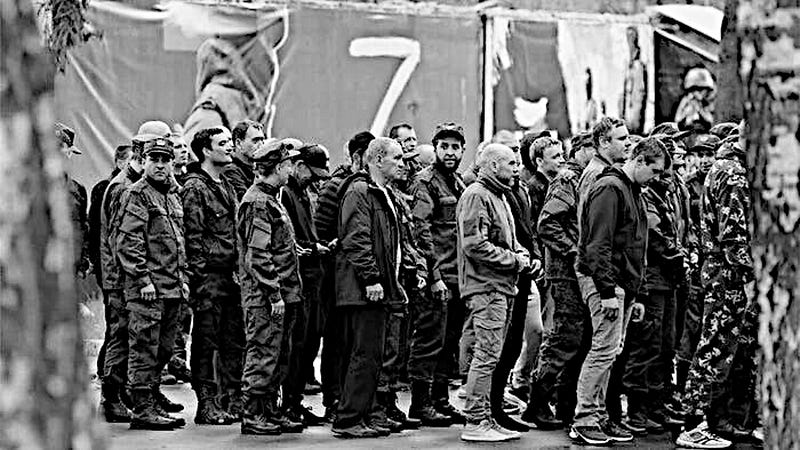
And they do. The exact number of those who have already turned from animated zombies to dead zombies is unknown, but according to general consensus, the figure is impressive, probably somewhere between 100,000 and 200,000. And all of this continues.
Do you think they were forced, had no choice, or something like that? There were also such people, but most find themselves in such a situation not because of insurmountable circumstances. Even in a country with almost no freedoms and rights, there are sufficient legal opportunities to avoid being sent to slaughter. Discovering them was simple — as soon as the war began, a ton of materials appeared on YouTube and Telegram channels, providing detailed instructions to Russians on how to act to avoid being reduced to nothing.
But the thought of avoiding it did not occur to those who had already turned into zombies and could not come.
Out of time and morality
It’s not about the circumstances; it’s the circumstances that become possible because the majority perceives them as the natural order of things. Zombies do not realize that this order did not always exist. That is the very moment that is overlooked when considering the behavior of the zombie mass: they exist outside of time. They only have the present moment, without a past or future, the eternal Groundhog Day. They simply have nothing to compare it to.
This fact helps us to understand a lot about the modus operandi of zombies — they do what they are commanded without considering the moral content of the instruction. That does not mean that they do everything they are told. It means that they automatically obey directives.
Therefore, it is meaningless to ask why they follow immoral directives; it is more appropriate to ask what message they perceive as a directive. The answer is simple — any message comes from someone they recognize as an unquestionable authority, such as someone possessing formal institutional power. Failure to comply with a directive means a conflict with the social norm accepted at the moment, and such a conflict is unacceptable in their worldview. If such a norm contradicts human universals on which civilized society is based, again, it does not cause any cognitive dissonance in them. Since in the consciousness of zombies, due to the absence of reflective representation of time, there is no process of formation of values, then there are also no universals.
So,
- If the norm here and now is military aggression against another country, they will participate in that aggression.
- If the norm is persecuting people based on ethnic/racial/religious grounds, they will persecute those individuals.
- If the norm is bullying other people on social media, they will bully those people.
- If the norm is snitching, they will snitch on their neighbors, friends, and loved ones.
- If cannibalism becomes the norm, they will engage in cannibalism, perhaps not the current generation, but the next.
That does not mean that zombies are villains. This moral evaluation is not applicable to them because social norms replace moral beliefs in the consciousness of zombies. In other words, zombies have no moral convictions. The actions of zombies fit perfectly into the behaviorist scheme of stimulus-response-reinforcement. Social norms can change drastically even within the same society in a short period, and the behavior of zombies immediately adjusts to them.
An excellent example of such an adaptation of zombies, similar to the example of Putin’s Russia, is Germany before and after Hitler came to power. When the Nazis took control, the norm became political persecution, concentration camps, and war. The majority of the population quickly accepted these norms, although a few years earlier, it would have seemed impossible.
Some researchers are inclined to explain the wide support for the Nazis by objective circumstances — the severe economic situation in Germany, the humiliating Treaty of Versailles, the rise of nationalism, and so on. All of this is true, but again, these are just circumstances. Acceptance of sending people to gas chambers as a norm is not a consequence of circumstances but a consequence of social zombie-conformism. When the majority agrees that it is normal, who dares to go against the majority? This observation led Hannah Arendt to the assumption of the banality of evil, which cost her the rupture of relationships with some friends and colleagues.
Zombies, non-zombies, and anti‑zombies
Anti-zombie
Meanwhile, we know that some people go against the majority opinion. These are the anti-zombies, and their existence serves as confirming evidence of the existence of zombies.
Zombies have existed, exist, and apparently will exist everywhere and always. The same goes for anti-zombies — they exist as long as zombies exist. These are two ontologically mirrored and, therefore, inseparable entities. Zombies outnumber anti-zombies, but the latter also exist. They existed in Germany as well. Ordinary people, including some military personnel, refused to follow the inhumane norms of the Nazis. Yes, they could not openly express their disagreement, but they expressed it through action when possible. Some refused to persecute dissenters, some saved Jews, and some participated in the resistance.
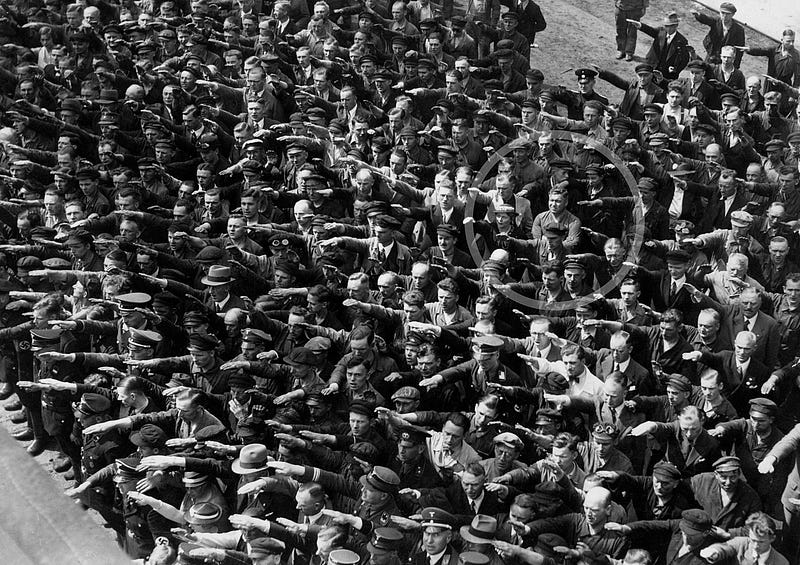
History repeats itself every time. And every time, the majority turns into zombies.
Why?
Non-zombie
Of course, there are many people who cannot be classified as either zombies or anti-zombies. These individuals generally do not follow the zombie behavior pattern described earlier but prefer not to oppose the zombies. Their position is best characterized as adaptive. We will include them and the anti-zombies in the general category of ‘non-zombies,’ referring to individuals capable of recognizing the specificities of zombie behavior in others.
About terminology
Now is the time to turn to the origins of the terminology used.
The word “zombie” is usually associated with pop culture but is also used in philosophy. The first image is associated with voodooism and the folklore of Haiti and other Caribbean countries, but it is not associated with flesh-eating. This connotation began to spread in Western popular culture, especially after the emergence of movies like George Romero’s “Night of the Living Dead.”
The concept of a philosophical zombie is part of the discourse on the nature of consciousness, involving participants such as Thomas Nagel, David Chalmers, Daniel Dennett, Saul Kripke, and other cognitive philosophers. This zombie image is a hypothetical being that outwardly resembles a regular human but lacks subjective experience (see the above remark about the absence of a sense of time in zombies). It does not sense its “self,” that is, it does not possess what philosophers call “sameness” (referring to the earlier mentioned behaviorist concept).
The pop culture zombie has become an icon of the entertainment industry. Its image is actively exploited, including for the amusement of zombies. The philosophical zombie influences debates on consciousness and the philosophy of mind.
Where do zombies come from?
So, how does zombification occur?
Let’s start with the question of “when?”
When?
Onset: Zombification begins in a predisposed individual from childhood, starting with socialization.
Completion: Typically, zombie formation is completed no later than the end of the pubertal period.
How?
By conforming to societal zombie rules contrary to the internal demand to act rightly (as philosophers say — due to moral intuition).
Why?
We intend to consider three perspectives for explaining the phenomenon of zombies — social, anthropological, and evolutionary.
1. Social perspective
The advantage of zombification for individuals lies in satisfying their needs with minimal bioenergy costs. It is safe and cheap, as justifying the expectations of the surrounding zombies brings social rewards. Non-compliance, on the other hand, leads to regular punishment, up to ostracism — within the family, at school, in college, in university, at work, and so on, in any social environment.
The zombification process has simple and intuitively understandable rules and is easy to fit into and follow. It doesn’t require high intelligence or talent; all you have to do is always agree to do what the majority does, regardless of what it is. Just do it, and you will be perceived as ‘normal.’
Eventually, the worldview of an individual turning into a zombie becomes hollowed out and replaced by a scheme that fits into the same behaviorist pattern of stimulus-response-reinforcement. Although this pattern represents a simplified interaction order between the individual and the surrounding world, it is sufficient for zombies. It benefits them by allowing them to preserve the mental energy that anti-zombies spend exploring the context of ambiguous situations.
2. Anthropological perspective
For a proper understanding of the essence of zombies, two facts are particularly important:
- As already noted, not everyone turns into a zombie.
- Zombification is only, to a small extent, a question of environment and upbringing. Of course, both are important, but zombie predisposition is an innate characteristic of a specific portion of the population.
A contradictory and not particularly pleasant fact of human history is that zombies’ presence and numerical dominance among people have been essential conditions for social evolution.
Because someone had to play the role of a functioning, non-thinking instrument.
Indeed, if everyone were to engage in reasoning, too few individuals would be willing to implement the plans of those who consider themselves entitled to command others. Without the realization of the ambitions of these individuals, we would either have a completely different civilization or no civilization at all.
The contradiction lies in the price generations pay to construct this civilization. Those concerned with perpetuating their names in history are rarely worrying about the fate of others. Mass violence has always been the most effective means of realizing their plans, to which they invariably resort, gaining confidence in their superiority over political rivals or neighboring peoples and states. And for their subjects to agree to engage in mass violence against other people, their consciousness needs to be brought into the appropriate state. In other words, their zombification is necessary.
It has worked at all times and continues to work to this day. But let us emphasize, once again, not with everyone.
In every society, there are always dissenters who lack herd mentality and whose moral intuition does not contradict reason. They are always there, appearing as the black sheep. Even in the most civilized society, they are often met with incomprehension and frequently with irritation and even hatred (Socrates was the most famous historical figure of this kind). And in an uncivilized (i.e., unfree) society, life can become unbearable for them. Many of them eventually become prisoners of conscience.
So, let us note that
while one part of the Homo sapiens population is predisposed to zombification, another part is immune to it. There is a discrete distinction between these parts, which leads to a conflict of latent alienation.
3. Evolutionary perspective
3.1 Not a blank slate
Certainly, the phenomenon of unconscious mass behavior and its destructive consequences has not gone unnoticed by thinkers since at least ancient times. However, it only became the subject of systematic study in modern times with the development of psychology, psychoanalysis, sociology, and related disciplines. This interest was largely driven by the desire to understand the causes of major social upheavals that occurred in Europe from the end of the Enlightenment and became particularly significant in the final stages of the formation of industrial society. The actions of the masses were a key element in all of these events.
Some research works have offered insightful perspectives on this issue, including classics such as Gustave Le Bon’s “The Crowd: A Study of the Popular Mind” (1895), Ortega y Gasset’s “The Revolt of the Masses” (1930), Elias Canetti’s “Crowds and Power” (1969), or Jean Baudrillard’s “In the Shadow of the Silent Majorities” (1978). However, these thinkers’ views cannot be considered comprehensive since they did not address, and perhaps, could not address, the crucial aspect of human nature — the evolutionary heritage of humans as a biological species. From approximately the mid-20th century, the state of affairs in this field began to change. It became the subject of study in two branches of evolutionary biology — sociobiology and evolutionary psychology — that emerged in the last quarter of the previous century.
They postulate the existence of evolutionarily determined mental qualities in Homo sapiens that influence social structure and interpersonal relationships. For sociobiology, humans are part of the general knowledge about animal social behavior. It investigates evolved cooperation, aggression, and mating strategies and how they contribute to reproductive success. On the other hand, evolutionary psychology is focused on humans. It explores the psychological mechanisms and processes that have developed in humans and seeks to understand how they were shaped by natural selection.
Both disciplines decisively reject the orthodoxy of humans as a blank slate — creatures whose moral worldview and actions are solely shaped by their cultural environment (while not diminishing the role of culture in the formation and development of human society).
However, this scientific initiative has faced fierce criticism from various quarters, culminating in the so-called “Sociobiology wars” since the mid-1970s. Much of this criticism comes from the social sciences, which traditionally claim to hold true knowledge about human beings. However, none of them has proven the validity of their claims, nor do they rely on a reliable scientific methodology. Sociobiology and evolutionary psychology seek to fill this gap by offering a synthesis of two major directions in anthropological research. We find this approach most promising and will adhere to it.
Thus, based on the observations above, we consider the existence of zombies among humans not only as a symbolic metaphor but also as an empirically substantiated social fact. However, unlike Durkheimian sociology, we do not consider it sufficient to focus solely on social facts. Instead, we aim to elucidate the evolutionarily determined causes of the phenomenon under consideration.
However, we should begin not with genes as such but with the philosophical aspect of Homo sapiens’ consciousness and its influence on the societal understanding of humanity.
3.2 What do humans need consciousness?
Zombie behavior has never been regarded as a systemic problem in Western society. Such an epistemology concerning real people was inconceivable because the core of the social ideology is based on the belief that humans are rational agents. If their behavior becomes irrational, it is interpreted as a kind of anomaly arising from an unfortunate combination of circumstances rather than a lack of cognitive functions capable of controlling that behavior.
However, this belief is not supported by evidence. The fact that humans can act rationally does not imply their ability or desire to comprehend the cumulative consequences of their actions from a moral perspective. While the former is a task of intellect, the latter is a characteristic of sapience. No one denies the presence of intellect in humans, but it also exists in all highly organized animals, and even birds, and its existence does not guarantee possession of reason. Whether humans possess reason and which individuals have it is an entirely different question. Meanwhile, manifestations of collective unconscious leading to group conflicts and actions contradicting not only commonly accepted social morality, but often basic common sense are so numerous and widespread that this question cannot be considered groundless.
This problem is exacerbated by the controversy among cognitive scientists who have not yet reached a consensus on the expediency of self-awareness. Therefore, it is unclear why all humans cannot simply be zombies. It is evident that, like animals, they perform most of their actions automatically through instinctive programs capable of generating extremely complex and productive behavior. And we have grounds to believe that this was sufficient for the activities of Homo sapiens for tens of thousands of years.
Paleoanthropologists have found virtually no traces of immaterial thinking in humans for most of our species’ history. The tools they created were as primitive as those of Neanderthals and even Homo erectus, and examples of art are also absent. Everything suggests that our species had no technological or social progress for a long time. The consciousness of these individuals likely did not differ significantly from that of our archaic predecessors.
But approximately 40,000–50,000 years ago, everything changed. Complex tools, art, and rituals appeared. It seems that Homo sapiens acquired the ability to see the world around them and themselves in that world. This pivotal moment is now known as the ‘cognitive revolution.’
3.3 Mental divergence within species
At this point, it is customary to praise the awakening of the human mind but let’s not rush into it. Because we have no evidence that these dramatic changes affected the entire human population. The confirming evidence of something else can be observed even now: only a small fraction of people demonstrate meaningful activity, while the majority do not strive beyond mechanically performed routines. That prompts us to see the cognitive revolution not as the awakening of the human mind but as a mental divergence within our species.
Why could this divergence have occurred? We cannot know for sure, but we believe that the transition of Homo sapiens to eusociality, the most advanced form of population organization, could be the reason.
The key characteristics of eusociality are:
- Specialization of individual tasks
- High level of cooperation
- Presence of a hierarchical structure
- Systematic distribution of resources
- Organized care for offspring, etc.
The advantage of eusociality lies in providing the community of organisms with an unprecedented level of stability, unparalleled in the animal world. In particular, ants and termites are the most successful insects on Earth: their populations can number millions of individuals and occupy vast territories. However, eusociality is a very rare phenomenon, found in only a few dozen species. Often, it manifests not only as functional but also as morphological differentiation of population members facilitated by gene plasticity. Although all individuals share the same genome, representatives of different castes look different and perform functions specific to their caste. For example, eusocial insect populations consist of soldier, worker, and forager castes. Bees and wasps have similar castes, including workers, queens, and males.
Among highly organized animals, naked mole rats are the most well-known. Despite an evolutionary gap between them and insects, their behavior includes similar eusocial characteristics: each colony has a reproductive female, several mating males, and non-reproductive worker individuals (both male and female).
Evolutionary biologists consider Homo sapiens a eusocial species partly because human communities rely on the same characteristic principles of specialization, cooperation, and hierarchical control. That allowed humans to become the dominant species in the world of highly organized animals and, ultimately, to free themselves from the direct influence of natural selection.
Therefore, it can be assumed that the eusocial transition required new skills from humans due to the complexity of the social organization and the need to solve ecological problems. However, nature could not increase the power of the human brain because it would require increasing its volume, which had already reached its maximum — instead, nature optimized different population segments to solve various cognitive tasks. Part of the population predominantly remained at the same cognitive level, continuing to solve basic tasks of tribal existence, such as hunting, gathering, and defense against natural threats. But gradually, another part of the population emerged, developing mental characteristics that facilitated humans in overcoming the threshold of primitive existence. The very threshold that our cousins, the Neanderthals, failed to cross.
3.4 Norm and deviation
Thus, we have indirectly approached the answer to the question posed in the article’s title. It is that zombies among humans are not an anomaly. They may be perceived as such by non-zombies but not by the zombies themselves. And if the majority or a significant number of individuals are zombies, then statistically, they are the norm.
It is essential to clarify what is meant by “statistically.” The statistical normality of zombie behavior does not refer to the frequency of such behavior in the overall behavioral repertoire of the population but rather to the ratio of those who consistently demonstrate such behavior in specific situations to those who are not inclined towards it (as mentioned in the earlier examples).
Therefore, it is essentially incorrect to ask where the zombies come from. Zombiness is a fundamental mental characteristic of Homo sapiens, inherent in a significant portion of the population due to their genetic predisposition. It is their relic alter ego, so to speak, masked by the cultural layers of modern life until the zombie behavioral pattern is triggered.
When discussed philosophically, the unconditional rationality of humans (i.e., the rationality of each individual of Homo sapiens) is an illusion arising from widespread ideological bias, historically conditioned. In reality, this rationality is quite conditional. Not every representative of our species is sapient, but only those capable of conscious moral actions that go beyond the zombie pattern, as opposed to those whose behavior is entirely determined by it.
Therefore, let us emphasize the following important point:
Zombiness is a statistical norm in the human population.
Evolutionary expediency of anti-zombies
Additional measurement
If you are not a zombie (and since you have read up to this point, that is indeed the case), then you are, in a certain sense, a privileged individual. You will not become cannon fodder for Putin, a stampede victim during Black Friday, or responsible for electing some Hitler-like person as the president of planet Earth.
That is because you can reason, whereas a zombie’s mental structure only allows for reactions.
Now, let us take a step back and complement the emerging picture with details of why individuals like yourself are necessary for the evolution of Homo sapiens.
Of course, evolution does not have intentions in the way we commonly think of them. However, this does not mean that it lacks direction. Regardless of any challenges to this hypothesis, it is no less useful than any other logically grounded hypothesis.
Specifically, it provides room for explaining the purposefulness of transcendent reason (not to be confused with intelligence) and, consequently, the existence of anti-zombies. We observe this purposefulness in ensuring the survival of the human species from an extended evolutionary perspective.
Surplus genetic diversity
Any population can face unexpected challenges from its environment. To cope with such challenges, that population must possess a sufficient diverse gene pool for adaptation within an acceptable timeframe. Evidence of such human diversity can be seen in individuals with mentalities that deviate from the statistical norm. Some exhibit exceptional creative abilities, some may be identified as neurodivergent, and others may simply appear peculiar to the average person.
In all likelihood, in a prehistoric society, most of these individuals’ exceptional abilities would not have been in demand. It is difficult to imagine, for example, the outstanding contributions of individuals like Albert Einstein or Alan Turing to the well-being of a primitive tribe. Their intellects seem to have been designed to comprehend intricate abstractions that did not exist in pristine reality. Thus, one can argue that neither Einstein, Turing, nor similar minds could have existed in that society. However, the genes that underlie the abilities of such individuals did exist back then. They simply were not activated within the population (perhaps the focus should not be solely on genes but also on epigenetic mechanisms, i.e., gene expression, but this does not change the essence). The emergence of these genes on the societal stage occurred later when the development of civilization made them valuable.
Among biologists, there is a saying, “Evolution is cleverer than you are,” and in many ways, it is true. Its inheritance mechanism appears to be so powerful and flexible that it seems as if evolution itself knows in advance what could happen to a species. Of course, evolution does not possess such knowledge, and this effect is achieved through the recombinant potential of the genome and the species’ ability to regulate gene expression in response to environmental conditions. So far, this has been sufficient for our species to overcome all its challenges.
Therefore, we can speculate that
the emergence of anti-zombies results from an epigenetic reprogramming of Homo sapiens in response to changing conditions in its prehistoric habitat.
Purpose of Transcendent Reason
System failure
What role could this species segment have played in eusocial transformation? We are still unsure if self-awareness was even necessary for our species’ survival. What if the existence of non-zombies is nothing more than an evolutionary epiphenomenon?
We have arguments against such skepticism inspired by systems theory.
It is known that every system is prone to failures, and the more complex it is, the more serious the consequences can be. Eusocial communities are much more intricate than ordinary ones because their members interact according to a unified algorithm. In this system, everything is interconnected, and an error in the processing circuit can lead to a domino effect with fatal consequences.
An example of this can be seen in the systemic failure of an ant colony known as the “ant mill.” It appears as a circular movement of insects involving more and more individuals, continuing until all participants die of exhaustion. That occurs due to accidental overlap of the so-called pheromone trail left by ants while searching for food for the colony. The essence is as follows: the more ants have traveled along a particular path, the stronger it smells and the more attractive it becomes to others. Therefore, if a few ants’ paths accidentally form a loop, they quickly make this “loop” highly scented, attracting more and more insects. Escaping from this situation becomes impossible because the pheromone trail is strongest within the “loop.”
Supersystemic surveillance
The problem here is that comprehensive control over the system’s state is impossible due to the absence of a supervisory subject. It is only carried out at the level of system agents. The system can collapse if each agent functions properly, but their interactions no longer satisfy the systemic goal-setting.
Is human society susceptible to such failures? There is no doubt about it. Perhaps the most vivid example of such a failure is World War I. It could be described as an unintentional attempt at the suicide of European civilization. No one desired the war’s outcome, but few could foresee it. Each conflicting side was convinced that it was functioning correctly. Still, their interactions contradicted its interests when considering them as components of a unified civilization system (interacting within the framework of common downward causation).
Awareness of this problem led to the creation of the League of Nations in 1920. Essentially, it was an attempt to establish the very supervisory body that could regulate the interaction of system components. Although this attempt proved unsuccessful, it demonstrates the mind’s aspiration for a transcendent understanding of reality. As we know, the United Nations succeeded the League of Nations, and overall, the efforts of various international organizations to collectively address common problems of modern society are evident.
However, once again, we should not indulge in unfounded confidence that sapience is a characteristic of the human species realized in every individual. It is possible to assume the probability of such realization with certain individual development, but that is another problem (clearly extremely complex in moral, political, and practical senses). The reality is that some of our fellow beings are sapient, while others remain latent zombies for tens of thousands of years. The perception of these two groups is so different that one could speak of them as different subspecies of Homo sapiens, physiologically identical but mentally incompatible. This incompatibility is rarely noticeable in ordinary life. Still, when a representative of one subspecies finds themselves in the environment of another, it becomes evident, and this applies to both sides.
Therefore, if we accept the thesis of the latent-alienated coexistence of zombies and non-zombies, we will see a new perspective in explaining many past, present, and likely future events in world history.
Zombies and Modernity
Undoubtedly, if only zombies remained on Earth, civilization would instantly regress to a state of barbarism, if not savagery. Zombies never create anything since such a need simply does not exist for them. Their relationship with the surrounding world is limited to satisfying immediate needs, even if they can take the form of some culture-like demands. In reality, the cultural demands of zombies are nothing more than the result of mechanically assimilating the most frequent memetic messages from the external world. In this sense, their perceptual matrix does not differ from that of primitive humans. In fact, zombie culture’s attributes often embody the attributes of an archaic, barbaric worldview, such as extensive tattooing (tribal body painting), excessive piercings (ritualistic/septum piercing), or garish, tasteless clothing and accessories.
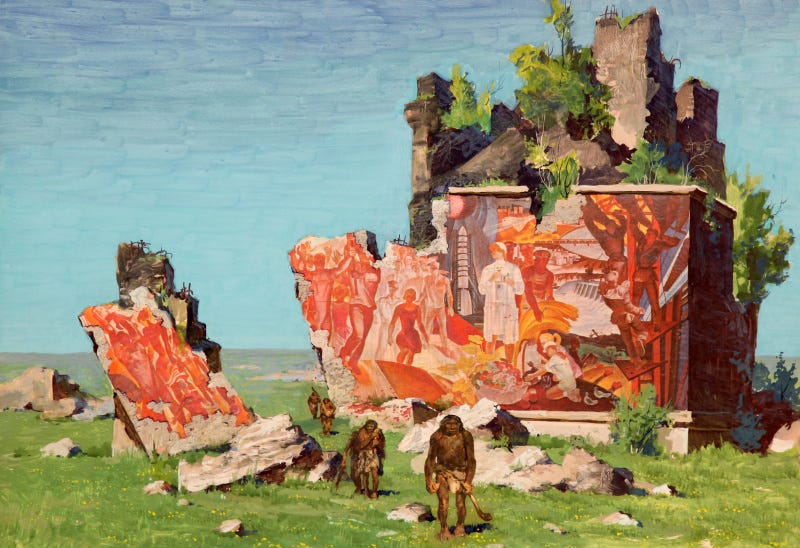
Naturally, those who view these individuals as a consumable resource actively exploit the mechanical nature of zombie consciousness. Zombies have practical significance as long as they are integrated into the economic and political system of modern society: they are needed by privileged classes as producers of material goods and services, as consumers that drive mass demand, and finally, as political actors.
The latter is the main reason for upholding the myth of universal suffrage democracy as the only permissible political system in a free society. Recognizing zombies among humans would necessitate a reevaluation of this principle and likely introduce some form of weighted democracy based on the assessment of voters’ actual ability to make unbiased judgments. Although this would not guarantee the eradication of political corruption, fair distribution of public welfare, or the elimination of societal ills, it would enable progress along this path and ultimately create a truly just and sustainable society.
Zombies and the future
But it doesn’t seem likely that such a turn of events will occur in the foreseeable future, as, as we noted, the zombie majority is advantageous to the current privileged classes. They are concerned with keeping as much of the population as possible under control, utilizing the full power of the propaganda machine at their disposal. Cultural norms that suppress the development of critical thinking are constantly and relentlessly imposed on the public, while traditional Western values such as a commitment to truth, justice, virtue, and the pursuit of wisdom are deliberately, cynically, and methodically displaced by the ideology of mindless, shallow, and corrupting consumerism.
Since this kind of care is entirely selfish, elites will gradually dispose of zombies.
When will this happen? It will occur when they lose their consumer and productive value. For now, they are still needed to legitimize the existence of the ruling class, create the appearance of democracy, perform menial tasks necessary for the system’s functioning, and drive corporate growth and consumer demand. However, as we approach the era of total automation, they will become a greater burden for those who still depend on them. Just as zombies have no concept of the past and future, they are not needed in this future.
But what will happen to them in the future and how it will unfold is another story.
You also may like my other stories like these:
Dear reader, subscribe to my updates and share your best thoughts on our present and future through philosophical lens!


