avatarsrgg6701

Free AI web copilot to create summaries, insights and extended knowledge, download it at here

6573

Abstract

erse. Being the medium of reason, Man played a non-random role in this grand process. His sphere of activity was not limited to the bounds of the Earth. His mission was an infinite expansion of Reason, reclaiming more and more living space from the universal void.</p><h2 id="4f35">2. Philosophy of Nature</h2><p id="90ed">For <b>the second</b> school, a proper name would be “Philosophy of Nature.” Its representatives could be named as Empedocles, Hume, Boden, Rousseau, Schelling, Goethe, Schopenhauer, Kierkegaard, Nietzsche, Marx, Freud, Husserl, Heidegger, Sartre, and some others (including E.O. Wilson, the creator of sociobiology).</p><p id="3488">These thinkers focused on <i>human nature</i>, which they considered a limit to what humans can achieve. They did not believe in the transcendent essence of Reason and assigned it a modest role as a “slave to passions.” Humans were destined to have a place here on Earth. The stars remained unreachable, alien and hostile, or ignored.</p><h1 id="2c22">Why not go further?</h1><p id="051d">Explosive technological development gives these lines of thought a particular urgency. If it can free Man from biological limitations, then the philosophical aspect of the problem becomes crucial for the future of the human race.</p><figure id="f5f7"><img src="https://cdn-images-1.readmedium.com/v2/resize:fit:800/1*hpWBvYnO5bS4Uv2sLbBPdw.jpeg"><figcaption>Photo by Tara Winstead: <a href="https://www.pexels.com/ru-ru/photo/8386422/">https://www.pexels.com/ru-ru/photo/8386422/</a></figcaption></figure><p id="49a8">On the one hand, using technology to achieve goals contradictory to human nature can be catastrophic. It can lead to Man’s self-destruction or losing his essential integrity. We may cease to exist in all senses — as a free society, species, or sentient beings.</p><p id="522e">But on the other hand, if we unreasonably reject technologies that can solve humanity’s most pressing problems, the consequences can be equally unacceptable.</p><p id="67f2">The universe has never cared about coordinating its plans with living beings. They have always had to adapt to its cruel whims. The history of life on Earth is a series of extinctions, and Homo Sapiens is not immune from such a nuisance. They obtained a unique chance to avoid the fate of other species not because of their unity with nature but because they overcame their dependence on it and learned to control it in many ways. In this sense, they have already got detached from their biological roots.</p><p id="3289">Why not go further?</p><h1 id="b5c6">Human Essence and Intelligence</h1><p id="657b">Those who object to intrusions into human nature ignore that it was shaped not only by the natural environment in which our ancestors lived. To no less extent, it was also created by their evolving intelligence.</p><p id="21c9">The evolution of Homo sapiens proceeded much faster than that of other species, and their brain was the most rapidly developing organ. The capacity of this repository of intelligence increased at unprecedented rates. This dynamic had an exponential character:</p><figure id="1a50"><img src="https://cdn-images-1.readmedium.com/v2/resize:fit:800/1*CKtDR83P_5jUziyN-FpAeg.jpeg"><figcaption>By Authors of the study: Brian Villmoare and Mark Grabowski — <a href="https://www.frontiersin.org/articles/10.3389/fevo.2022.963568/full">https://www.frontiersin.org/articles/10.3389/fevo.2022.963568/full</a>, CC BY 4.0, <a href="https://commons.wikimedia.org/w/index.php?curid=122405325">https://commons.wikimedia.org/w/index.php?curid=122405325</a></figcaption></figure><p id="8fcf">It became possible as humans used to invent meaningful ways of interacting with their habitat. The human developing mind was able to accomplish what animal instincts were unable to do.</p><p id="9619">That was a process of a positive feedback loop involving factors such as the transition to a protein-rich diet, intellectual collective interaction, and, finally, the development of speech and abstract (symbolic) thinking.</p><p id="ef08">Over time, this connection became more complex and mediated and increasingly determined by the impact of human culture. And in the industrial and especially the information age, culture, in turn, came under the enormous influence of technology.</p><h1 id="8b16">The only constant</h1><p id="dc08">Therefore, our intelligence is the most important contributor to the formation of human nature. At the same time, intelligence itself is dynamically shaped by the conditions of human existence and our collective experience.</p><p id="1619">That leads to the conclusion that <b>intelligence is the only constant</b> in human essence, abstracted from human animality.</p><p id="0c3f">More precisely, it is not intelligence itself but the <b>ability for abstract thinking</b>. This clarification is essential since all living beings possess intelligence to some extent, albeit to different degrees. But only Homo Sapiens can think abstractly.</p><figure id="5dc5"><img src="https://cdn-images-1.readmedium.com/v2/resize:fit:800/1*QhJDWeyqHwX8uXZBQtGNBA.jpeg"><figcaption>Image by <a href="https://pixabay.com/users/kellepics-4893063/?utm_source=link-attribution&amp;utm_medium=referral&amp;utm_campaign=image&amp;utm_content=2879946">Stefan Keller</a> from <a href="https://pixabay.com//?utm_source=link-attribution&amp;utm_medium=referral&amp;utm_campaign=image&amp;utm_content=2879946">Pixabay</a></figcaption></figure><p id="72e7">Here, the Philosophy of Nature hastily presents to its rival its main argument — the subordination of Reason to passions. It is this threshold that the latter must overcome to prove its transcendence.</p><h1 id="99bb">Transcendence of Reason</h1><p id="ffc3">But is Reason indeed a transcendent essence?</p><p id="b4f8">The honest answer is that we do not know for sure. The future will reveal this. But now we can try to understand why there is such hope.</p><p id="408d">So, what is Reason?</p><p id="3848">It is necessary to clarify that we are talking about Reason, which is not what Intelligence is. There is often confusion between these concepts, and bringing definitions for them to a common denominator is useful.</p><p id="9907">Then what we have so far called <i>Reason</i> should be called “objective reason” (metaphysical essence), and Intelligence — “instrumental reason” (utilitarian essence).</p><p id="cbbd">Instrumental reason is nothing more than a tool for solving technical tasks that ensure the specimen’s survival and the transfer of its genes into the futur

Options

e.</p><p id="6f18">Objective reason is a superstructure over instrumental reason. It tries to represent the relationship between all phenomena in the Universe comprehensively.</p><p id="72dd">Armed with this understanding, we <b>can</b> consider the nature of objective reason transcendent. Its horizons of aspirations are not limited by anything. It can be called a manifestation of the self-awareness of the Universe expressed through the consciousness of the only known intelligent being — Man.</p><p id="d18e">In a sense, this is a phenomenon of the Absolute. But human reason is structurally similar to objective reason, projected onto a cosmic scale.</p><p id="0a73" type="7">This connection between human reason and objective reason as the Absolute is the continuity value between Man as a representative of the Homo sapiens species and the posthuman medium of Reason.</p><h1 id="fee6">Humanism, Transhumanism, and Posthumanism</h1><p id="5b30">It is impossible to anticipate what the posthuman era will be like. Transhumanism is a concept that aims to facilitate this transition, but in our view, it suffers from a lack of a reliable ideological basis necessary to convince the public of the feasibility and moral acceptability of such a transition. Therefore, it is vulnerable to criticism and remains a marginal movement.</p><p id="1e7b">Transhumanism is concerned with using scientific advancements to enhance human physical and cognitive abilities and ultimately achieve physical immortality. It does not shy away from intervening in human nature through genetic engineering. However, it fails to explain the meaning of human existence relevant to the posthuman transition. In this sense, it does not go beyond its predecessor Humanism.</p><p id="b90f">For humanists, the ultimate value is human beings themselves. This limit was natural for the worldview of people living on the cusp of the Middle and Modern Ages, but the posthuman era will be completely different from all of human history: humans can change beyond recognition and eventually disappear. Technologies can ensure continuity between humans and posthumans but can also destroy it.</p><p id="5bd0" type="7">If we do not want the history of humankind to be interrupted, we must understand what the value of human beings is, preserve it, and pass it on to the successors of Homo Sapiens.</p><p id="3c87">Transhumanism does not focus on the problem of value continuity. That is why we find the reason for the lack of widespread interest in it. Most likely, even when technologies allow for implementing the requirements it proposes, their realization will be based on another idea, which is more philosophically consistent than transhumanism, although it intersects with it in many ways.</p><h1 id="6b04">Conclusion</h1><p id="cd92">In the first quarter of the 21st century, the posthuman transition may seem like a distant prospect, but it is already a pressing issue for those who are concerned about the fate of mankind.</p><p id="5353">The advent of the posthuman era is an objective consequence of the development of modern technologies and their penetration into social life. Sooner or later, this era will come. For the transition to be peaceful, people need to have faith in its feasibility, and civilizational institutions should be able to control this process.</p><p id="cbd8">That can only be achieved with an appropriate ideological framework that is adequate to the perception of most members of society. <b>It must replace the spiritual emptiness and nihilism</b> that have arisen after the widespread abandonment of religion.</p><p id="61b4">Creating such a framework is a crucial task for thinkers passionate about contributing to the further development of humanity.</p><p id="7c0b" type="7">Undoubtedly, this is a colossal intellectual challenge for society’s most thoughtful and progressive part.</p><p id="9f4c">But it can and should be resolved if we want to believe that we, as possessors of Reason, have a destiny beyond our biology.</p><p id="bed2">[1] The term “<a href="https://en.wikipedia.org/wiki/The_Human_Condition">human condition</a>” was introduced into philosophy by the renowned German-American philosopher Hannah Arendt (1906–1975).</p><p id="070a">You also may like <a href="https://medium.com/@sergeykleftzov/lists">my other stories</a> like these:</p><div id="77f6" class="link-block"> <a href="https://readmedium.com/but-if-everything-will-work-without-people-what-will-they-be-needed-for-1f2e42a3eb51"> <div> <div> <h2>But if Everything Will Work Without People, What Will They Be Needed For?</h2> <div><h3>And it could happen very soon</h3></div> <div><p>medium.com</p></div> </div> <div> <div style="background-image: url(https://miro.readmedium.com/v2/resize:fit:320/1*5tZnczI1m5o3aoblfoit6g.jpeg)"></div> </div> </div> </a> </div><div id="0665" class="link-block"> <a href="https://readmedium.com/why-you-should-learn-to-stop-worrying-and-embrace-immortality-b5fa2ef80c81"> <div> <div> <h2>Why You Should Learn To Stop Worrying and Embrace Immortality</h2> <div><h3>Don’t lose your identity, love, and soul in the coming future.</h3></div> <div><p>medium.com</p></div> </div> <div> <div style="background-image: url(https://miro.readmedium.com/v2/resize:fit:320/1*ZAYlI7_4ST20VOB2EMlhkg.jpeg)"></div> </div> </div> </a> </div><div id="d905" class="link-block"> <a href="https://readmedium.com/why-humans-will-strive-to-create-strong-ai-despite-the-threat-it-poses-17dee21bb819"> <div> <div> <h2>Why Humans Will Strive to Create Strong AI Despite the Threat It Poses</h2> <div><h3>Our technology or our nature? Either we disappear or become one with them.</h3></div> <div><p>medium.com</p></div> </div> <div> <div style="background-image: url(https://miro.readmedium.com/v2/resize:fit:320/1*0s0tgVGS9dMMyQFZIUmGNQ.jpeg)"></div> </div> </div> </a> </div><p id="0ed9">Dear reader, <a href="https://sergeykleftzov.medium.com/subscribe">subscribe to my updates</a> and share your best thoughts on our present and future!</p></article></body>

Homo Sapiens as a Problem

What Will Remain of Man When Homo Sapiens Disappear?

Reflections on the continuity of the humane values on the eve of the Posthuman era.
Image by Gerd Altmann from Pixabay

Approaching the tipping point

It is widely believed that in the history of mankind, there have been several transitions between human social arrangements. They are usually indicated as a chain of

hunter-gatherer society → agricultural society → industrial society → informational society.

Each time, the duration of this transition has been shortened, and each subsequent era has become shorter than the previous one.
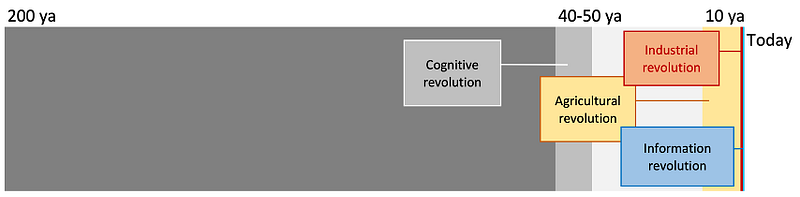
The author’s scheme

It is a typical exponential pattern suggesting that humanity is approaching a moment of radical qualitative change.

Apparently, this will be another point of no return and the consequences of this transition promise to be the most serious compared to all previous ones.

By common agreement, the term Posthumanism is used to refer to this upcoming era. The driver of these changes is the natural human desire to get rid of the burden of human condition[1].

Unknown World

No one can predict what this new world will be like, but everyone agrees that our species will radically transform. Modern biotechnologies already allow us to intervene in the biological nature of humans, and this trend is likely to continue.

Thus, as optimists hope, in the foreseeable future, not only will many diseases be left in the past, but unlimited life extension, reversal of aging, genetic upgrading of the human body, and ultimately, consciousness uploading will be achieved.
Image by Sujo26 from Pixabay

As fantastic — even exotic — as these predictions may seem, no physical laws prevent their implementation. Everything depends on the level of technological development, which also follows exponential dynamics and is stimulated by the demands of the free market.

Ultimately, abstract reflections of philosophers about freeing the soul from the prison of the body can be realized. Although none of them could envision a way to fulfill such a dream, the result will be surprisingly similar: people can disconnect their identity from their bodies. Someday the body may be discarded as unnecessary, clearing the way for the Mind into infinity.

Key question

Some find such a prospect exhilarating, while others find it terrifying. It is possible to understand both parties, as well as those who have not yet decided. Overcoming the limitations of the external world is humanity’s cherished dream. But freedom without understanding how and why to use it is a potentially explosive asset.

There is an apparent paradox in this freedom. The concept of human nature is inextricably linked to human limitations. And if we get rid of them, what will Man become, and will anything human be left in him?

The most radical thinkers — heralds of the new era — go so far as to doubt whether anything should be left of Man at all. They tend to see Homo Sapiens as nothing more than an animal that impedes the achievement of the goals of human reason. However, others, following the tradition established by D. Hume, argue that reason simply has no inherent goals. In this case, renouncing human nature does not mean replacing the animal with some shining intelligent entity but the disappearance of reason itself.

Photo by Alessio Ferretti on Unsplash

Thus, the key question of the inevitable post-humanist transition is as follows: is there something in Man that must be preserved, transmitted, and strengthened in his offspring?

What is the destination of Man?

But what is Man?

The complexity of this question is daunting. Many philosophers have attempted to answer it, but consensus has never been reached and is unlikely to be.

Nevertheless, it is possible to identify at least two schools of thought that represent opposing views on the destiny of Man.

1. Philosophy of Reason

The first could be called the “Philosophy of Reason.” It dates back to Antiquity, to such names as Heraclitus, Plato, Aristotle, and some others. In modern and contemporary times, contributions to its development have been made by thinkers such as Descartes, Leibniz, Spinoza, Kant, Hegel, Teilhard de Chardin, Russian Cosmists, and finally, modern scientists, popularizers of science, and artists such as Carl Sagan, Arthur C. Clarke, Isaac Asimov, film director Stanley Kubrick, and others.

All of these thinkers found in Man a cosmic destiny, considering him as an integral part of the great transformation of the Universe. Being the medium of reason, Man played a non-random role in this grand process. His sphere of activity was not limited to the bounds of the Earth. His mission was an infinite expansion of Reason, reclaiming more and more living space from the universal void.

2. Philosophy of Nature

For the second school, a proper name would be “Philosophy of Nature.” Its representatives could be named as Empedocles, Hume, Boden, Rousseau, Schelling, Goethe, Schopenhauer, Kierkegaard, Nietzsche, Marx, Freud, Husserl, Heidegger, Sartre, and some others (including E.O. Wilson, the creator of sociobiology).

These thinkers focused on human nature, which they considered a limit to what humans can achieve. They did not believe in the transcendent essence of Reason and assigned it a modest role as a “slave to passions.” Humans were destined to have a place here on Earth. The stars remained unreachable, alien and hostile, or ignored.

Why not go further?

Explosive technological development gives these lines of thought a particular urgency. If it can free Man from biological limitations, then the philosophical aspect of the problem becomes crucial for the future of the human race.
Photo by Tara Winstead: https://www.pexels.com/ru-ru/photo/8386422/

On the one hand, using technology to achieve goals contradictory to human nature can be catastrophic. It can lead to Man’s self-destruction or losing his essential integrity. We may cease to exist in all senses — as a free society, species, or sentient beings.

But on the other hand, if we unreasonably reject technologies that can solve humanity’s most pressing problems, the consequences can be equally unacceptable.

The universe has never cared about coordinating its plans with living beings. They have always had to adapt to its cruel whims. The history of life on Earth is a series of extinctions, and Homo Sapiens is not immune from such a nuisance. They obtained a unique chance to avoid the fate of other species not because of their unity with nature but because they overcame their dependence on it and learned to control it in many ways. In this sense, they have already got detached from their biological roots.

Why not go further?

Human Essence and Intelligence

Those who object to intrusions into human nature ignore that it was shaped not only by the natural environment in which our ancestors lived. To no less extent, it was also created by their evolving intelligence.

The evolution of Homo sapiens proceeded much faster than that of other species, and their brain was the most rapidly developing organ. The capacity of this repository of intelligence increased at unprecedented rates. This dynamic had an exponential character:
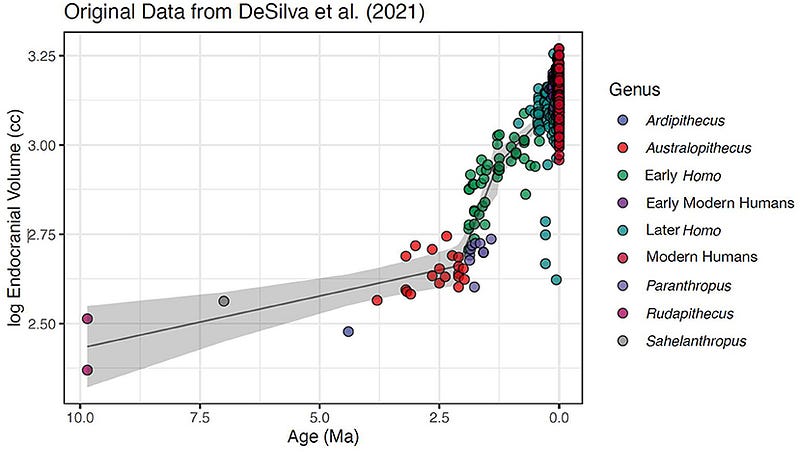
By Authors of the study: Brian Villmoare and Mark Grabowski — https://www.frontiersin.org/articles/10.3389/fevo.2022.963568/full, CC BY 4.0, https://commons.wikimedia.org/w/index.php?curid=122405325

It became possible as humans used to invent meaningful ways of interacting with their habitat. The human developing mind was able to accomplish what animal instincts were unable to do.

That was a process of a positive feedback loop involving factors such as the transition to a protein-rich diet, intellectual collective interaction, and, finally, the development of speech and abstract (symbolic) thinking.

Over time, this connection became more complex and mediated and increasingly determined by the impact of human culture. And in the industrial and especially the information age, culture, in turn, came under the enormous influence of technology.

The only constant

Therefore, our intelligence is the most important contributor to the formation of human nature. At the same time, intelligence itself is dynamically shaped by the conditions of human existence and our collective experience.

That leads to the conclusion that intelligence is the only constant in human essence, abstracted from human animality.

More precisely, it is not intelligence itself but the ability for abstract thinking. This clarification is essential since all living beings possess intelligence to some extent, albeit to different degrees. But only Homo Sapiens can think abstractly.
Image by Stefan Keller from Pixabay

Here, the Philosophy of Nature hastily presents to its rival its main argument — the subordination of Reason to passions. It is this threshold that the latter must overcome to prove its transcendence.

Transcendence of Reason

But is Reason indeed a transcendent essence?

The honest answer is that we do not know for sure. The future will reveal this. But now we can try to understand why there is such hope.

So, what is Reason?

It is necessary to clarify that we are talking about Reason, which is not what Intelligence is. There is often confusion between these concepts, and bringing definitions for them to a common denominator is useful.

Then what we have so far called Reason should be called “objective reason” (metaphysical essence), and Intelligence — “instrumental reason” (utilitarian essence).

Instrumental reason is nothing more than a tool for solving technical tasks that ensure the specimen’s survival and the transfer of its genes into the future.

Objective reason is a superstructure over instrumental reason. It tries to represent the relationship between all phenomena in the Universe comprehensively.

Armed with this understanding, we can consider the nature of objective reason transcendent. Its horizons of aspirations are not limited by anything. It can be called a manifestation of the self-awareness of the Universe expressed through the consciousness of the only known intelligent being — Man.

In a sense, this is a phenomenon of the Absolute. But human reason is structurally similar to objective reason, projected onto a cosmic scale.

This connection between human reason and objective reason as the Absolute is the continuity value between Man as a representative of the Homo sapiens species and the posthuman medium of Reason.

Humanism, Transhumanism, and Posthumanism

It is impossible to anticipate what the posthuman era will be like. Transhumanism is a concept that aims to facilitate this transition, but in our view, it suffers from a lack of a reliable ideological basis necessary to convince the public of the feasibility and moral acceptability of such a transition. Therefore, it is vulnerable to criticism and remains a marginal movement.

Transhumanism is concerned with using scientific advancements to enhance human physical and cognitive abilities and ultimately achieve physical immortality. It does not shy away from intervening in human nature through genetic engineering. However, it fails to explain the meaning of human existence relevant to the posthuman transition. In this sense, it does not go beyond its predecessor Humanism.

For humanists, the ultimate value is human beings themselves. This limit was natural for the worldview of people living on the cusp of the Middle and Modern Ages, but the posthuman era will be completely different from all of human history: humans can change beyond recognition and eventually disappear. Technologies can ensure continuity between humans and posthumans but can also destroy it.

If we do not want the history of humankind to be interrupted, we must understand what the value of human beings is, preserve it, and pass it on to the successors of Homo Sapiens.

Transhumanism does not focus on the problem of value continuity. That is why we find the reason for the lack of widespread interest in it. Most likely, even when technologies allow for implementing the requirements it proposes, their realization will be based on another idea, which is more philosophically consistent than transhumanism, although it intersects with it in many ways.

Conclusion

In the first quarter of the 21st century, the posthuman transition may seem like a distant prospect, but it is already a pressing issue for those who are concerned about the fate of mankind.

The advent of the posthuman era is an objective consequence of the development of modern technologies and their penetration into social life. Sooner or later, this era will come. For the transition to be peaceful, people need to have faith in its feasibility, and civilizational institutions should be able to control this process.

That can only be achieved with an appropriate ideological framework that is adequate to the perception of most members of society. It must replace the spiritual emptiness and nihilism that have arisen after the widespread abandonment of religion.

Creating such a framework is a crucial task for thinkers passionate about contributing to the further development of humanity.

Undoubtedly, this is a colossal intellectual challenge for society’s most thoughtful and progressive part.

But it can and should be resolved if we want to believe that we, as possessors of Reason, have a destiny beyond our biology.

[1] The term “human condition” was introduced into philosophy by the renowned German-American philosopher Hannah Arendt (1906–1975).

You also may like my other stories like these:

Dear reader, subscribe to my updates and share your best thoughts on our present and future!

Future
Transhumanism
Posthumanism
Philosophy
Humanity
Recommended from ReadMedium