Why Are Gen Alphas So Obsessed With Their Skin?
Have our efforts to shatter the rigid beauty standards been in vain?
It’s atrocious.
Tweens are flocking to Sephora and buying expensive beauty products while ruining the cosmetic displays and spitting rude remarks at the employees.
Yep, that’s the latest social media news on kids 13 and younger, the Generation (Gen) Alphas. But I don’t care about the messy displays or the rude kids.
I care about how these girls are being bombarded with skin-care and beauty products on social media. That they’re made to feel like they’re not enough.
That looks is all that matters.
Yep, it’s true. Social media is forcing Gen Alphas to grow up way faster than we had to.
And I can’t help but wonder — has all the efforts to shatter the rigid beauty standards been in vain?
Gen Alphas are not the problem
At 10, I was on the chubby side.
During P.E. class, we’d split into two groups for a race relay and the boys would grunt like a pig when they found out I was in their team. Man, that pierced.
It would’ve been worse if I was bombarded on social media by images of beautiful girls I didn’t look like.
Gen Alphas — born between 2010 and 2025 — are the first generation of kids unaware of life before social media.
They grew up exposed to social media channels like TikTok and Instagram alongside influential peers. These factors are why Gen Alphas are interested in skincare at an early age.
Hell, they probably know someone who catapulted to fame on TikTok.
Being powerful makes life easier in school, too. Boys are vying for you, and girls want to be you. I mean, what’s not exciting about having hundreds or thousands of followers, right?
But the age limit for most social media channels like TikTok is 13. How are pre-teens getting access? Their parents found a legal loophole — parents like Kim Kardashian.
Two years ago, she opened a joint TikTok account for her then eight-year-old daughter, North West, and named it @KimandNorth with a bio that reads: “Me and my bestie. Managed by an adult.”
I don’t know if a Kardashian started this trend, but there are numerous — I mean numerous — mom-and-tween-daughter accounts on social media.
Most center around the skin-care routine of the tween daughter and something called GRWM (Get Ready With Me), where these girls show us how they get ready for school.
This girl is eight and is doing a GRWM.
In the almost two-and-a-half-minute video, she is seen with a pink headband to push her hair back.
She shows the brand label on the lotion, squirts it on her hand, and cleanses her face — all this while talking about a boy crush.
Then, she continues to put on a toner, serum, and eye cream. Wow, I only use two products. Her mom is a popular beauty influencer with 1.46 million subscribers, so maybe it’s expected.
Another girl, whose mom is also a beauty influencer, looks to be about five or six. The video is a product placement for Shiseido.
Making an ad with your cute daughter definitely raises viewership, I’m sure, but why is a child marketing a product meant for adults?
Besides, there’s the issue of consent and money, which I’ve written about extensively here.
Then there’s this toddler. She’s doing a night-time skin-care routine with her mother.
What happened to reading your child a book at bedtime instead of showcasing her using three adult skincare products in front of thousands of viewers?
One of the products includes a cream with hydrochloric acid, which dermatologists warn is unsuitable for children since it damages their skin barrier.
These types of videos aren’t exclusive to kids with momfluencers. There are post after post of children creating these types of videos with or without their moms.
A new research from Mintel revealed that 80% of 9–11-year-olds in the United States use beauty and personal care products.
Wow, right?
Kids wanting to be creative and express themselves through fashion and make-up is valid. And Moms wanting to bond with their children is also legitimate.
And it’s not a bad thing that kids are prioritizing self-care, either. This is the age when kid are experimenting and coming into their own.
But it sure bothers me that kids are rushing into Sephora to buy skincare and beauty products meant for adults.
It also bothers me that parents are encouraging their children to flaunt themselves to strangers on social media at such a young age.
What kind of message does that send to a child who is easily susceptible? I mean, what are we teaching these girls about beauty, self-esteem, and validation?
Moreover, what’s particularly concerning is the growing interest of some beauty brands in targeting Gen Alphas, aiming to establish them as future consumers from an early age.
Beauty brands only care about money
In the last decade alone, women have made a lot of progress in rejecting conventional beauty standards. We’ve seen influencers refusing to filter themselves.
The #nomakeup challenge on TikTok. Celebrities coming out about the pressure to look young and thin.
But it feels like we’re starting all over again.
I grew up in Japan in the 80s. Back then (and still now), slim White/Japanese descent (called Hafus) were beauty goals.
I remember seeing posters of these girls posing on trains, buses, and stores. I went on a restrictive diet, straightened my naturally frizzy hair to straight, and shaved my arm — everything to erase my Southeast Asian heritage.
It made me miserable.
Research shows the detrimental effect of young girls judging their attractiveness in terms of idealized body images and high beauty standards.
But beauty brands know how to hook a young girl. They conduct research like this one to determine the essential criteria for retaining young, loyal customers.
It concludes that “confidence and relatability” are paramount to converting young consumers into loyal customers. And they recruit young influencers to advertise their brand.
Drunk Elephant is one of the most popular skin-care brands among tweens. They’ve received a slew of criticisms lately because their products aren’t meant for children.
Although that’s hard to see when their products have bright, colorful packaging (even my 5-year-old pointed at the screen and yelled “Lego!” — point made).
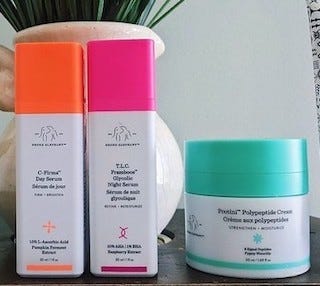
It does look like the kind of stuff kids will gravitate to, doesn’t it?
The green plastic product you see above is made to open the lid. To use the lotion, you don’t open it like a conventional bottle. You push the top like a pump until lotion oozes out from the middle.
Then you squirt any of their other skin products and mix them with your fingers (they call this a smoothie) until you attain the desired look.
The viral videos about Sephora kids are primarily based on Drunk Elephant products. Kids are making a huge mess at Sephora by mixing the products and not cleaning up afterwards (shown below).
Does the mixing of different colored lotions remind you of something, though?
“Making a smoothie” sure looks to me like playdough or hand paint — stuff my little son loves.
It’s like going to a candy store with all these fun, colorful displays.
Just sayin’.
They use ingredients — like retinol and acids — that are only safe for kids when it’s used with a prescription for acne because kids are at a “higher risk of harm given their immature immune systems and rate of growth.”
Last December, Drunk Elephant finally made a statement regarding their products on Instagram (but not on TikTok).
To be fair, the company does have almost 800k more followers on Instagram than on TikTok, but would it hurt to place the warning on TikTok, too?
Besides it has a younger demographic than Instagram.
The post on Instagram is headlined: Can kids & tweens use drunk elephant?
The first paragraph reads:
Yes! Many of our products are designed for all skin, including kids and tweens. First, I would say stay away from our more potent products that include acids and retinols — their skin does not need these ingredients quite yet.
Then they list the products that are safe for tweens and teens to use. And a simple routine kids can do in the morning and evening.
Well, simple but expensive — it’ll cost you a little over $100 and this is for the smaller containers.
If Drunk Elephant was so concerned for your kids, they wouldn’t warn you on a teeny tiny post on Instagram that’s about a month old.
They would post a warning on the Sephora displays with big, clear letters. It’s disappointing that Drunk Elephant still hasn’t addressed these concerns more widely.
Mind you, there are brands that care about children.
Brands like Rile, which was launched last June after several friends were unable to find suitable skincare products for their prepubescent children.
In an interview with Vogue, one of the founders say that “most offerings on the market are too harsh for young consumers or too cartoonish in their branding.”
Most of their posts say: “only basics way better” or “cleanser, hydrator and lip balm, add a sunscreen and you’re covered.”
In contrast, most Drunk Elephant products like Virgin Marula Oil, which they said are okay for kids to use, say this:
“This super-absorbable oil will quickly sink in and diminish the look of fine lines and wrinkles.”
Do tweens need to worry about “fine lines and wrinkles?”
Rile repeats three products dermatologists recommend for tweens: cleanser, moisturizer, and sunblock. But if you go on social media, especially TikTok, that’s not so obvious.
Unfortunately, Rile has only 2,821 followers on TikTok compared to Drunk Elephant’s 1.2 million followers. But then Elephant has been around for 11 years.
Gen Alphas obsession with skincare is merely a symptom of a bigger problem — the relentless money-greedy beauty industry targeting our children.
Parents also need to educate themselves and their children about the ingredients they are putting on their faces. And studies say if you want a healthy child, limit exposure to social media.
Not all is doom and gloom, though.
Thanks to a beauty influencer on YouTube, I stopped wearing make-up a few months ago after educating myself about the ingredients.
Alpha Gens are our future. We can’t let the beauty industry corrupt their self-esteem — like it did and continue to do — ours.
We just can’t.
I write about feminism, women, and motherhood. Join me on a journey around the Internet here.