
Why are China and India Fighting In The Middle of Nowhere?
Hint: It’s About Oil
China and India share a border — and quite frequently have skirmishes along it.
The most recent flare-up though was different.
People died.
For the first time in over 40 years — soldiers from both sides engaged in hostilities with dozens wounded and dead as a result.
This begs the question:
Why would the world’s two most populous countries — both with nuclear weapons, risk war over barren and inhospitable land in the roof of the world?
The reason, like for many other geopolitical skirmishes, relates to oil.
Why Kashmir?
Kashmir has no oil. It does not have access to the sea. Heck, most of the land isn’t even arable.
So why bother?
To answer this— let us first consider the map below:
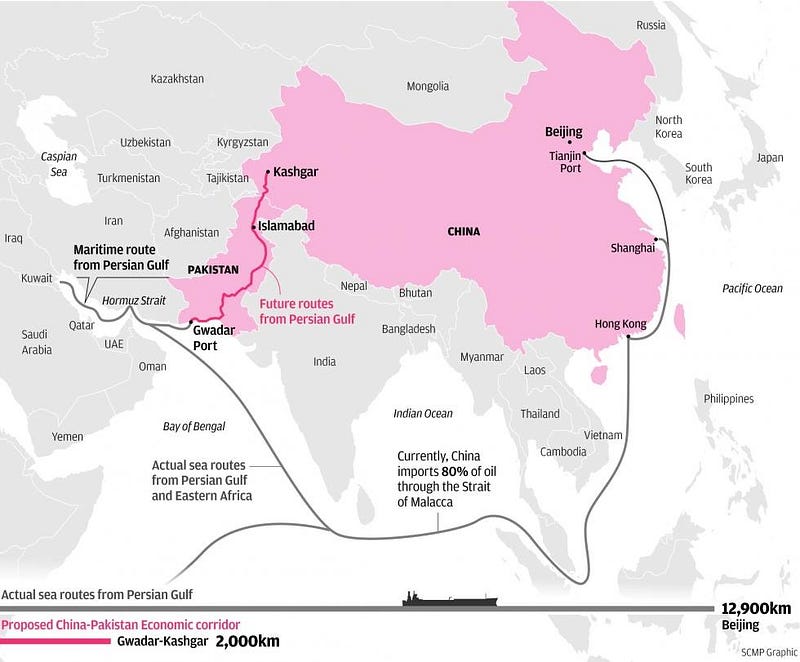
China — receives most of its oil from the Middle East.
Oil — is not only important to fuel the growth of a developing economy (like that of China’s), but is essential in your ability to wage war.
Oil tankers ship this oil via the Gulf of Aden (near Yemen) or the strait of Hormuz; through the Malacca Strait and over to China.
In fact — about 80% of oil bound for China passes through the Malacca Strait.
There is a huge geo-strategic problem with this. India has a huge naval presence in the Andaman Islands — not too far from the entry into this strait.
In the event of war — either with India herself (or one of her potential allies like the USA); India could deny passage of precious oil cargo to China via this path.
The Sunda and Lombok Straits (on either side of the Indonesian island of Java) are possible alternative routes — however, they are:
- Much shallower. This limits the size of vessels and thus the amount of oil that can transit through them
- A longer route — adding 1.5–3.5 days to the journey (as well as the additional expense in fuel and wages incurred as a result)
- Full of pirates posing a significant risk to the cargo actually reaching its destination.
As such, China needs to somehow establish another, secure, pathway through which to get its oil.
Enter: The China-Pakistan Economic Corridor (CPEC)
China shares on its South-Western corner a border with Pakistan — which in turn has the world’s deepest seaport at Gwadar, on the edge of the Arabian sea.
The Arabian sea, as the name suggests— has close proximity to the Middle East from which oil can be procured without having to circumnavigate hostile Indian waters.
Through it’s Belt and Road initiative, China has invested over $60Bn in roads and other infrastructure to link Gwadar port straight through to Chinese territory.
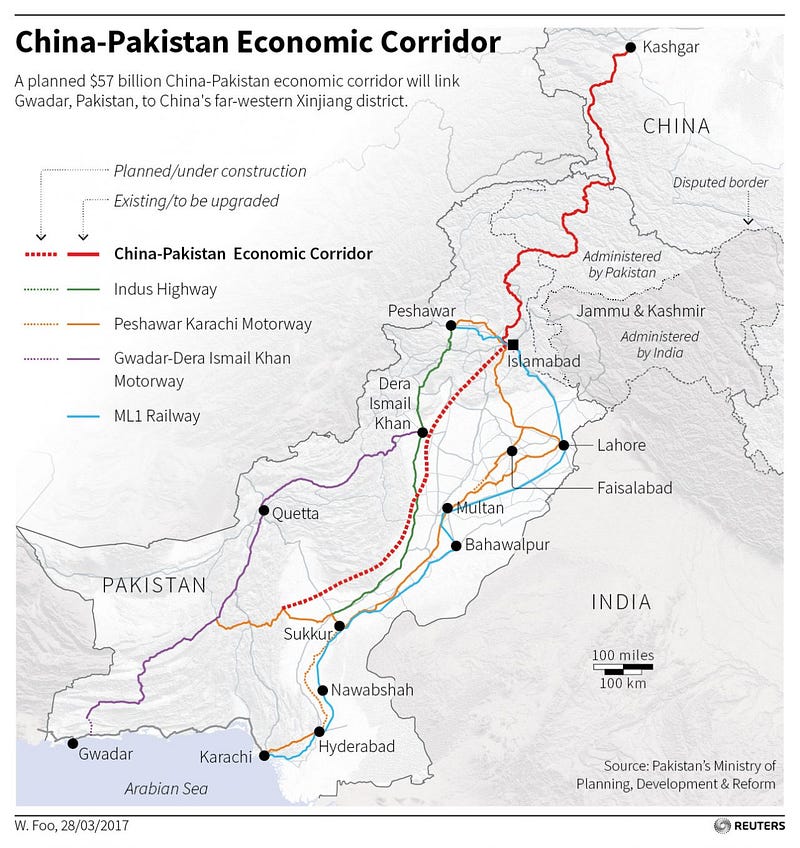
The problem this time, however, is that this route — passes through Kashmir (albeit the portion currently under Pakistani control); which is a region India claims.
Should India re-take Pakistani controlled Kashmir — China loses access to Gwadar and hence all that Middle Eastern oil.
Tangentially — should India take control of Aksai Chin (the portion of Kashmir under Chinese control); then China loses a key highway linking two of its more unruly provinces: Tibet and Xinjiang.
It is for these reasons that this isolated and mountainous region is of keen interest to China.
Why is China acting out now?
Kashmir has been divided for over 70 years — with the last war fought between India and China in 1962.
Why is it just now that Sino-Indian tensions seem to be rising again?
Well — because Delhi has recently been making some noises which are very unsettling to Beijing.
In August 2019, the powerful Home Minister, Amit Shah, strongly reasserted India’s claim on both Pakistani and Chinese controlled parts of Kashmir.
A number of airfields in Kashmir (very close to the Chinese Line of Actual Control) have also been revived and new roads built meaning that troops can be shuttled around this mountainous terrain quite swiftly in the event of war.
Lastly — In 2019; India split and downgraded the erstwhile state of Jammu and Kashmir into two union territories. By altering the status of a disputed region — Beijing’s interest in the region was piqued once more.
In summary: China’s interest in Kashmir is not just about territorial integrity, but a key pillar in its geopolitical strategy.
Let us hope that the brinkmanship involved in trying to secure Chinese oil supplies in case of future wars does not itself precipitate that very war.
You may also like:


