
Is India’s first prime minister, Nehru, overrated?
A look at his major achievements during India’s early years of post-colonial independence
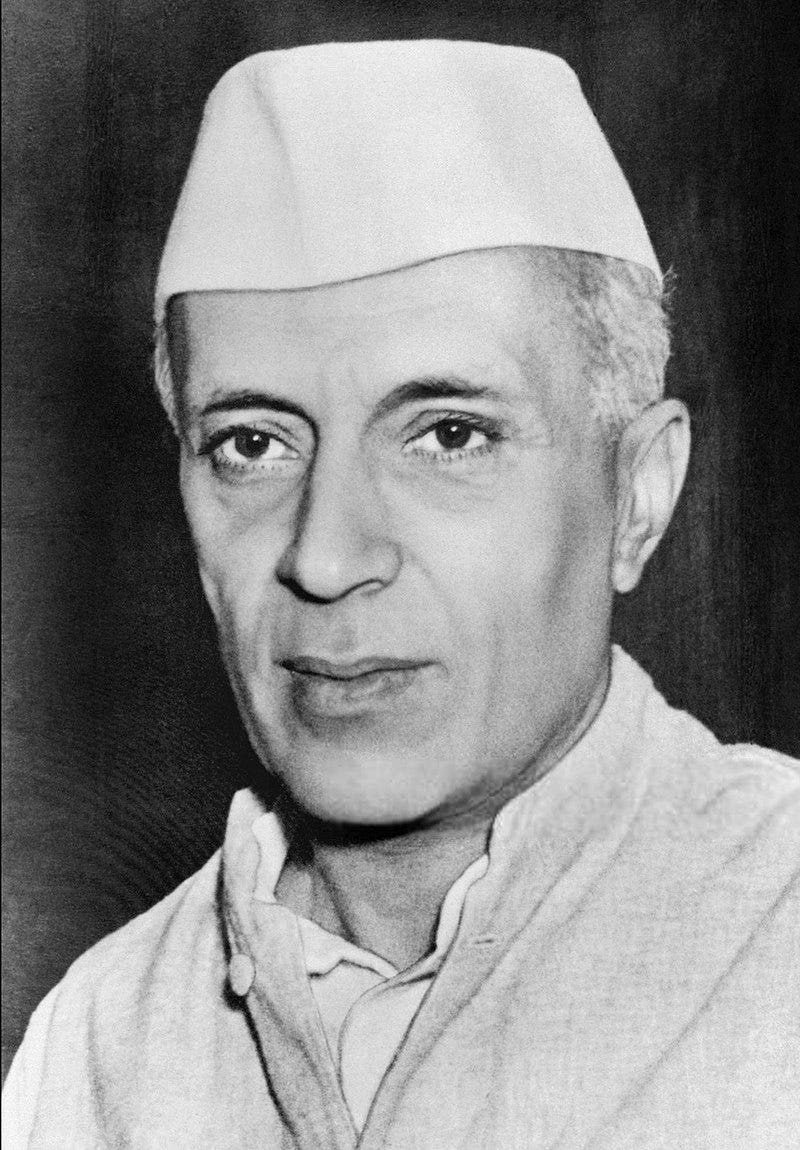
India upon independence in 1947 was an economic and social basket case. The economy was highly agrarian and the state near bankrupt from centuries of colonial extraction and active deindustrialisation. Life expectancy was 32 years and literacy was 16%; society was reeling from millions dead due to recent disastrous famines and the religious violence of riotous partition.
The physical geography of the country was flanked both East and West by a hostile power (Pakistan), and its body was peppered with near 600 independent princely states as well as European possessions (notably Portuguese Goa and French Pondicherry).
The nation had what appeared to be the most insurmountable of challenges to overcome.
Into this stepped Jawarlahal Nehru — independent India’s first prime minister. A man who ruled the nation for sixteen years — longer than any other in modern times.
A couple of generations on, it appears to be in vogue these days amongst some circles with a little interest in Indian politics to decry that he was overrated, or otherwise came short of being a great leader.
This post argues that while his record was not perfect, his contribution to the making of India as Prime Minister was titanic. This is based on the fact that he:
- oversaw the establishment of key national institutions to provide educational and health services to the masses as well as industrialise the country;
- united the subcontinent across linguistic and sectarian divides lines as well as the patchwork of principalities and states
- built India’s position on the world stage
These feats are all the more awe-inspiring given the dire straits the fledgling nation was in when he took the wheel.
Institutional Nation Building:
When the British left, the state apparatuses endowed to the country were largely those that enabled the colonisers to subjugate the populace (such as the army, police and legal system), and infrastructure to extract resources from the country (notably railroads and some ports). There was a dearth of higher educational institutions, health care services, heavy industry and useful infrastructure for a nation of 400 million.
Nehru approached this challenge through:
- Establishing the country’s greatest educational institutions such as the Indian Institute of Technology, Indian Institute of Management, and All India Institute of Medical Sciences; as well as universal primary school education. This provided a base level of education for the masses, and a pathway for best and brightest of Indian citizenry to escape centuries of agrarian lifestyles and transition into knowledge workers who would be the leaders of the future economy
- Expansion of health insurance coverage and availability of medical care. The first was achieved by moving toward universal health care through implementing self-funded insurance schemes for low wage employees, as well as government-funded initiatives for all public sector employees. The second was achieved through carrying out national control and eradication programs (such as for malaria, smallpox, and TB), and opening up several new hospitals and medical schools to increase the number of doctors and beds
- Rapid industrialisation — with a particular focus on moving away from relying on imports toward autarky. This required a stock of productive capital — without an abundance of investment banks or private sector players, this meant that the state had to take a leading role. Through a mix of nationalisation, subsidies, protectionist measures, and the directing investments — India quickly built up domestic capabilities in coal, energy, iron, and steel. India’s industrial output trebled during Nehru’s reign
- Basic infrastructure establishment and repair. Through the execution of 5-year plans, Nehru sought to rehabilitate the ports and railways damaged through partition, increase food production to avoid relapsing into more famines (through increasing land under cultivation and establishing land-grant colleges), and implement large river valley schemes to support irrigation and energy needs. Whilst this established many of the basics, he could not push much faster given the lack of materials, skilled workforce participants, and funding
Integration of a patchwork nation:
As noted in the opening paragraph of this post; Independent India was a rump of British India. Burma had left pre-independence, and what are now Pakistan and Bangladesh both left to form their own country in 1947. This however meant that whilst those remaining provinces directly under British dominion fell under the remit of the new federal Indian government; some 554 principalities were technically independent from India — not to mention the two remaining enclaves of Portuguese Goa and French Pondicherry. Further — the population was further fractured within different communal groups.
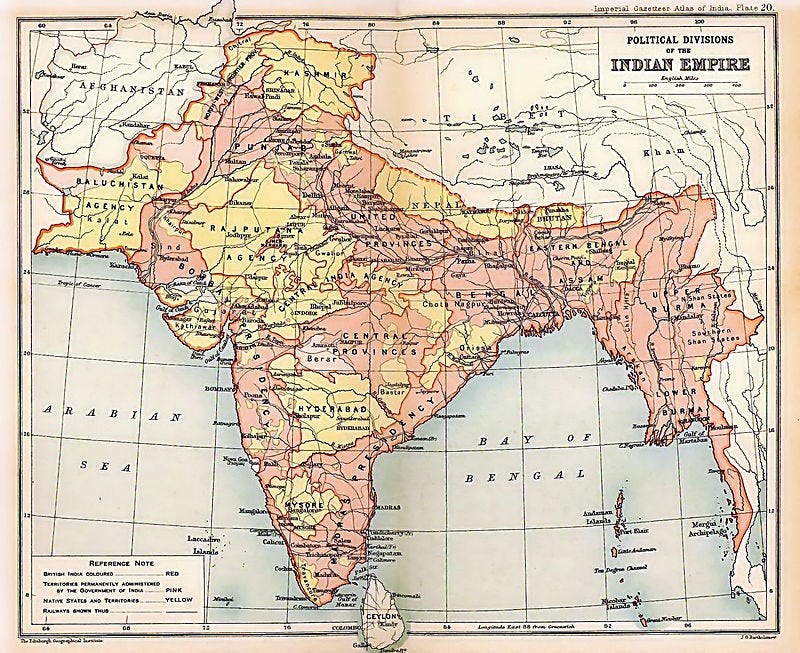
The Nehru led government acquired, incorporated and re-organised these territories to re-create the nation as a single polity. This was done by:
- Convincing the princely states to ascent into the union of India — a herculean task given that these principalities had other options such as: remaining independent, joining Pakistan, or forming a third country consisting of these princely states. With the exception of a few that bordered Pakistan, they joined India either willingly or were annexed through military action (Hyderabad being the notable example). The key actors who made this happen were Lord Mountbatten, Sardar Patel, V.P Menon — all of whom were further empowered by Nehru. Nehru’s threats of military action against any princely state that didn’t join a union and enlisting of Mountbatten to be the first Governor General of independent India bolstered their bargaining power when dealing with the princes
- Using military force to annex Goa, Hyderabad, and arguably Kashmir — all of which occurred under Nehru’s prime ministership
- Standardising the administration and governance of each state by extending the conditions of ascension by each princely state beyond defence, foreign affairs and communications. This included merging smaller principalities into larger polities, removing inter-state trade tariffs, and adoption and alignment to a national constitution
- Reorganising several Indian states based on language groups — the largest set of changes to state and territory boundaries since independence
- Passing Hindu code bills — which established a uniform civil code for all Hindus. This standardised, and more importantly — improved the rights for the highly heterogeneous Hindu community especially women in areas such as inheritance
India on the world stage:
British suzerainty meant that India did not feature as a geopolitical actor in world affairs for two centuries — other than being an anchor around which many other British colonies were created to help keep British hold on India, and as a source of resources and soldiers to help realise many of the colonial enterprise’s ends.
When India awoke once upon that midnight hour, India needed friends in the international area — to provide access to their markets, to invest capital into India, and to support India in diplomatic stoushs. New India’s foreign policy was lifted largely from that of the Indian National Congress’ which in turn was largely set by Nehru. So it was that he was best placed to help the nation on this front. In this sphere he:
- Personally established the foundations of the Non-Aligned Movement (NAM) which helped the country stay out of the domination of the US first world, and Soviet second world. This movement has since grown to incorporate more than 120 countries; and thus is one of the greatest international relations policies and forums in the world today
- Through NAM, he supported the independence of many nations across Africa, as well as Indonesia
- Helped establish and maintain ties with the US and USSR which provided sufficient cover at the UN for certain actions (e.g. annexation of Goa), and attracted foreign aid
Conclusion:
Perhaps his greatest achievement of all was that unlike Gandhi, Patel and Jinnah — he survived; long enough to see a fledgling nation establish a tradition of democracy and secularisation.
My own grandparents were in India during much of the Independence movement as students, as well as post-independence when they raised their family. I remember them telling me of the day Nehru died — the streets were quiet, and the country was in shock and mourning. The light had gone out.
The man was not without his blunders. He bungled the Kashmir situation and the war with China. He embraced a centrally planned economic model which limited India’s growth for decades. He did not extend the Hindu civil code to cover other religions too. However, we must remember that he was a mortal man; and given the gigantic accomplishments outlined above — one cannot think of him as anything other than a juggernaut of Indian history.
Those who know a little of him say he was one of India’s greatest prime ministers. Those who know a little more say he is grossly overrated and has cost India dearly. Those who know a lot say he was one of India’s greatest prime ministers.
You may also like: