
Why #AllLivesMatter, #NotAllMen Miss the Fundamental Point
Racism and Sexism aren’t about race or gender.
“Woke” is a term that is probably more widely used today than ever before. It is almost fashionable to use it, and socially irresponsible to not use it or rather be it.
Here’s how woke is defined, per Merriam-Webster,
Woke is a slang term that is easing into the mainstream from some varieties of a dialect called African American Vernacular English (sometimes called AAVE). In AAVE, awake is often rendered as woke, as in, “I was sleeping, but now I’m woke.”
The problem with slang is that the term often overpowers the actual meaning behind it. It becomes cool to be “woke” without even fully understanding what it actually stands for. Just like it is socially desirable to be a “feminist” without really understanding what that even means.
The other sibling of slang is the hashtag. There are certain hashtags that spread faster than a forest fire, and often have more devastating effects too. Most of them start with positive intent, but in the hands of the wrong people, take a bit of a convoluted meaning, which may or may not serve the original intent.
That’s the story of all recently famous hashtags — #MeToo, #BlackLivesMatter that started movements, and the others such as #AllLivesMatter, #NotAllMen, #YesAllWomen, that were more responsive hashtags to counter an existing trend.
The problem with this all is many of these just miss the point. Every hashtag, every slang focuses too much on the micro — on a specific problem i.e. the symptom, and fails to encapsulate, let alone address, the core of the issue.
Discrimination has its roots in the psychology of perceived power
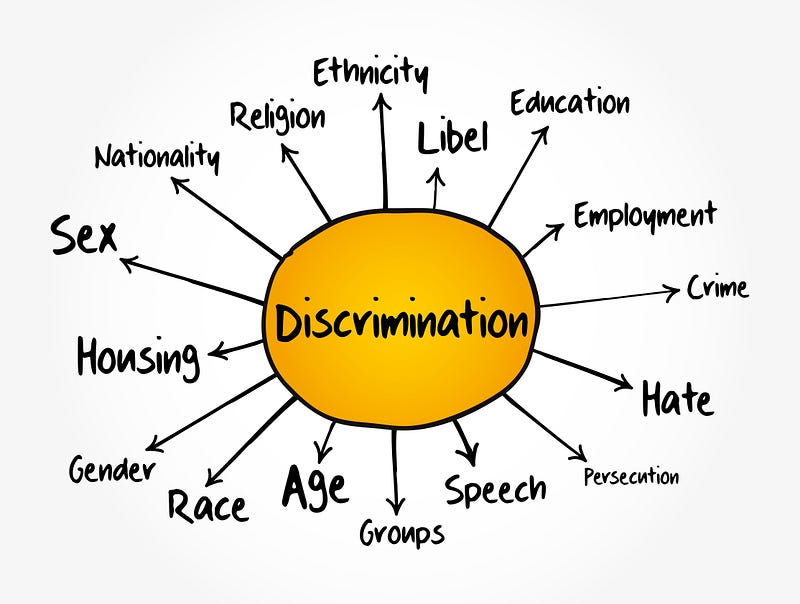
There’s a ton of discrimination out there — racism against Blacks or Asians, sexism against women, sexualism against the LGBTQ community, and a whole host of variations. Saying one is more rampant than the other, or one deserves more attention than the other is a pointless debate.
The underlying issue is that neither sexism nor racism or any other kind of discrimination is about a specific minority. It all stems from a false sense of superiority or power over another group.
When does discrimination occur?
It begins when a certain individual or group of individuals that share a common characteristic — ethnicity, color, gender, etc. — starts to see themselves as superior to another individual or group that doesn’t share the common characteristic.
White population discriminating against Blacks, men discriminating against women, Caucasians or Blacks discriminating against Asians, and so on.
What is at the core of the feeling of superiority is the hunger for power or the desire to hold a higher status. In most cases, the discriminating group belongs to a majority, while the discriminated group belongs to a minority. While in other cases, eg. the men and women dynamic, it isn’t the numbers but a sheer belief that in a certain environment, women are “weaker” than men.
This isn’t actual superiority, but the need to counter a hidden insecurity, which feels threatened by the other community, and so in most cases a defense mechanism.
When the face-off is between two minorities — eg. Blacks vs. Asians — the perceived power takes a different meaning. A Black American may see themselves as more entitled to America vs. an Asian American or may have an inner sense of inner insecurity or inferiority in knowing that Asian Americans are usually economically better off than African Americans. This can then translate into a correction of the dynamic, by enforcing their own dominance and discriminating against the Asians. Other topical prejudices, eg. most recently the pandemic, can add to the feeling of hatred.
Discrimination is based on visible characteristics
Sundar Pichai could be the CEO of Google, arguably the most powerful corporation in the world, but the fact that he looks Indian might mean that he’s ill-treated by the Caucasian cashier at a Walmart, because in the cashier’s mind “he doesn’t belong” and is a minority.
There’s also the perception against Indians or Asians in America that they’re stealing the jobs and the wealth that would otherwise be reserved for the true “American.” This was one of the agenda items the Trump campaign was built on — the mission to make America great again (or MAGA) by eliminating “immigrants.”
So while a person could have been born or brought up in America, a green-card holder, and a socially responsible contributing citizen — (s)he may be perceived based on purely visible characteristics.
Hence, sexism and racism — both based on visible characteristics, are the most common forms of discrimination that we see.
Why #AllLivesMatter and #NotAllMen miss the point?
On the surface, I get the backlash. If #BlackLivesMatter, then so should Asian lives, or lives of any other minority and hence probably all lives.
#NotAllMen — of course, because not all men are rapists or dangerous or criminals, and the majority are probably well-meaning human beings.
However, the point of highlighting “all men” and “black lives” in particular is that it addresses the visible traits of a community that has discriminated or been discriminated against. To a woman who’s been eve-teased or raped, there is no label on our heads that tells her if we’re the good ones or the bad ones. And so, to her, it is “all men” that she’ll be guarded against.
All lives matter, yes. But a white man is hardly ever “discriminated” against in America, or a Hindu is hardly ever at the receiving end of religious remarks in India. It is always the “minority” or the “perceived” weaker section of society that is at a higher risk and hence on constant guard.
So, how does it all matter? Where’s the solution?
The solution really lies in understanding that the type of discrimination doesn’t matter. You can’t stand for women's rights but ignore black rights. Or you can’t be a BLM activist but not care about the hate crime against Asians.
You can’t choose to be a feminist but at the same time be a homophobe.
Double standards have no room in the fight against discrimination.
If we are to truly end discrimination and get rid of it from its roots — we need to spread awareness that equality is blind. It is blind to any inherent characteristics of a human being and only sees every human as that — a human.
We must teach our kids to treat everyone equally irrespective of their race, gender, disability, sexual orientation, or any other characteristic. This is a common fight, and let’s not miss out on the bigger picture by making it a battle of one community vs. the other. This is everyone’s battle against discrimination — and it can only be won together.