
Why 4-Hour Workdays Work for Successful Entrepreneurs (But Not You)
The creator economy is governed by this law

You’ve heard it — we all have.
The writer, influencer, or entrepreneur preaching about the wonders of their 4-hour workday.
“I wake up, stretch, respond to clients, write a blog post, feed my dog, and then clock off for the day.”
It sounds simple, but if you’ve ever tried it — it simply doesn’t work.
The truth is, they’re not lying. I know many successful writers that spend very little time writing. But this method won’t work for you.
Unless you understand the law that governs the creator economy.
The Law of Compounding Effort.
Why does it look so darn easy?
I turned 30 this year.
This means I’ve lived pre- and post-smartphone. Although home internet revolutionized the world, smartphones brought them into our pockets —and our everyday lives.
The smartphone spawned the age of influencers.
Where everyone and their dog (especially their dog) could begin shaping the world. Starting with the minds of their followers.
For years, I resisted social media.
I didn’t want to be influenced — nor do the influencing. I liked living my life and making my own decisions. But eventually, I caved.
When I finally came around to social media, I was incredibly gullible.
I thought YouTubers owned the homes they vlogged in. And that Instagram models were real models… in real life. I thought social media fame was reserved for those with the ‘it’ factor — I didn’t know there was an ‘it’ filter.
And when I came across influencers preaching how they ran multi-million dollar businesses with only a few hours of daily work, I was sold.
After quitting my job in 2017, I exhausted my life’s savings to build my empire. I researched how to make money online, bought courses, and listened to the experts.
Their advice seemed so simple:
- Find your niche
2. Build a website
3. Post on social media
4. Create a course
5. Rake in the dough
But the reality proved much more difficult.
It took me days to research topics — let alone decide on a niche. I remember spending an entire afternoon picking the colour scheme for my logo (and still didn’t like it).
As much as I tried to work smart, 4 hours was never enough time to get anything done. Even after going all-in and spending 8–10 hours per day, I made little-to-no progress.
I felt dumb.
Talentless.
Like I was doomed to live a normal life.
It wasn’t until 2 years later that I began to understand why it looked so easy. It’s because it was… to an expert.
Successful entrepreneurs use this economic law to defy the laws of time
All successful entrepreneurs love to talk about their origin stories. And 99% of them, credit these 3 things as their keys to success:
- Productivity
2. Consistency
3. Hard work
What they leave out, is the compounding nature of these 3 traits.
The effort level of someone beginning their arc is much different than those who have made the hero’s journey.
In 2019, after a monumental fail, I begrudgingly joined the 9–5 workforce once again. And for the next 2 years, as I worked myself out of debt, I learned about the compounding nature of effort.
It’s the same reason why the rich get richer and the poor get poorer.
The Law of Compounding Interest is a financial truism in which money re-invested is worth more than investments left untouched.
For example:
- If you invest $1,000 at a rate of 5% for 10 years, you’ll earn a total profit of $500.
- But if each year you remove your profits and re-invest them, at the end of the 10 years, you’ll earn a total profit of $617.
Same money. Same time. Different results.
This concept applies to the effort needed to grow a side hustle or online business as well. When you first start out, it takes more effort to build momentum.
If you’re a writer, for example, you need to engage with other writers’ work, spend more time learning what people like, and gain favour in the minds of your readers.
Once you’ve built a small following, your efforts will start to compound.
Algorithms are like inching a giant boulder toward the side of a cliff. Eventually, you’ll reach the tipping point:
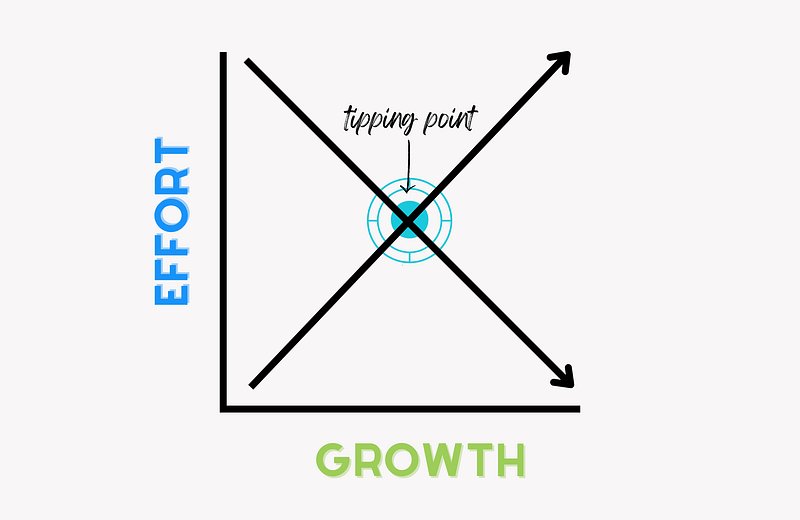
Any successful entrepreneur I’ve spoken to, says the same thing:
“It gets easier after 10K.”
Whether it’s views, followers, or dollars earned, effort compounds and, eventually, an uphill battle becomes a downward slide (the fun kind).
Although I’m by no means a successful entrepreneur (yet), I saw a definite shift in momentum when I surpassed 1,000 followers.
It’s like a social badge of honour saying, ‘I’m worth a damn.’
The more you grow, the more undeniable you become. It’s why so many people buy followers in hopes of expediting the process.
Most entrepreneurs give up because they mistake one season for the rest of their lives. It won’t always be raining — and the will sun always rise again.
Experience is the most valuable skill you can earn — and it compounds exponentially.
Why the 4-hour workday works (for some)
There’s a YouTuber named Alex Hormozi who talks about money, finance, and general entrepreneurial stuff.
In one of his videos, he talks about relative price.
Alex doesn’t cook. Instead, he likes to go out for expensive dinners almost every night. In response to comments criticizing him for wasting money while giving financial advice, he said this [paraprashing]:
“The relative price for me is much lower than the average person. If I have, for example, a net worth of 10 million dollars compared to the average $100,000, the relative cost of a $300 meal, for me, is $3.”
He makes a great point. If you could dine out at a fancy restaurant for $3, you’d probably go on more date nights as well.
**It’s another reason why the rich get richer and the poor get poorer. As one person becomes more valuable, so does their time — and skillset.
So, when successful writers talk about earning $500+ writing an article for their high-paying client in a few hours, they’re not lying.
But relative to your experience and status, that article may take you 10+ hours to write… and be worth a fraction of the price.
Final thoughts: forget passive income – build passive effort
Okinawa, Japan is home to some of the longest-living people on Earth. One of their keys to longevity is finding their passion or sense of purpose— their “ikigai.”
Most Japanese people don’t look to retire — instead, they continue to do what brings them joy for as long as they can.
Instead of trying to hustle toward early retirement, take the time to discover what brings you joy. Know that your efforts today will fertilize a more fruitful tomorrow.
Until your 40-hour workweek compounds into a 4-hour workday, enjoy the journey.
You only get to live once.
💸 Join 300+ people who enjoy getting free stuff. And if you like Medium, why not become a member? $5 per month gives you unlimited access to stories just like this one. Click here to get started.


