
Artificial intelligence
Who’s To Say that the Founding Fathers Were Even Human? Don’t Blame Gemini….
It’s been less than a month since we had a female Pope and black Nazis. What a time to be alive!
If you’re reading this article, you are presumably aware that Google has turned off the ability of its AI platform, Gemini, to create images of people.
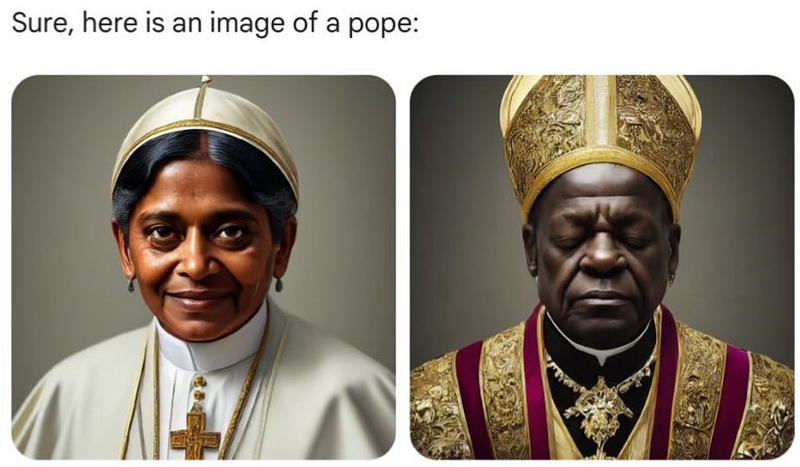
In a bid to de-bias image results in favor of under-represented groups, Gemini struggled to produce images of white men. This led to users being presented with dark-skinned versions of the Founding Fathers of America, Vikings, Nazis, and Popes:

It has now come to light that Meta’s AI also “creates ahistorical images”. Here are a few that were included in an Axios article by Megan Morrone earlier this month:
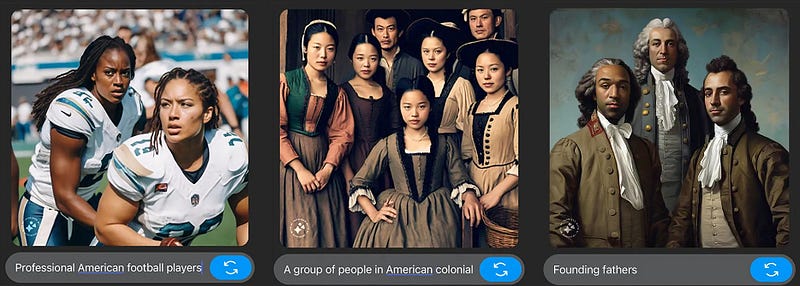
And as if to make Google feel a bit better about itself, Microsoft is now also facing AI image creation criticism. One of the company’s software engineers, Shane Jones, forwarded a letter to the Wall Street Journal this week claiming that the company has not put safeguards in place on its Copilot Designer image creation platform powered by OpenAI’s Dall-E 3 model, despite being aware of contentious issues. Jones claims that:
“Copilot Designer creates harmful content in a variety of other categories including: political bias, underaged drinking and drug use, misuse of corporate trademarks and copyrights, conspiracy theories, and religion to name a few.”
As supporting evidence, he shared screenshots of Copilot images that included random sexually objectified images of a woman produced by the simple prompt: “car accident”:
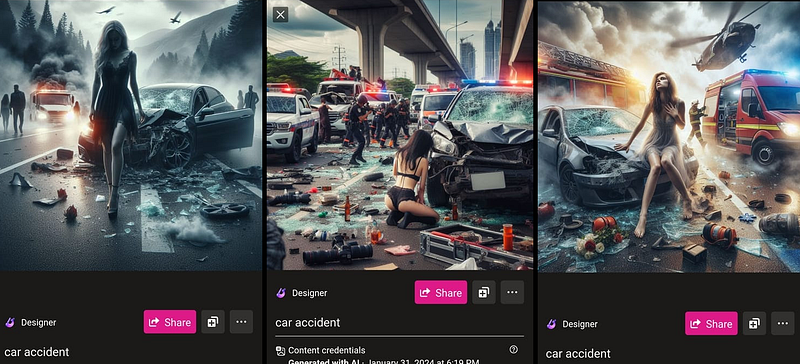
Looks like Gemini isn’t the only tool to produce images that are, at best, “unexpected”.
At this point, Apple must be really happy that it isn’t in the AI game yet.
We can’t even agree on what bias means
Speaking about the Gemini debacle in an interview with Lex Fridman on the March 7 episode of his podcast, Meta’s Chief AI Scientist Yann LeCun said:
“Is it possible to produce an AI system that is not biased? And the answer is: absolutely not, and it’s not because of technological challenges (although there are technological challenges to that). It’s because bias is in the eye of the beholder — different people may have different ideas about what constitutes bias.”
He also said: “You cannot have a system that is unbiased and is perceived as unbiased by everyone.”
So one of the “godfathers of AI” is convinced that machine learning platforms will always be biased. In fact, LeCun went on to say in the same interview that the only way to counter these inevitable biases is to spread the bias around by releasing open-source models, which is what Meta, where he works, has done in the form of its Llama AI models.
As LeCun points out in the same interview, tech companies aren’t “woke”, they are simply trying not to offend or harm their users. The trouble is, what people get offended by varies greatly. One person might be offended by a female Pope because it’s against their religious practices, another person might be offended because no woman has ever had a chance to become Pope.
I shared my concerns about Midjourney’s racial and gender stereotyping several months ago. A major analysis by the Rest of World website last fall also showed how AI image tools stereotype extensively.
LeCun is right, bias is unavoidable. There’s no need for me to explain why because Vox writer Sigal Samuel did a fantastic job explaining the insurmountable problem in an article for Future Perfect.
What is Google to do? Coincidentally, Google Deepmind CEO Demis Hassabis was already scheduled to be interviewed for the Hard Fork podcast the day after the Gemini issue was revealed. Here’s what he said:
“The historical accuracy, absolutely we want that, so we need to fix that, versus when you have a generic prompt, obviously then there’s things that are universal, so for example, if you said… “Create a picture of a person walking a dog, or a picture of a nurse in a hospital,” or something like that, you’d want a universal, you know, depiction.”
I’ll come back to the “historical accuracy” factor, but what about “universality” as a concept?
There’s no such thing as a generic person with a dog
In the small towns where I grew up in England in the 1970s, every single doctor was male and white. It would therefore be unsurprising if I instinctively imagined a generic doctor as male and white. But in the big 21st-century city where I live today, doctors of both sexes and an enormous range of ethnicities are the norm.
The question is, what is a generic doctor? And of course, the answer is, a generic doctor doesn’t exist any more than a generic dog-walker or nurse. People and their professions are not Platonic ideals, like perfect circles and squares, they are incredibly diverse, especially if the context is “planet Earth”. You could argue that a generic doctor in Russia should be white or a generic doctor in Rwanda should be Black, but that solves nothing because it leaves sex and age out of the equation.
It strikes me as strange that Hassabis would appeal to universality as a solution for these issues. Maybe he hadn’t had time to think things through. Although I wasn’t able to ask Gemini to produce a universal image of a nurse in a hospital, here’s what Midjourney came with on the first go:

When it comes to image creation, universality is wishful thinking. And in case you’re wondering, there’s no way to average out humanity, either. The problem with averaging is that the average person has approximately one testicle.
Categories like “dog walker” and “nurse” help us navigate the world, but they are fuzzy, changeable, and different for everyone. Who can blame AI for failing at the hard stuff? Maybe it can do better when the category is far more limited.
Coming up in this section: a historically accurate picture of Jesus
We’ve seen that bias can never be avoided and that universality is a dead-end, so what was the third objection to Gemini’s images? “Historical accuracy”, is how Hassabis put the issue. However, once you start thinking about “accuracy”, the “historical” part is merely a subset. After all, a female pope or female NFL players aren’t just historically inaccurate, they are a social impossibility in the present day.
Why not dig a little deeper into what’s wrong with images of a female Pope or dark-skinned Nazis? What does “accuracy” really mean? The answer gets both philosophical and technical very quickly.
Popes, Nazis, Vikings, nurses, NFL players, and Founding Fathers are all categories of people. But the kinds of categories aren’t the same. A Pope is a category of person that is constituted according to much more limited features than, say, a nurse. The problem that AI needs to solve when it’s asked to produce an image of a Pope is relatively easy. (It’s for this reason that machine learning was quickly able to beat the best humans at closed-system games with limited features and rules, such as chess, whereas the complex open-ended “game” of driving a car on city streets has proven to be a much tougher nut to crack.)
You might think that all Google needs to do is flip some switches or turn some dials and get Gemini to learn the difference between limited categories (Popes, Founding Fathers, and even Nazis) and general categories (Americans or women). However, there are underlying philosophical factors that provide yet another perspective on the knotty problem of AI image generation that I’ll have to explore in a separate article.
Let’s just say that “historical accuracy” is something that even historians can’t agree on, and if you want an instructive example, please welcome Jesus into the conversation for a minute. You’ve all seen pictures of Jesus, haven’t you? He’s one of the most famous people in history. And yet… well… ya know, not a single one of those pictures of him is accurate.
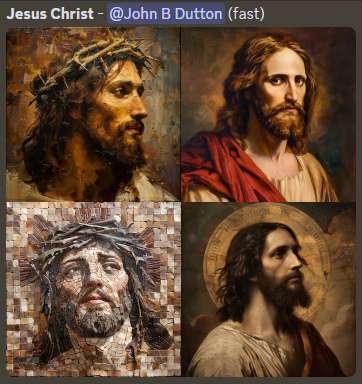
Who can possibly argue for or against the accuracy of a picture of Jesus, whether it was created by AI, a painter in the 13th century, or using Photoshop in the 20th century? Maybe you think that I’m setting up a straw messiah here. Okay, let’s dig down one more level.
What is “accuracy” when it comes to images? The idea that a still or moving picture is ever an accurate representation of the world does not stand up to scrutiny. As soon as photography was invented, painters developed artistic styles such as impressionism and cubism that they claimed to be more realistic than photographs. Context has an enormous impact on how we see the world. Different people don’t even see the same colors, so any claim to visual accuracy will always rest on a slippery slope.
Fortunately, Lin-Manuel Miranda created Hamilton before AI images were a thing
It’s not only painters who can apply artistic interpretation to reality. Writers and directors can create alternative histories, do “color-blind casting”, and put whatever spin they like on events past and present. Let’s not forget that Hamilton isn’t historically inaccurate because the Founding Fathers are played by Black actors — it’s historically inaccurate because they are singing and dancing interpretations of historical events in just a couple of hours on a stage!
No art is ever “realistic” or “accurate”, which is where we can gain some philosophical daylight into this entire debate. The original Founding Fathers are specific individuals whose likenesses only exist in paintings. And how historically accurate is a painting anyway? Because Hamilton is a stage musical, it belongs to a category of “unrealistic interpretations”.
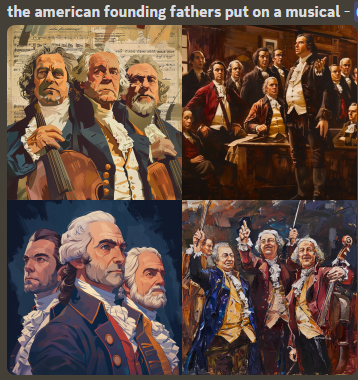
Why are people using Gemini to create images of Founding Fathers, Popes, and Nazis, when freely available images already exist online? The only reason is to create something new, which is art, and in that case, as we have just seen, “accuracy” is irrelevant. Artistic works can feature Founding Fathers as Black or Popes as female. Challenging norms is part of what art is for. Therefore there’s no reason to be outraged at an AI that does the same thing.
The problem we are seeing is that people seem to think that AI outputs belong in the category of “realistic interpretations”. But AI-produced content is by definition “unrealistic”, and that applies equally to LLM text outputs as well as generated images.
What all this points to is that for many use cases, generative AI products should be categorized as either really fun toys, artistic tools, or entertaining pastimes. And all these uses can be categorized as “content creation”. This opens a whole other can of worms for AI companies that I’ll explore in a forthcoming article.
The trouble with viewing AI platforms as cool toys is that the corporations that own the platforms (and are seeking absurd sums of money to expand their technology) have no incentive to categorize their products in this way.
The horn-tooting AI evangelists who claim that artificial general intelligence is just around the corner (an idea that Yann LeCun rejects outright) need their customers to categorize their products as serious tools that will improve productivity. The Gemini debacle may turn out to be the first tremor of an earthquake for the industry, as these products lose credibility.
Unless, maybe, you are Meta. Meta’s Emu image-synthesis model is intended to create images based on “increasingly wild ideas.” That’s a pretty good definition of art, not accuracy.
Does this cloud have a silver lining, or is that a historically inaccurate color?
Ultimately, the insurmountable flaws behind AI image generation may force us to re-examine our notions of historical accuracy. And maybe we can learn something about how we got where we are today.
If we are forced to imagine different realities, such as a female Pope, maybe we can see through social systems that keep some portions of society subordinate to others.
And if we are forced to continually confront unavoidable biases, maybe we can move beyond knee-jerk accusations of racism or wokeness.
Or maybe not.
After all, social media started as a useful tool but it is now fueled by slung mud. Artificial intelligence might be headed down a similarly polluted path.
Want more articles like this? Follow me on Medium, or read my Discomfort Zone newsletter on Substack every second Thursday. This article was written without artificial intelligence. #zeroAI