
Bullshit is the Least of our Worries
I’ve buried the lede here on purpose…
It’s fair to say that there’s a general sense of panic among knowledge workers who fear their jobs will disappear, tech bros who fear missing out on the investment gravy train, and philosophers who fear that the world will literally end soon. Why? AI, of course!
I’ve used ChatGPT-4 extensively, upgraded to the paid version of Midjourney, and played around with a bunch of other AI-powered tools. They are spectacularly effective for certain tasks and extremely disappointing for others. You won’t get a great novel or a groundbreaking artwork out of them. And either way, as I wrote recently, we are not on the brink of an AI-pocalypse.
But where AI excels is as a salesperson, and that’s where jobs will be lost. The fact is, text produced by an LLM (large language model) sounds extremely convincing because it is trained to predict the next word in a sentence based on statistical probabilities. So everything it says makes sense on a very superficial level. Will this fill the world with quackery, BS and fake news? Or, conversely, will people quickly become hyper skeptical? And if they do, might this be even worse for society?
Genuine trust in what we read, see and hear is already hard to come by and AI is making things a whole lot muddier with invented sources, fictional duets and convincing deepfakes (love the Keanu Reeves one!)
Honestly, if the outcome of all this is that we become more skeptical of the communications we receive, that might not be such a bad thing. We should all learn to check provenance and activate our mental doubt circuitry. Humans evolved as hyper social beings in the jungles of Africa, where possessing an excellent subconscious bullshit detector helped individuals pass on their genes. With AI threatening to generate so much of the online content we consume, we’ll need to use that same detector in the social media jungles, as we pass on our memes.
The previous paragraphs were all written a couple of weeks ago as the intro to my newsletter, Discomfort Zone. The focus of that piece was the trustworthiness of AI content. In the meantime, something happened that changed my outlook completely.
As I mentioned, I’ve been using Midjourney for a variety of purposes, often purely for exploration and entertainment, other times to produce images. The platform is incredibly powerful. New features, such as single-click outpainting, are being added all the time. The cool thing about Midjourney is that because the pictures are generated on a Discord channel, you get to see a self-scrolling feed of everyone else’s prompts, outputs and revisions. Sometimes this can be creatively inspiring. Sometimes it’s amusing, because the platform has no real intelligence. But on a number of occasions I’ve seen crystal clear instructions give rise to an image that was spectacularly dumb.
Back when I was creative director in an ad agency, if my designer had taken a prompt (in other words, a brief) from me to create a picture of a woman on a beach showing off an engagement ring, then delivered four pictures without a single engagement ring in sight, I would have fired them on the spot!
Bizarre discrepancies such as this example aren’t the platform’s “fault” of course. Midjourney simply has no understanding of the real world we live in — it’s just churning out pixels based on probabilities.
But this lack of true awareness of anything real matters enormously when it comes to stereotyping.
My first inkling that there was a serious problem came when I saw another user request an image of a CEO. The output was four different pictures of a handsome, fit white man. So I instantly decided to do my own quick-and-dirty test.
I wrote three prompts using the formula, “Realistic photo of a CEO in X”, where X was the name of a different country: Canada, China and Kenya. I was truly curious to see what the AI would create. The results were disturbing:
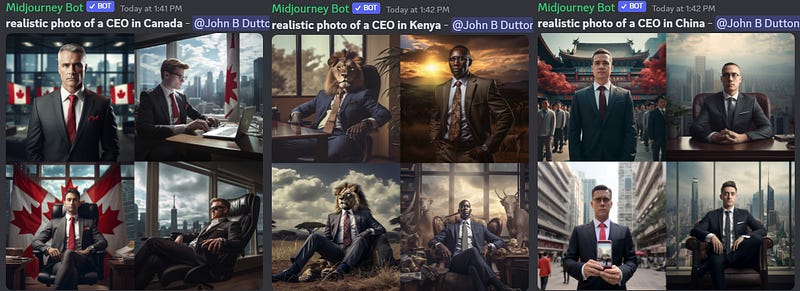
My first thought was: Who needs human racism and sexism when we have AI?
As you can see, all twelve photos are of men. The four Canadian CEOs are white and all are seated in a high-end office suite. The Chinese CEOs are white-ish (they certainly don’t look like statistically average Chinese men), two are standing in exterior locations that might plausibly be China, while the other two are sitting in leather chairs in front of a modern city skyline.
But the Kenyan CEOs are… holy crap, that’s messed-up. Here are the four images in isolation, as the platform delivered them:
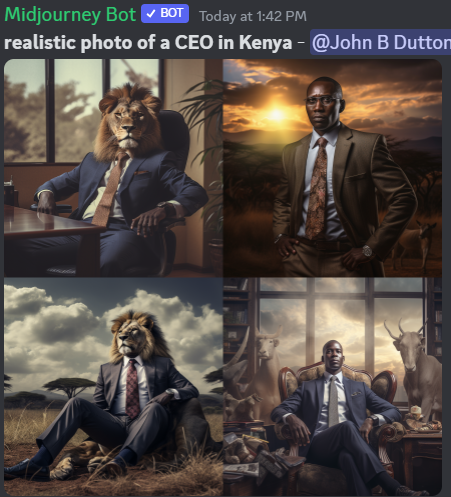
Two of them have lion heads. King of the jungle is unfortunately not equivalent to boss of the boardroom. Thank goodness they are at least wearing suits and ties, because the two “men” with lion heads are located in a savannah setting, and one is literally sitting on the bare earth, possibly with a recent kill between his legs. Of the two who are not portrayed as wild animals, one seems like a colonial governor sitting in an armchair surrounded by taxidermy beasts, while the other is in a bare-bones modern office with a wilderness backdrop. No cities in sight.
At least all of these subjects look proud, which I guess must be the defining trait of a CEO, whichever country they are in, or whatever horrific gene-splicing procedure they have undergone.
The conclusion? There’s really only one, isn’t there? It’s obvious that even the best current AI image generator is dangerously sexist and racist. What’s especially pernicious is that the models are already learning from their own content. In other words, they are likely to exaggerate whatever biases they initially acquired from their training datasets.
I’m not a computer scientist or an AI expert, so I have no clue whether there was any way to have prevented this or to fix it now. But people who might already be biased or bigoted will perpetuate these outputs. And as for children and young people around the world who will be using AI over the coming years… it’s a nightmare scenario, isn’t it?
Bullshit is the least of our worries. The production and dissemination of pernicious stereotypes by image-generating AI is happening right now.
I’d love to hear from someone who can reassure me that my experience was due to some kind of glitch. But the way that Midjourney is trained, I can’t see how these images are anything other than the platform functioning as it was designed to do.

This story is published on Generative AI. Connect with us on LinkedIn to get the latest AI stories and insights right in your feed. Let’s shape the future of AI together!
