avatarKim Vertue

Free AI web copilot to create summaries, insights and extended knowledge, download it at here

2373

Abstract

g src="https://cdn-images-1.readmedium.com/v2/resize:fit:800/1*__dwnI-tTUjpeLOB_3yT0Q.jpeg"><figcaption><b>Elizabeth I featured in ‘A Royal Maundy’ (c.1560) attributed to Levina Teerlinc</b> [<a href="https://commons.wikimedia.org/wiki/File:Elizabethan_Maundy_Teerlinc.jpg">view license</a>]</figcaption></figure><p id="ae17">Elizabeth’s first years on the throne as a protestant Queen were perilous, and she used her image to promote her power among her subjects. Teerlinc designed the first great royal seal used by Elizabeth I and painted many portraits of Elizabeth as a young princess (one commissioned by Edward VI) and of the young queen; with her knights of the garter, on royal progress and carrying out state duties. But because she never signed her work, few paintings attributed to Teerlinc survive to this day. One miniature which scholars ascribe to Teerlinc shows Queen Elizabeth at a Maundy Thursday ceremony. This was an important public event where the Divinity of the monarch was shown in healing her sick subjects by laying on of hands, handing out coins, and symbolically washing the feet of poor women.</p><figure id="8574"><img src="https://cdn-images-1.readmedium.com/v2/resize:fit:800/1*8BlGoIrMv6VaCJckkfUsGw.jpeg"><figcaption><b>the first ‘Great Seal of the Realm’ (1559) designed for Queen Elizabeth I by Levina Teerlinc</b> *</figcaption></figure><p id="c501">Levina Teerlinc was granted English citizenship and she and her husband built a handsome house in Stepney where, after an illustrious career, Teerlinc died in 1576. Throughout her life she was treated as a gentlewoman at court, and received gifts in exchange for her New Year portraits (Mary I gave her a salt cellar of considerable worth) in addition to her handsome annuity which meant she never needed to seek private commissions for extra income. Some scholars believe Teerlinc trained her successor, Nicholas Hilliard, who was to design Elizabeth’s second royal seal.</p><p id="ba7a">Teerlinc is a shadowy figure because she never signed her work, but she developed miniatures as beautiful and very human glimpses into the private lives of Tudors, behind the changes at court, during a tumultuous period in English history. Some of these precious miniatures would’ve been secret love tokens, provided with discretion and not shown widely. For this reason, historians suggest that

Options

many of Teerlinc’s miniatures may be erroneously attributed to other artists.</p><p id="a1df">Many more examples of miniatures by her successor, Nicholas Hilliard, survive. Perhaps because he marked his work and also indulged in self-promotion, producing self-portraits that demonstrated his skill. He went on to produce many miniatures of famous Elizabethan figures such as the explorer Sir Frances Drake, the Earl of Southampton (patron to Shakespeare) and more informal portraits.</p><figure id="0f88"><img src="https://cdn-images-1.readmedium.com/v2/resize:fit:800/1*1dY6a2H4LYuj4vJ8KVBUiA.jpeg"><figcaption><b>miniature portrait of an unknown man, backlit by fire (c.1580s), and miniature self-portrait of the artist, Nicholas Hilliard (c.1577)</b> [view license<a href="https://commons.wikimedia.org/wiki/File:Hilliard_flames.jpg"> 1 </a>and<a href="https://commons.wikimedia.org/wiki/File:Nicholas_Hilliard_021.jpg"> 2 ]</a></figcaption></figure><p id="66dd">One of an unknown man against a background of flames, wearing an open shirt and clasping another miniature (presumably of his lover) worn about his neck, looks amazingly contemporary — like a still from a pop video. It reminds us that Elizabeth’s Tudor England looked forwards rather than back, in order to survive as a new Protestant nation. Elizabeth’s cult of personality helped maintain her long reign and encouraged a flowering of progress, establishing England as a key player in Europe and developing the basis for many aspects of our modern society.</p><p id="8245"><i>* All images are used with permission, or are of works in the Public Domain, sourced from Public Collections, and presented here for educational purposes under fair usage policy.</i></p><div id="d213" class="link-block"> <a href="https://readmedium.com/merians-metamorphosis-5685962c5831"> <div> <div> <h2>Merian’s Metamorphosis</h2> <div><h3>A closer look at the art and science of illustrator and pioneering entomologist Maria Sibylla Merian</h3></div> <div><p>medium.com</p></div> </div> <div> <div style="background-image: url(https://miro.readmedium.com/v2/resize:fit:320/1*6LvUcxEb-KMRMdDzznspMw.jpeg)"></div> </div> </div> </a> </div></article></body>

Who was Levina Teerlinc?

She was big in Tudor miniatures and the most successful painter you haven’t heard of…

The English Renaissance is remembered as the golden age of Queen Elizabeth I, and for the great plays of Shakespeare, the Tudor voyages of discovery, and the intimate, exquisite miniatures that were designed to be exchanged and kept close to the heart. This portable intimacy is a tantalising glimpse into the private lives of Tudors amid the intrigues at court. Nicholas Hilliard is the most famous yet before him there was a female court painter — Levina Teerlinc.
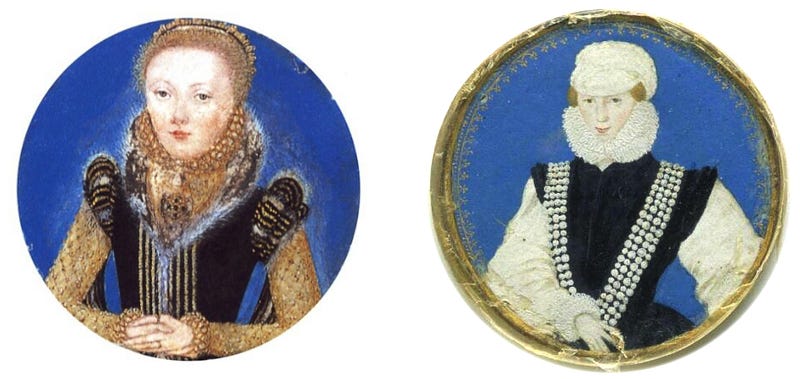
two miniatures by Levina Teerlinc: Queen Elizabeth I (c.1665, left), and Mary Dudley Lady Sidney (c.1575) one of her ladies in waiting, nurse, and confidante who was often given diplomatic duties [view license 1 and 2 ]

Born 1520 in Bruges, she was trained by her father Simon Bening, a successful liminer, or painter of miniatures, and illustrator of illuminated manuscripts. The techniques for both are similar using fine brushes, often of squirrel hair, and watercolour, sometimes thickened by gum arabic, on fine vellum. Some miniature portraits were stiffened with a backing of a playing card and often placed in elaborate lockets or boxes with lids so they could be protected and kept secret as a concealed pendant or broach — quite literally worn ‘close to the heart.’

By 1545 Levina was married to George Teerlinc and the couple had moved to England, where King Henry VIII retained her as a ‘paintrix’ to his court on a handsome annuity of £40 a year. She remained court painter to Henry’s son Edward VI, his eldest daughter Mary I, and his second daughter Elizabeth I. She also painted a miniature of Lady Jane Grey, the fated ‘nine days queen’ who attempted to succeed to the throne instead of the catholic Mary I after Edward’s death. This suggests she was a great diplomat as well as a gifted artist!
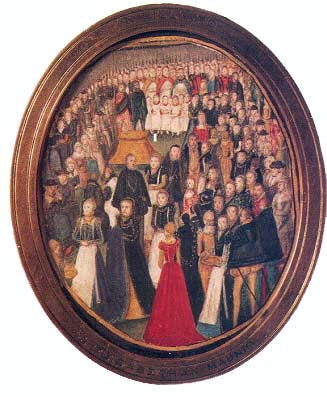
Elizabeth I featured in ‘A Royal Maundy’ (c.1560) attributed to Levina Teerlinc [view license]

Elizabeth’s first years on the throne as a protestant Queen were perilous, and she used her image to promote her power among her subjects. Teerlinc designed the first great royal seal used by Elizabeth I and painted many portraits of Elizabeth as a young princess (one commissioned by Edward VI) and of the young queen; with her knights of the garter, on royal progress and carrying out state duties. But because she never signed her work, few paintings attributed to Teerlinc survive to this day. One miniature which scholars ascribe to Teerlinc shows Queen Elizabeth at a Maundy Thursday ceremony. This was an important public event where the Divinity of the monarch was shown in healing her sick subjects by laying on of hands, handing out coins, and symbolically washing the feet of poor women.
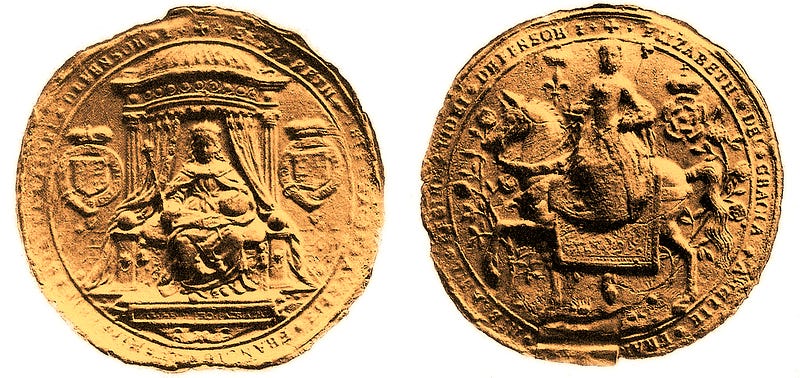
the first ‘Great Seal of the Realm’ (1559) designed for Queen Elizabeth I by Levina Teerlinc *

Levina Teerlinc was granted English citizenship and she and her husband built a handsome house in Stepney where, after an illustrious career, Teerlinc died in 1576. Throughout her life she was treated as a gentlewoman at court, and received gifts in exchange for her New Year portraits (Mary I gave her a salt cellar of considerable worth) in addition to her handsome annuity which meant she never needed to seek private commissions for extra income. Some scholars believe Teerlinc trained her successor, Nicholas Hilliard, who was to design Elizabeth’s second royal seal.

Teerlinc is a shadowy figure because she never signed her work, but she developed miniatures as beautiful and very human glimpses into the private lives of Tudors, behind the changes at court, during a tumultuous period in English history. Some of these precious miniatures would’ve been secret love tokens, provided with discretion and not shown widely. For this reason, historians suggest that many of Teerlinc’s miniatures may be erroneously attributed to other artists.

Many more examples of miniatures by her successor, Nicholas Hilliard, survive. Perhaps because he marked his work and also indulged in self-promotion, producing self-portraits that demonstrated his skill. He went on to produce many miniatures of famous Elizabethan figures such as the explorer Sir Frances Drake, the Earl of Southampton (patron to Shakespeare) and more informal portraits.
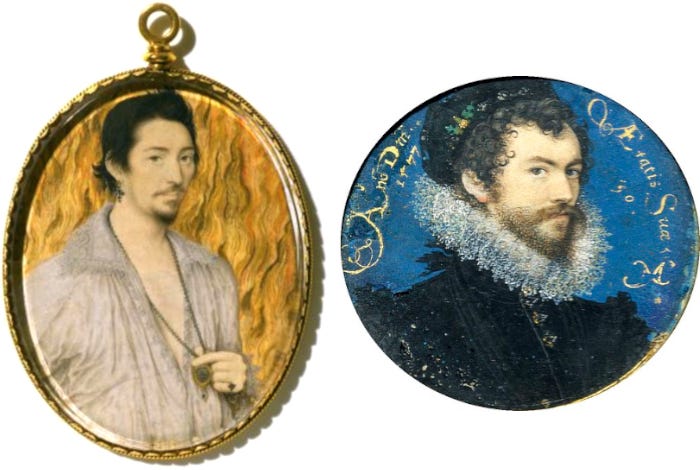
miniature portrait of an unknown man, backlit by fire (c.1580s), and miniature self-portrait of the artist, Nicholas Hilliard (c.1577) [view license 1 and 2 ]

One of an unknown man against a background of flames, wearing an open shirt and clasping another miniature (presumably of his lover) worn about his neck, looks amazingly contemporary — like a still from a pop video. It reminds us that Elizabeth’s Tudor England looked forwards rather than back, in order to survive as a new Protestant nation. Elizabeth’s cult of personality helped maintain her long reign and encouraged a flowering of progress, establishing England as a key player in Europe and developing the basis for many aspects of our modern society.

* All images are used with permission, or are of works in the Public Domain, sourced from Public Collections, and presented here for educational purposes under fair usage policy.

Art
Art History
History
Tudors
Renaissance
Recommended from ReadMedium