
Merian’s Metamorphosis
A closer look at the art and science of illustrator and pioneering entomologist Maria Sibylla Merian
It’s hard to believe that around 400 years ago, when the Royal Society was first established in London by Charles II, people still believed in the theory of ‘spontaneous generation’ — that maggots arose from rotting meat, swallows from mud, and caterpillars from cabbages. It seems that nobody had watched caterpillars hatch from eggs, devour leaves they were laid upon, turn into pupa then emerge as moth or butterfly that then repeated this glorious life cycle — until Maria Sibylla Merian.
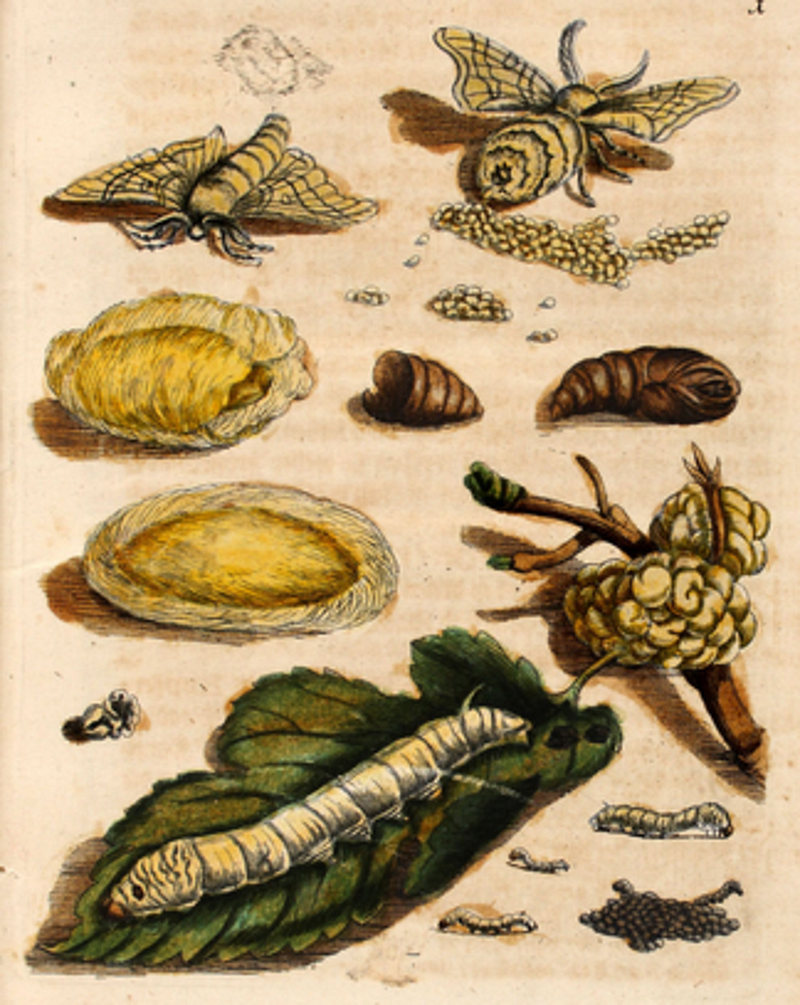
Although she has been commemorated on German banknotes, Merian is often overlooked today as both artist and naturalist. Yet she was the first to depict, in the same image, the full life cycle of the eggs, caterpillar, pupae and adult form of an insect. The first of these illustrations was of the silk moth, which she first began to study at the age of 13. Her innovative approach became the accepted method for naturalists and is widely seen in scientific illustration, identification guides, botanical and decorative art, to this day.
Merian was born in Frankfurt, 1647, into a family of artists and printers. Her father was the engraver and publisher Matthäus Merian the Elder. When he died, her mother married still–life painter Jacob Marrel, who encouraged his stepdaughter’s talent. As a young girl, Maria Sibylla Merian painted flowers, before becoming obsessed with caterpillars and how they metamorphosed into moths and butterflies.
At sixteen, Merian married Johann Andreas Graff, an artist who had been her stepfather’s apprentice. It wasn’t a happy marriage, but even as a mother of two daughters, she found time to rear caterpillars and draw them as they developed. In 1679, a year after the birth of her second daughter, Merian published Der Raupen Wunderbarer Verwandlung / The Wondrous Transformation of Caterpillars, which was the culmination of almost two decades of observations.
She also earned an independent income teaching well-to-do ladies the art of watercolour painting and embroidery using flowers as her chief subject. At that time, still lifes and flowers were often depicted with insects, perhaps a butterfly, to show the fragility of the subjects, but Merian produced meticulous, glorious watercolours of the insects themselves, with their food plants as the backdrop.
It had been fashionable to draw botanical specimens reared in gardens often collected into books known as ‘Herbals’, and also to compile illustrations of animals, real and imagined, to produce ‘Bestiaries’. These books rarely relied on direct, first-hand observation and were often more interested in the symbolism of the specimens rather than accuracy.
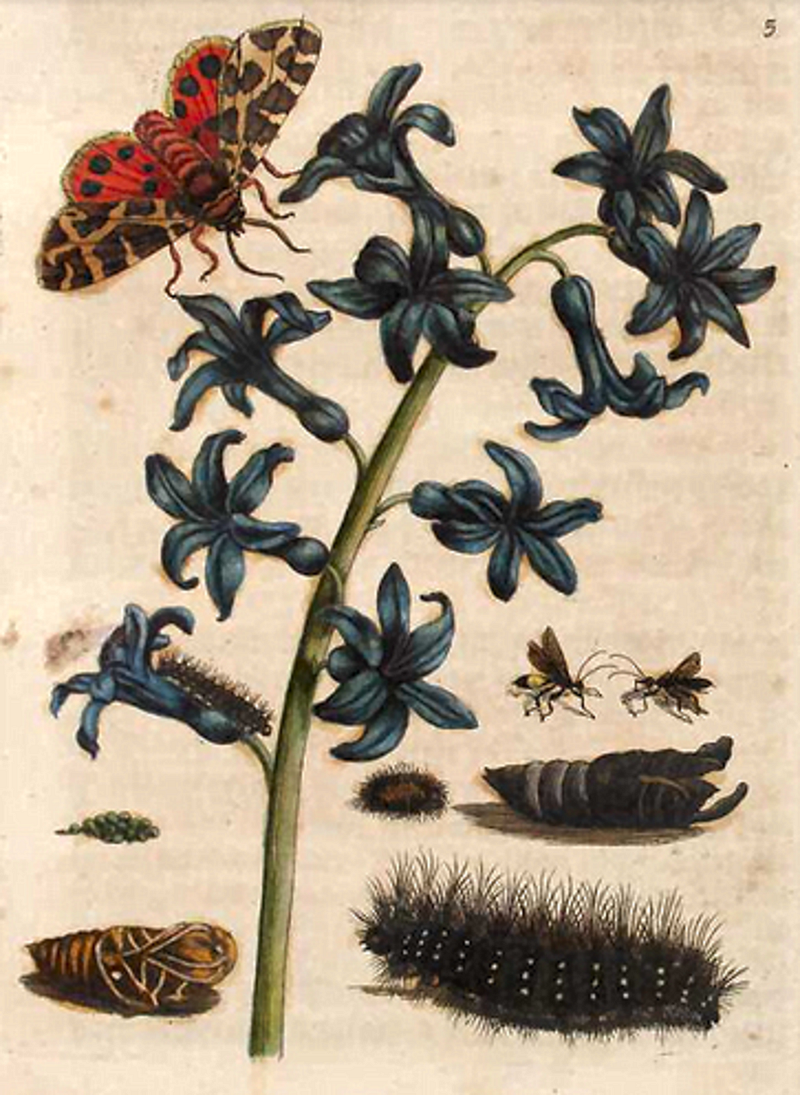
Mythical beasts had been mixed-in with others approximated from second-hand accounts. Plants were sometimes given faces, or their roots drawn to resemble human form. Merian however relied upon her own primary observations to produce scientifically accurate watercolours and engravings as an expression of her ongoing fascination. She even included details of parasitic wasp species that relied on some of the caterpillars as part of their own life cycle. She began to show us how nature is one big intricately interwoven system.
In her late thirties, she divorced her husband over differences in faith and moved into a Labadist castle commune with her mother and two daughters. When she was in her fifties, she became fascinated with specimens of insects sent back from Surinam, a colony that Holland had recently swapped for New Amsterdam in an arrangement with England.
She financed her own independent scientific mission with her daughters and spent two years studying the flora and fauna of the colony. Enlisting help from the natives, they tracked deep into rain-forest, and collected live specimens to draw and paint.
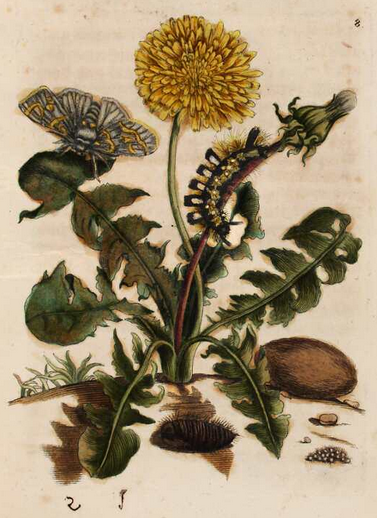
The resulting engravings revolutionised scientific illustration as she collected and observed living creatures, rather than drawing dead specimens. She was the first artist to illustrate the entire life cycle of any insect, its characteristic behaviours, food plant and habitat, all within a single image.
Science still relies on art to communicate such information in a more accurate and vibrant way than herbariums (pressed flowers and specimens) can portray. Using an image to convey knowledge and ideas is a powerful tool and we still favour pictures and info-graphics over ‘dry’ text.
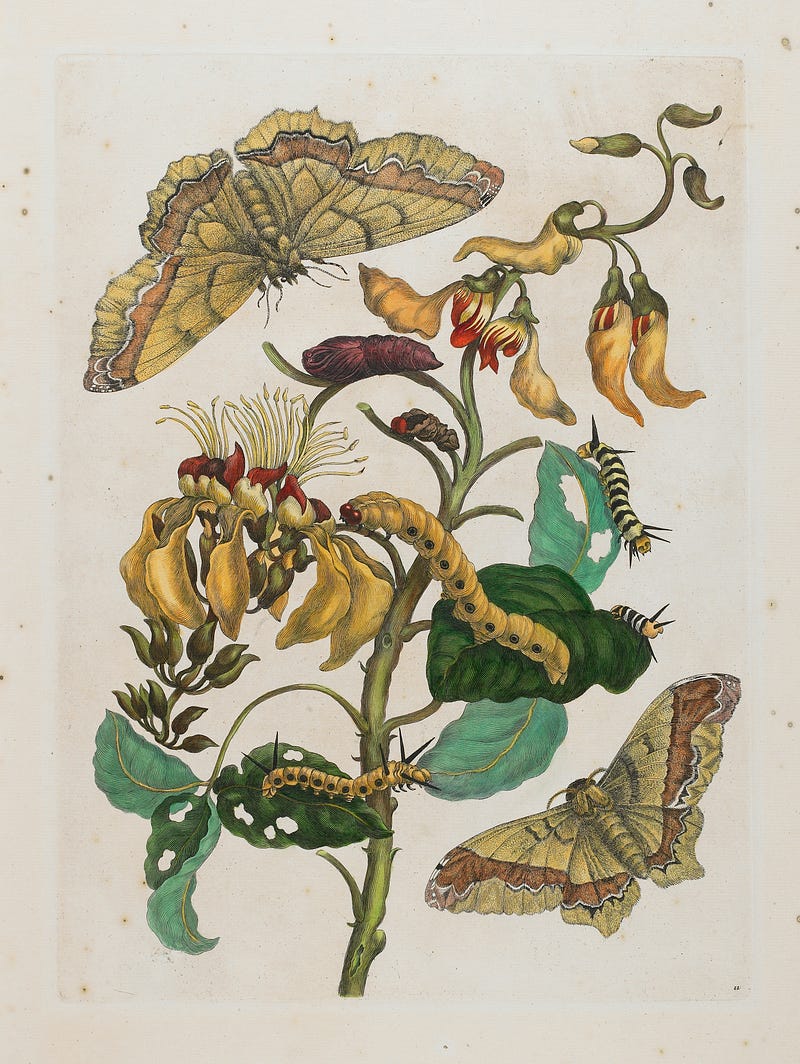
Earlier in the century, Charles Butler first published his discovery that it was a queen which ruled the beehive. This had long been a symbol used by monarchs to denote industry and ordered society. Merian, of course, had an interest in a society where women had more rights and powers — she had set up her own business in Holland with her daughters to earn themselves a living. Perhaps it was the matriarchal society of the hive that fuelled her own interest in entomology…
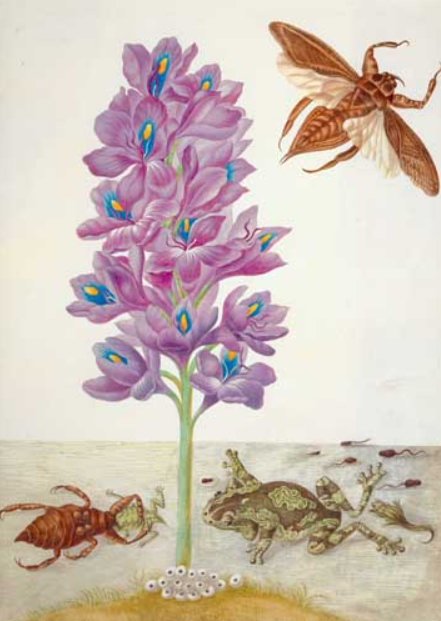
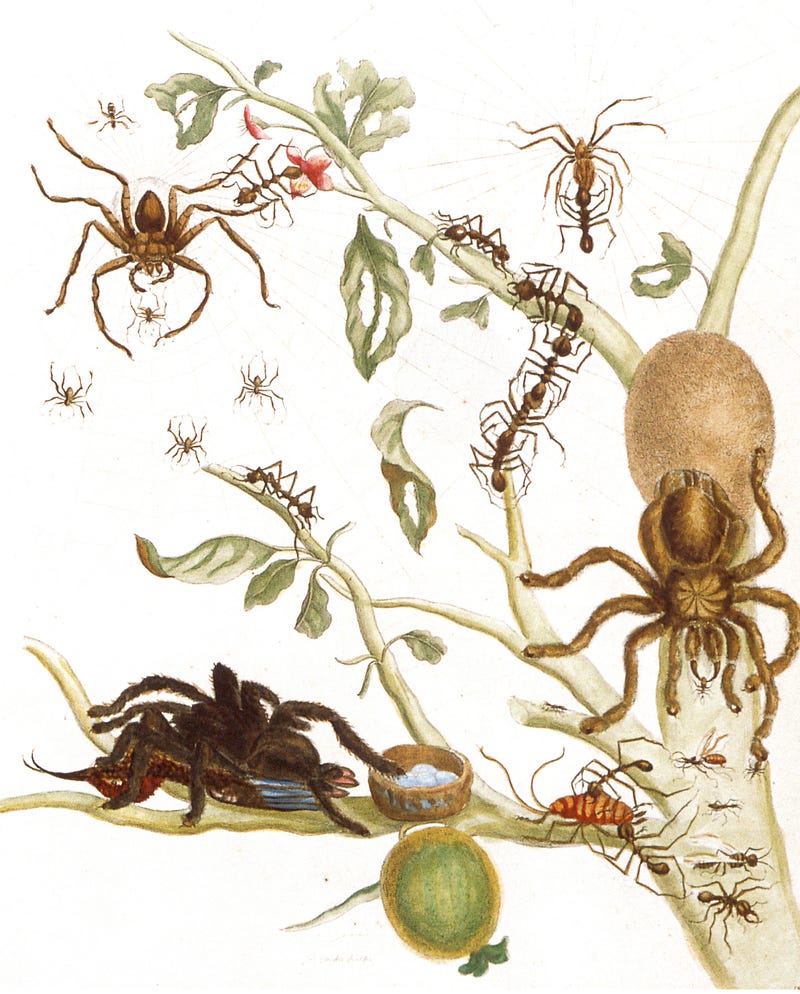
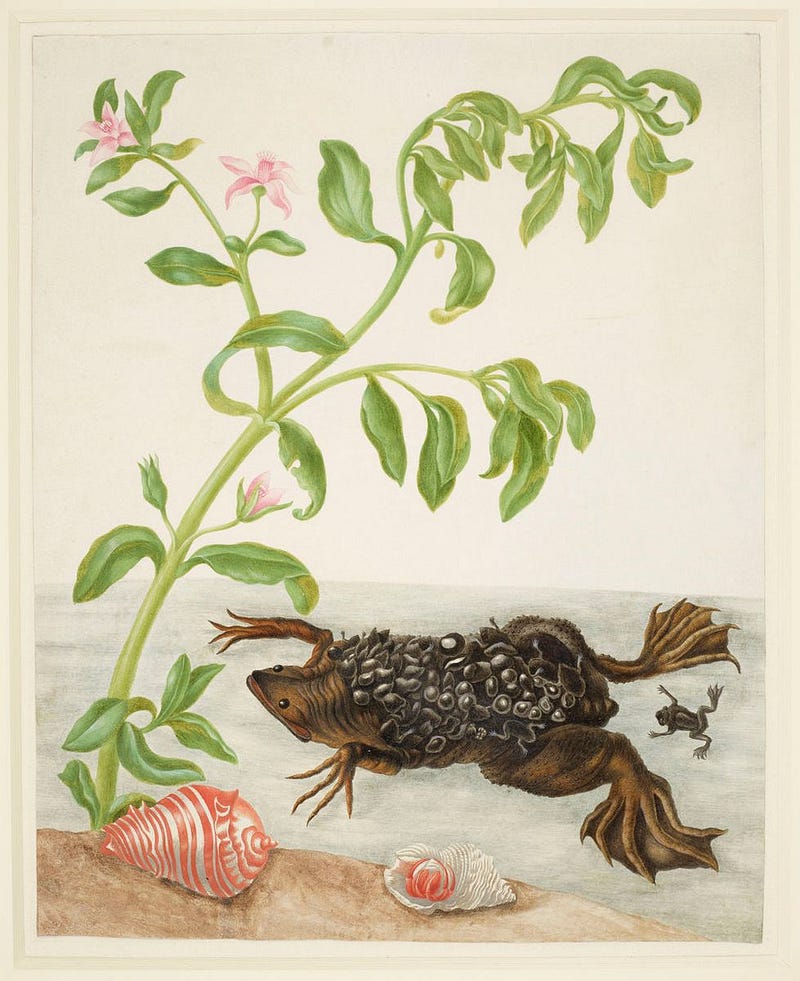
On her return from her scientific expedition to Surinam (which is now spelled with an additional ‘e’ — Suriname), she produced the landmark book Metamorphosis Insectorum Surinamensium / Metamorphosis of the Insects of Surinam which, among other things, had the first illustration of leaf-cutter ants at work. She also showed a Suriname Toad carrying it young on its back, the first time such behaviour had ever been recorded. These depictions have great scientific and aesthetic value. They show a talented artist at work — lively compositions with vibrant colours, which our modern eyes still find beautiful. They were also accurate, with realistically half-chewed leaves and less than perfect blooms.
Upon her death, Peter the Great of Russia and George III of England purchased her work for their Royal Collections and, many years later, when Linnaeus began his system for the scientific classification of flora and fauna, he used some of Merian’s illustrations to identify new species.
So, not only was Merian an important pioneer of botanical art, which she made pleasing and accurate. She was also part of the bedrock of modern biological science, and her ‘wholistic’ approach of looking at the ecology around each species remains relevant to this day as we come to realise just how interdependent our world’s biosphere is.


