
THOUGHT PROVOKING
Who Gets to Decide Who’s Worthy?
The moral paradox
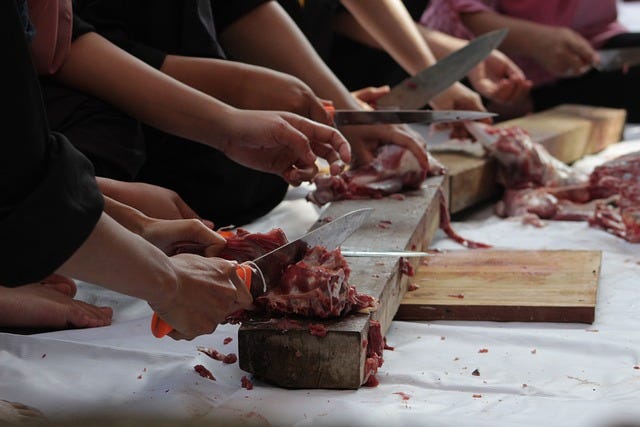
“If we truly lived in a world based on survival of the fittest humans — who would die off? An entire generation? The uneducated? Republicans? Democrats because the Republicans have all of those guns? The elderly? The young? The unhoused? The morbidly obese? The poor?”
I always chuckle when I see people making their case about the world being a better place if certain people weren’t living among us.
It’s a bitter amusement because that has to do more with human behavior and ways of thinking than anything else. And those cannot be controlled or influenced 100% across generations without using some drastic measures that turn the advocate into a tyrant — judge, jury, and executioner.
In such cases, the road to hell is paved with good intentions, at the very least. First there’s an innocent wish for the better, then reality hits: “We must do something; just wishing for it’s never gonna cut it.”
But if you feel like that, you open the Pandora box of hate, brutality, and tyranny. You end up feeling cruel, cold, and insensitive, scaring even yourself in the process. That’s not who you want to be, no matter how justified your feelings are.
There’s a thin line between “these people shouldn’t be allowed to exist” and “let’s make sure they don’t,” condoning the need for a well-organized, surgical, and emotionless culling of their species.
Take violent criminals, rapists, child molesters, murderers, and serial killers, for example. All of these specimens make us tap into our cruel side every time we think about their deeds. In our mind, there’s a festering thought that their lives amount to nothing and they shouldn’t be treated as humans when punishment is administered.
That’s a scary thought because deep down we realize that, up to a certain point, we start to become as vicious and disregarding of another human person as the scum I mentioned before. It doesn’t matter how justified it seems. We feel the need to be the good guys, and the “Yeah, they need to go, and if they go out screaming and suffering, it’s even better” way of thinking doesn’t make us feel like good people.
Then there’s the lighter version of this. Some people are annoying, intrusive, radical, bullying, and mean. Maybe they’re not walking around committing crimes, but yet again, we feel like the world would be better without them.
And then there’s the lowest of the lows. There are those among us who advocate that the world would be a better place if the human population were reduced by 90%, let’s say. The 90–10 equation that I first heard about right here on Medium.
Sure, maybe there’s a practical side to it. The world is certainly overpopulated, and most humans aren’t really contributing to humanity in any deeper and more meaningful way.
But that’s just an excuse. That type of person can’t really justify the means when the way they think is actually a reasonable way of portraying genocide — the good ole “it’s for the greater good” that every tyrant used in the past — well dressed in some sort of philosophical bullshit way.
If you push the bullshit aside, it all comes down to who gets to play God. It’s safe to say that whoever advocates for the 90–10 theory sees themselves as the one who gets to do that, as the 10%. And that’s questionable, because one can argue that the level of danger they pose might overwhelm the major contribution they make to society.
It’s all a matter of perception. For the discarded 90%, the 10% would be the ones needing to go. Even sheep would look at a wolf and say, “Better you than me, fam,” when fighting for survival. And it makes less sense when the wolf claims he’s so cool he doesn’t really need to eat sheep meat, but for the sake of those who are left behind, he must.
Well, who’s left behind? The wolves who claim they don’t really need the sheep? How’s that making sense? Without the 90%, the 10% would not be anything special. That X in the equation is special because it’s the only unknown factor. If you remove the rudimentary numbers, then the X just marks the spot on an empty piece of paper.
Anyway, who the fuck wants to live in a world in which the weak and needy are exterminated? I can’t really see how any decent human being would view this shit as a utopia, even at a hypothetical level.
Can someone really call themselves strong and smart when they see the weak and the stupid as annoying or bothersome? Or when they take advantage of the weakness and stupidity of others? Or even worse, when they advocate for the extermination of the weak and foolish?
Slap me silly, but I think that real strength is when you have the capacity to control, force, and enforce, but you choose not to do it. Real strength is when you’re weak and you still stand up to the strong. And being smart is when you realize you’re nothing special — not your merit in any form, shape, or way — you were just born that way.
Therefore, I find this debate about who should or shouldn’t survive extremely dangerous, if you look at it from a human’s perspective. Sure, it might happen all the time, naturally or indirectly. Because sometimes nature involves human-influenced external factors (like society). But if we look for a more direct approach, that’s just evil in my book!
I might need to make this into two parts to cover all the aspects without boring people with a long post. So stay tuned.
Think Hard & Dig Deep Prompt #9: I’m asking you essentially — who SHOULDN’T be surviving right now in terms of Darwinism? Explain your reasoning. — by Ruby Noir 😈.


