avatarAllison Wiltz

Free AI web copilot to create summaries, insights and extended knowledge, download it at here

5589

Abstract

href="https://www.gsb.stanford.edu/insights/why-whites-downplay-their-individual-racial-privileges">an article</a> published in Standford Business, “<i>white people downplay their individual racial privileges</i>.” However, downplaying their privileges is a blatant attempt to protect white innocence. They don’t want to think of their great uncle with his <a href="https://www.loc.gov/rr/print/list/085_disc.html">whites-only store</a> or their other problematic family members and “<a href="https://www.bbc.com/news/world-us-canada-47477354">heroes</a>.” When white people attempt to protect white innocence, they place truth on the chopping block.</p><p id="3f75">Imagine the re-emerging character of <a href="https://www.jstor.org/stable/1409497">the cowboy</a> in American cinema. He played the role of the white hero, protecting and furthering the needs of white supremacy as it spread throughout the West. The cowboy was willing to kill Indigenous people, and Hollywood was ready to glorify that. Directors portrayed white people as <a href="https://www.jstor.org/stable/1409497">innocent settlers</a>, even though they actually colonized land <a href="https://www.cowboysindians.com/2014/11/sand-creek-massacre/">owned by</a> Indigenous people. White people’s collective desire to maintain white innocence transforms history into fairy tales.</p><p id="557b">White people feel triggered when white innocence is threatened. That’s why most of our history books portray settlers as noble despite their cruelty. White people who run from their privilege find themselves on a wild goose chase, desperately trying to distance themselves from the harmful <a href="https://www.forbes.com/sites/jeffraikes/2019/07/16/americas-legacy-of-white-supremacy/?sh=7565acd66ee2">legacy of whiteness</a>.</p><p id="e66e">Jeff Raikes, a contributor at Forbes magazine, said, “<a href="https://www.forbes.com/sites/jeffraikes/2019/07/16/americas-legacy-of-white-supremacy/?sh=7565acd66ee2"><i>The term white supremacy makes me uncomfortable</i></a>.” After feeling this discomfort, what, if anything, will white people do about it. More often than not, white people feel triggered and then use that discomfort as an excuse to disengage. Accepting the cold hard reality of systemic racism challenges white innocence.</p><h2 id="8312">Accountability brings about feelings of white guilt</h2><p id="36fe">White people feel triggered by equality because admitting the system is riddled with systemic racism makes them feel responsible. That’s when white guilt creeps into the scene. Accountability triggers white people because they have no idea what accountability would look like.</p><p id="7b83">Imagine you are playing a game of streetball with your friends. Everything seems fine until one of your friends accidentally breaks a neighbor’s window. You can either knock on the door, leave a note, or apologize in some way or you could run away and hide in the bushes. Which would you choose?</p><p id="cf93">Accountability triggers white people because they lose control. For example, you cannot break someone’s window and then say, <i>“I will only pay you $10. Take it or leave it</i>.” The trigger or tension comes from not knowing what the person will expect. Maybe the neighbor wants you to rake leaves for a few weeks or give her a ride to Home Depot to help her replace the window. People who want to avoid accountability don’t want to deal with their actions' physical or mental cost.</p><p id="7650">White people feel triggered by accountability for systemic racism because they are afraid of what Black people will want. They’re terrified that we will ask for “<i>too much</i>,” and rather avoid the conversation altogether.</p><p id="8015">This perspective is selfish, and it also sells humanity short. Maybe the person will forgive you for breaking their window. But, when you duck and dodge, hiding behind shrubs, you deprive them of the opportunity to confront you in their own way.</p><p id="0f8e">Fully acknowledging that you have privileges deprived to Black people and people of color can overwhelm a white person. Maybe a stone-cold racist wouldn’t feel anything at all, but some white people will experience severe bouts of guilt. As a result, some white people try to keep Black people at arm’s length just to avoid feeling that way.</p><p id="6172">It’s essential to acknowledge that white people are born with white privilege. Their forefathers choose violence, and they don't want to feel guilty about that. But that’s too bad. The consequences of racism are too dire to dismiss because of white fragility. Even Black babies are <a href="https://www.washingtonpost.com/health/black-baby-death-rate-cut-by-black-doctors/2021/01/08/e9f0f850-238a-11eb-952e-0c475972cfc0_story.html">more likely to die</a> when in the care of white doctors. There is no escaping the privilege. But there’s no reason to live in sorrow because each person has power.</p><p id="00e4">Instead of wallowing in guilt, white people can take accountability for the privileges they enjoy and use their <a href="https://www.urbandictionary.com/define.php?term=clout">clout</a> to pursue equality. Accountability triggers white people, bringing about feelings of guilt. But whether white people move past this stage is entirely up to them.</p><figure id="a913"><img src="https://cdn-images-1.readmedium.com/v2/resize:fit:800/0*u_AXUkq43sZpaSOi"><figcaption>Photo by <a href="https://unsplash.com/@chesterwade?utm_source=medium&amp;utm_medium=referral">chester wade</a> on <a href="https://unsplash.com?utm_sourc

Options

e=medium&utm_medium=referral">Unsplash</a></figcaption></figure><h2 id="6c4f">Committing to structural change threatens white supremacy</h2><p id="7bd2">Even when a white person accepts the harmful role of systemic racism and overcomes their fear of accountability, they may still feel triggered by commitment. Anyone can look at a video of police brutality, like in the case of <a href="https://www.nytimes.com/video/us/100000007159353/george-floyd-arrest-death-video.html">George Floyd</a>, and sympathize with him. However, very few committed to structural changes. Why is that?</p><p id="4063">Well, when you commit to structural change, you threaten white supremacy. For example, fighting for diversity in the workplace may mean you have fewer white colleagues. Even some white people who care about Black people as human beings don’t want to change the system. They have everything to lose.</p><p id="db39">In <a href="https://readmedium.com/white-people-will-never-get-sick-and-tired-of-racism-because-they-benefit-e87422f78ec3"><b><i>White People Will Never Get Sick and Tired of Racism Because They Benefit</i></b></a>, I explored this dynamic. Within the piece, I argue that “<i>White people are unlikely to give up racism because they have benefits and no consequences for maintaining inequities</i>.”</p><div id="7611" class="link-block"> <a href="https://readmedium.com/white-people-will-never-get-sick-and-tired-of-racism-because-they-benefit-e87422f78ec3"> <div> <div> <h2>White People Will Never Get Sick and Tired of Racism Because They Benefit</h2> <div><h3>The privilege feels too good to let go</h3></div> <div><p>medium.com.</p></div> </div> <div> <div style="background-image: url(https://miro.readmedium.com/v2/resize:fit:320/1*uJnMnpLfmXaZ2VPXaspeMg.jpeg)"></div> </div> </div> </a> </div><p id="7c96">If white people didn’t benefit from systemic racism, they would have dismantled the system of white supremacy ages ago. The sad part is, they do benefit, and the idea of losing those benefits is potentially the most triggering feature of equality.</p><h2 id="1d44">Where do we go from here?</h2><p id="0807">A lot has changed since the racial reckoning began. For one, white people are less committed to confronting personal and systemic racism. What started as an interracial movement is dissolving before our very eyes. White support for Black Lives Matter has <a href="https://www.nytimes.com/2021/05/22/opinion/blm-movement-protests-support.html">plummeted.</a> While the initial response to police brutality was horror, it was followed quickly by complacency. Some <a href="https://www.bostonglobe.com/2020/09/24/metro/new-survey-says-white-support-black-lives-matter-has-slipped-some-historians-say-theyre-not-surprised/">historians</a> saw this stage coming because white people have a track record for disengaging.</p><p id="878f">However, unlike during the Civil Rights Movement, my generation has no federal legislation to show for it. Now that the dust has settled and white people have retreated into denial and apathy, I wonder what hope we have for re-establishing our civil rights. If white people continue to feel triggered by the very idea of equality, then where does that leave us? When it comes to people, equality is complex. But it shouldn’t be. We just have to check our values and make sure our society lives up to them.</p><div id="da8e" class="link-block"> <a href="https://aninjusticemag.com/victorias-secret-karen-plays-victim-after-racist-attack-db6979f0eb0f"> <div> <div> <h2>Victoria’s Secret Karen Plays Victim After Racist Attack</h2> <div><h3>When white women weaponize their tears, they expose intent</h3></div> <div><p>aninjusticemag.com.</p></div> </div> <div> <div style="background-image: url(https://miro.readmedium.com/v2/resize:fit:320/1*A0-qqv2QTOfZK3q0LV2GjA.png)"></div> </div> </div> </a> </div><div id="7e84" class="link-block"> <a href="https://momentum.medium.com/flipping-cars-without-a-care-the-apex-of-white-privilege-835f66e5b829"> <div> <div> <h2>Flipping Cars Without A Care — The Apex of White Privilege</h2> <div><h3>Black Lives Matter protestors couldn’t get away with this</h3></div> <div><p>momentum.medium.com</p></div> </div> <div> <div style="background-image: url(https://miro.readmedium.com/v2/resize:fit:320/1*d2pA44ZAPQnakQ_4Ha6AaA.jpeg)"></div> </div> </div> </a> </div><div id="5234" class="link-block"> <a href="https://aninjusticemag.com/why-your-perception-of-martin-luther-king-jr-is-smoke-and-mirrors-b95e81765936"> <div> <div> <h2>Why Your Perception of Martin Luther King Jr. is Smoke and Mirrors</h2> <div><h3>Assessing Martin Luther King’s non-violent civil disobedience</h3></div> <div><p>aninjusticemag.com</p></div> </div> <div> <div style="background-image: url(https://miro.readmedium.com/v2/resize:fit:320/1*nyY8oFYoQvWLpbUix-y1_w.jpeg)"></div> </div> </div> </a> </div></article></body>

BLACK LIVES MATTER

White People Feel Triggered By Equality. Here Are 3 Reasons Why

Unpacking their resistance to change

Photo Credit | Pegasus

Equality is supposed to be simple. I remember putting five blue bears in one cup and five red bears in another cup — my earliest memory of unpacking the concept. Something about the symmetry of this game made me smile. Somehow, when we substitute people for bears, the idea of equality becomes unnecessarily complex. Many white people feel triggered by the notion of equality and any attempt to implement policies that represent that value.

The American pledge of allegiance states, “I pledge allegiance to my Flag and the Republic for which it stands, one nation, indivisible, with liberty and justice for all. So, according to our national mantra, we’re supposed to live in an equal society which means that Black people have every right to protest when that mantra dissolves into broken promises.

White people feel triggered by equality because, deep down, they know our society maintains wealth and power in the hands of white people. So to create an equal society, things would have to change — that’s triggering for them.

More often than not, white people feel triggered and then use that discomfort as an excuse to disengage.

First things first, if we’re going to discuss equality, we should get this nefarious false equivalency out of the way. We need to acknowledge that the idea of reverse racism is a farce because racism “unfairly disadvantages some individuals and communities, unfairly advantages other individuals and communities.”— APHA Past-President Camara Phyllis Jones, MD, MPH, PhD

Sure, some Black people and people of color dislike white people. However, dislike is not the same as racism. It’s not even in the same ballpark. Black people live in a society where white people control most of the levers of power. Oodles of statistics continue to reveal deep-seated racial disparities. Yet, despite the available evidence, many white people seem triggered by attempts to facilitate equality. We need to unpack that.

While most white people like the idea of an equal society, they’ve shown a collective unwillingness to address racial inequality. The very notion of equality challenges the privileges white people have. They fear what they would have to give up, what sacrifices they would have to make. So instead of trusting the process, they are tensing up.

Let’s try to break it down rationally. If we have five red bears in one cup and five blue bears in another cup, neither is superior. Thus, there are only two possible reasons why red bears would oppose equal opportunities for blue bears. For one, the red bears could fear that equality would be a farce, that they would be cheated. Second, as an alternative, the red bears could hate the blue bears and thus oppose equality for the simple fact that it would help them. Are you following?

White people have to reckon with the logical fallacy of opposing attempts to create an equal, just society. While most would not openly admit, their resistance to fundamental change is clear as day. White privilege and the comforts it affords to cause a problem. Racism isn’t happening to white people, and it makes them doubt Black people’s experiences.

Many white people feel triggered by the very idea of equality. Here are three reasons why:
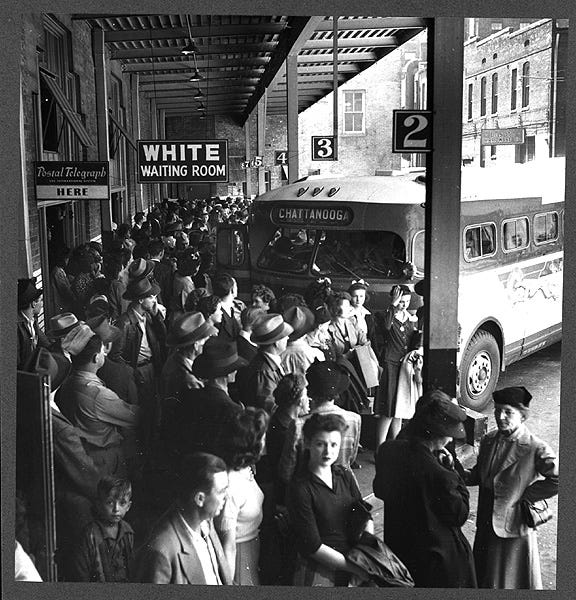
A Greyhound bus trip from Louisville, Kentucky, to Memphis, Tennessee, and the terminals. Waiting for the bus at the Memphis terminal | Photo Credit — Library of Congress

Accepting systemic racism challenges white innocence

If white people accepted the harmful nature of systemic racism, it would challenge their perception of white innocence. So, instead, most of them avoid, obscure, or deflect attention away from their white privilege.

According to an article published in Standford Business, “white people downplay their individual racial privileges.” However, downplaying their privileges is a blatant attempt to protect white innocence. They don’t want to think of their great uncle with his whites-only store or their other problematic family members and “heroes.” When white people attempt to protect white innocence, they place truth on the chopping block.

Imagine the re-emerging character of the cowboy in American cinema. He played the role of the white hero, protecting and furthering the needs of white supremacy as it spread throughout the West. The cowboy was willing to kill Indigenous people, and Hollywood was ready to glorify that. Directors portrayed white people as innocent settlers, even though they actually colonized land owned by Indigenous people. White people’s collective desire to maintain white innocence transforms history into fairy tales.

White people feel triggered when white innocence is threatened. That’s why most of our history books portray settlers as noble despite their cruelty. White people who run from their privilege find themselves on a wild goose chase, desperately trying to distance themselves from the harmful legacy of whiteness.

Jeff Raikes, a contributor at Forbes magazine, said, “The term white supremacy makes me uncomfortable.” After feeling this discomfort, what, if anything, will white people do about it. More often than not, white people feel triggered and then use that discomfort as an excuse to disengage. Accepting the cold hard reality of systemic racism challenges white innocence.

Accountability brings about feelings of white guilt

White people feel triggered by equality because admitting the system is riddled with systemic racism makes them feel responsible. That’s when white guilt creeps into the scene. Accountability triggers white people because they have no idea what accountability would look like.

Imagine you are playing a game of streetball with your friends. Everything seems fine until one of your friends accidentally breaks a neighbor’s window. You can either knock on the door, leave a note, or apologize in some way or you could run away and hide in the bushes. Which would you choose?

Accountability triggers white people because they lose control. For example, you cannot break someone’s window and then say, “I will only pay you $10. Take it or leave it.” The trigger or tension comes from not knowing what the person will expect. Maybe the neighbor wants you to rake leaves for a few weeks or give her a ride to Home Depot to help her replace the window. People who want to avoid accountability don’t want to deal with their actions' physical or mental cost.

White people feel triggered by accountability for systemic racism because they are afraid of what Black people will want. They’re terrified that we will ask for “too much,” and rather avoid the conversation altogether.

This perspective is selfish, and it also sells humanity short. Maybe the person will forgive you for breaking their window. But, when you duck and dodge, hiding behind shrubs, you deprive them of the opportunity to confront you in their own way.

Fully acknowledging that you have privileges deprived to Black people and people of color can overwhelm a white person. Maybe a stone-cold racist wouldn’t feel anything at all, but some white people will experience severe bouts of guilt. As a result, some white people try to keep Black people at arm’s length just to avoid feeling that way.

It’s essential to acknowledge that white people are born with white privilege. Their forefathers choose violence, and they don't want to feel guilty about that. But that’s too bad. The consequences of racism are too dire to dismiss because of white fragility. Even Black babies are more likely to die when in the care of white doctors. There is no escaping the privilege. But there’s no reason to live in sorrow because each person has power.

Instead of wallowing in guilt, white people can take accountability for the privileges they enjoy and use their clout to pursue equality. Accountability triggers white people, bringing about feelings of guilt. But whether white people move past this stage is entirely up to them.
Photo by chester wade on Unsplash

Committing to structural change threatens white supremacy

Even when a white person accepts the harmful role of systemic racism and overcomes their fear of accountability, they may still feel triggered by commitment. Anyone can look at a video of police brutality, like in the case of George Floyd, and sympathize with him. However, very few committed to structural changes. Why is that?

Well, when you commit to structural change, you threaten white supremacy. For example, fighting for diversity in the workplace may mean you have fewer white colleagues. Even some white people who care about Black people as human beings don’t want to change the system. They have everything to lose.

In White People Will Never Get Sick and Tired of Racism Because They Benefit, I explored this dynamic. Within the piece, I argue that “White people are unlikely to give up racism because they have benefits and no consequences for maintaining inequities.”

If white people didn’t benefit from systemic racism, they would have dismantled the system of white supremacy ages ago. The sad part is, they do benefit, and the idea of losing those benefits is potentially the most triggering feature of equality.

Where do we go from here?

A lot has changed since the racial reckoning began. For one, white people are less committed to confronting personal and systemic racism. What started as an interracial movement is dissolving before our very eyes. White support for Black Lives Matter has plummeted. While the initial response to police brutality was horror, it was followed quickly by complacency. Some historians saw this stage coming because white people have a track record for disengaging.

However, unlike during the Civil Rights Movement, my generation has no federal legislation to show for it. Now that the dust has settled and white people have retreated into denial and apathy, I wonder what hope we have for re-establishing our civil rights. If white people continue to feel triggered by the very idea of equality, then where does that leave us? When it comes to people, equality is complex. But it shouldn’t be. We just have to check our values and make sure our society lives up to them.

BlackLivesMatter
Racism
Equality
Politics
Life
Recommended from ReadMedium