
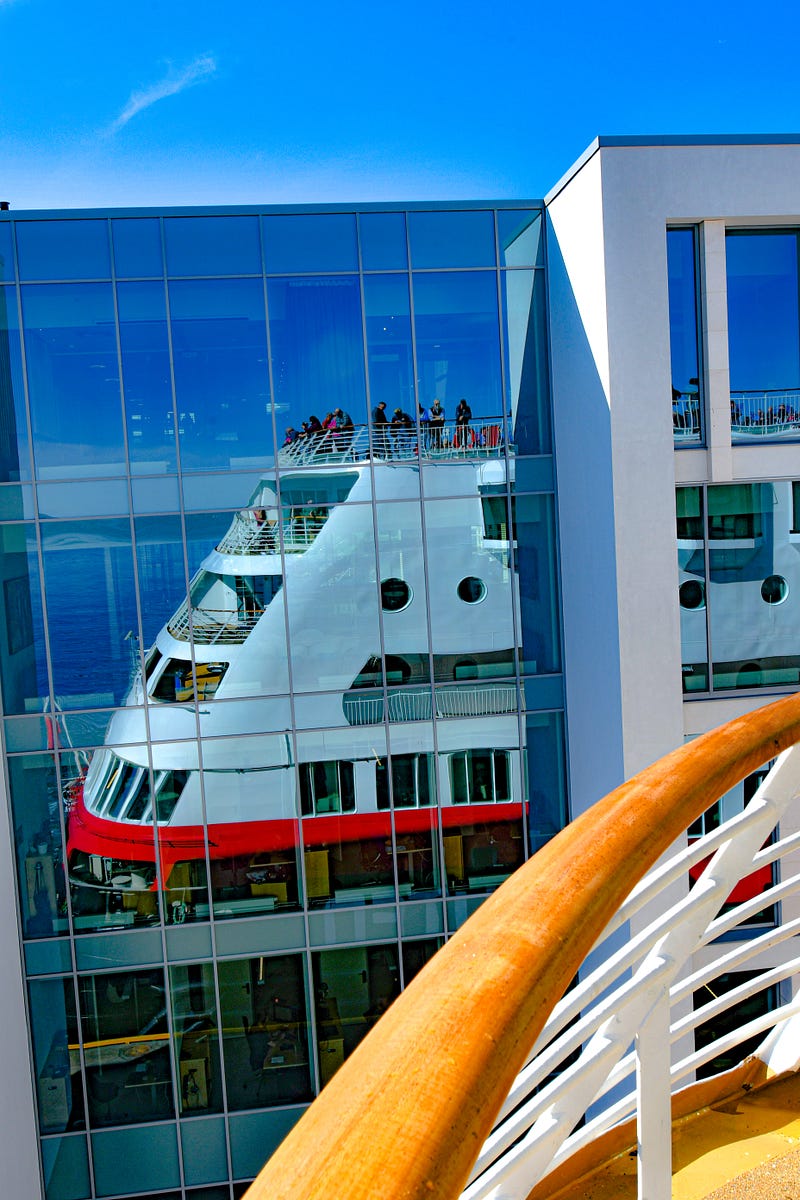
Which is Real and Which is an Illusion?
Musings on Time
I knew that we were headed to “The Land of the Midnight Sun,” where the sun never sets. And while I understood this concept intellectually, to experience it physically, viscerally, and emotionally was a completely different thing.
I recently returned from Norway, where my husband and I spent a week aboard the Hurtigruten, which is literally the local postal service/ferry/cruise ship. At all hours of the day and night, we pulled into tiny ports all the way up the coast from Bergen to Kirkenes (far up above the Arctic Circle) to drop off the mail.
For this reason alone, I am so happy to have chosen this mode of travel over an exclusive cruise line. I feel like we were so fortunate to be able to catch glimpses of some of these tiny towns, bordered by snow-capped mountain ranges and glacial blue fjords, which are only accessible by boat.
Because of the remoteness of these villages, and also because of the geography (which isolates them), locals hop onto the Hurtigruten and then disembark at the next town over. Or they might stay onboard one night, or three, choosing which port to hop off at.
We chose to ride the Hurtigruten up to the top of the world.
We began our journey in Bergen, where the nights are short this time of year (about a week before the Summer Solstice). Twilight descends about eleven. And there are only about three dark hours.
I knew that we were headed to “The Land of the Midnight Sun,” where the sun never sets. And while I understood this concept intellectually, to experience it physically, viscerally, and emotionally is a completely different thing.
There was a night, a few days before the summer solstice, after we had driven down the Trollstigen (Norway’s famous hairpin road embedded amongst mountains thought to be trolls frozen in time) and we were waiting in Molde, about eleven p.m., to be picked up by our boat.
The very air around us began to “pinken” like no other sunset I had ever seen.
To say that the snow-capped mountains on the far side of the bay had been brushed with copper fire and dusted with lilac powder would have been an understatement. Entranced, I watched this magical time of night materialize in front of my eyes. I could barely breathe for the beauty of it.
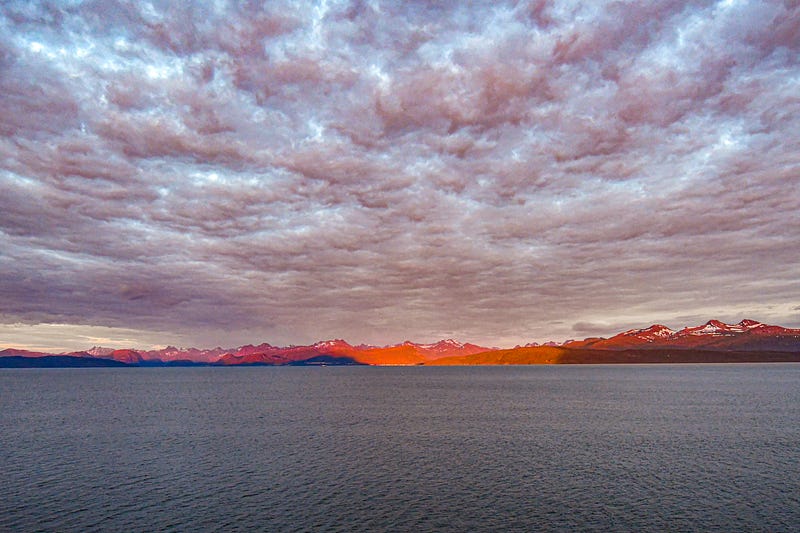
That far north, the sun never sets in the summer. Rather, it hovers just above the horizon, painting the whole world with the glow of the heavens.
Once back on the boat, I perched up on the balcony with my camera. Frissons of excitement continually coursed through my body. The sheer beauty of Mother Nature overwhelmed me with what I can only describe as a transcendent experience.
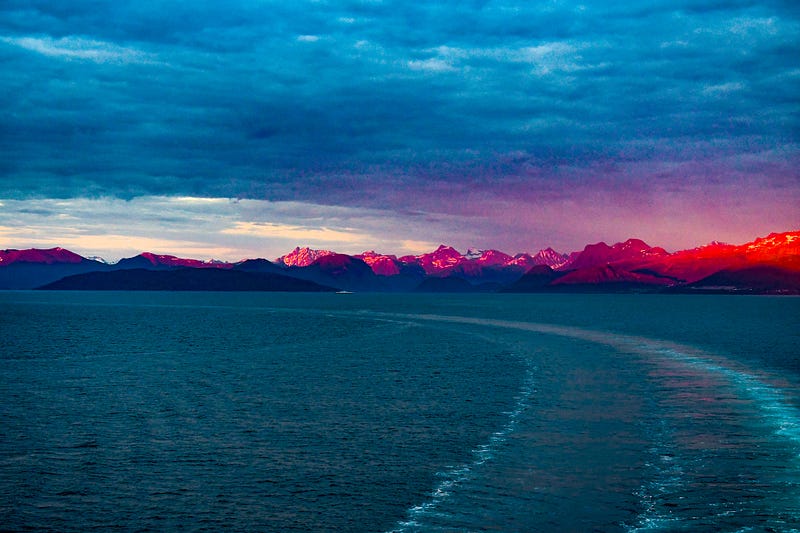
That night, and for the rest of the trip, I never went to bed before two in the morning, because I didn’t want to miss the “purple hours.”
We had intentionally planned this trip to coincide with the summer solstice. But the sight of the full moon, hovering in all of her glory just above the rippling horizon, while the whole world was dipped in this ethereal glow moved me to tears nightly.
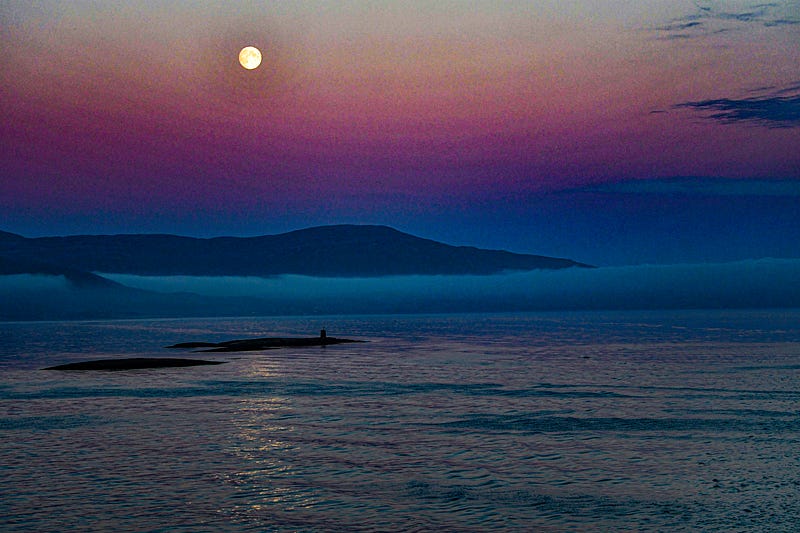
The intense coloring of the midnight hour lasted for just a few evenings. The further north we headed, the clearer the light became. Even at midnight or one in the morning, if you didn’t know what time your iPhone said it was, I don’t know how you would have any idea if it was sunset, sunrise or anytime in between.
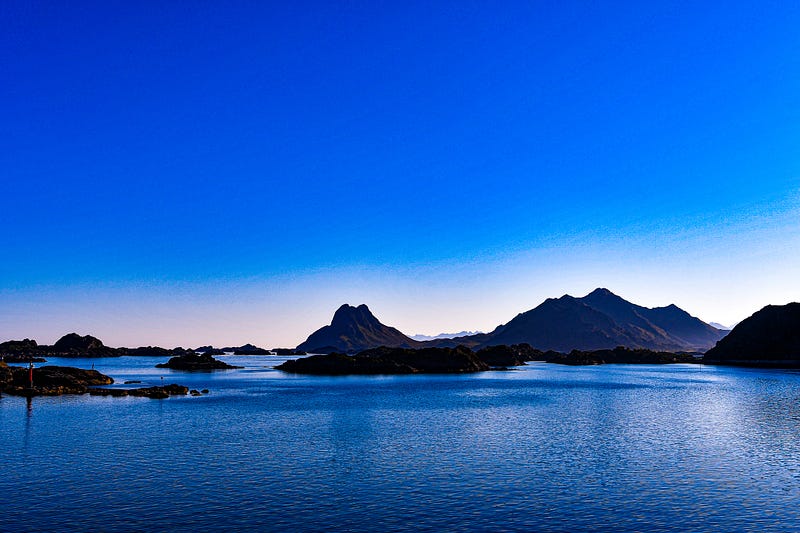
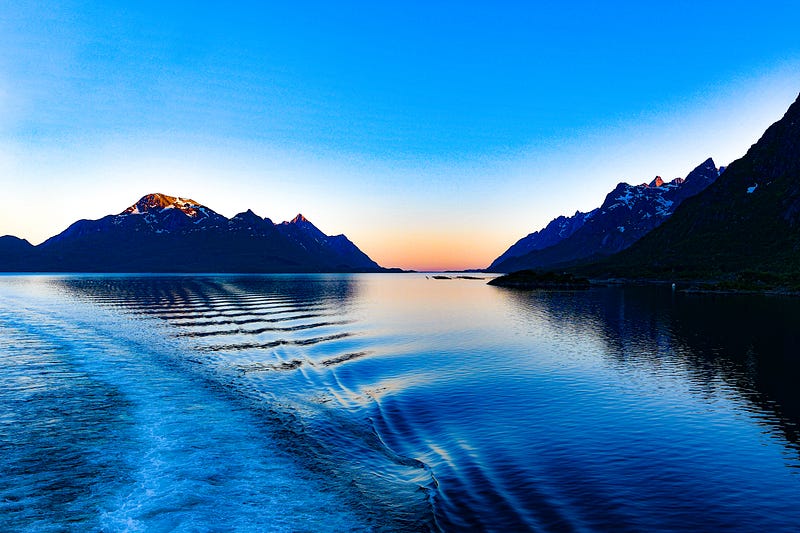
This experience of “time out of time” really got me thinking about what “time” actually means. Midnight in Kirkenes, Norway, is not the same thing as midnight in Southern California. During the long summer evenings, children can be spotted playing soccer in the middle of the night here. Life happens at a different pace.
Without the external markers of day and night, which those of us living closer to the equator encounter daily, should time be divided up the same way?
And, what about the seasons? I grew up in Upstate New York, where the winter snows sometimes drifted up the second story windows and the summer nights, filled with fireflies, stretched until past ten p.m..
But, in these northern realms of the world, in the winter, the sun never even comes up. It sort of gives a new definition to the concept of seasons.
But these Norwegians are prepared. All of the cars are equipped with heavy-duty lights for shining through blizzards. And the buildings seem to be constructed to maximize the hours of sun. And, for those who were born in this region, this is normal.
I would suppose that it would be an odd experience for someone who grew up in the Lofoten Islands to come to California in the summer, where our nights are only slightly shorter than they are in the winter.
I do know this though — I intend to go back to Norway, all the way up to the top again, in the dead of winter, to see the Northern Lights.
And, I anticipate that their green glory in the midday sky will be every bit as moving as witnessing the midnight sun in the summer.
I am constantly amazed at the beauty and diversity of this planet of ours. To touch a toe to someplace as pristine as Northern Norway sets the flickering fire of passion in me into a blazing bonfire for the protection of areas like this.
We only have one Earth. She needs our help. So many species and forgotten forests have been lost to the modern age. I do have hope for places like Norway, where they have refused to drill for oil in Lofoten Islands. If only the rest of the world would follow suit….
I do believe that sharing our images and words about these precious spots of such overwhelming beauty can help inspire others to take action. So, thank you for reading. I hope that you find some time today to spend in your own place of sanctuary, nestled into Mother Nature’s arms.
Erika Burkhalter is a yogi, cat-mom, photographer, and lover of travel and nature, spreading her love and amazement for Mother Earth’s glories, one photo, poem or story at a time. (MS Neuropsychology, MA Yoga Studies).
If you enjoyed this, you might also like:
Story and photos ©Erika Burkhalter. All rights reserved.


