
Where Protection of the People Is for the Wrong Reasons
Beware the creeping police state in times of crisis
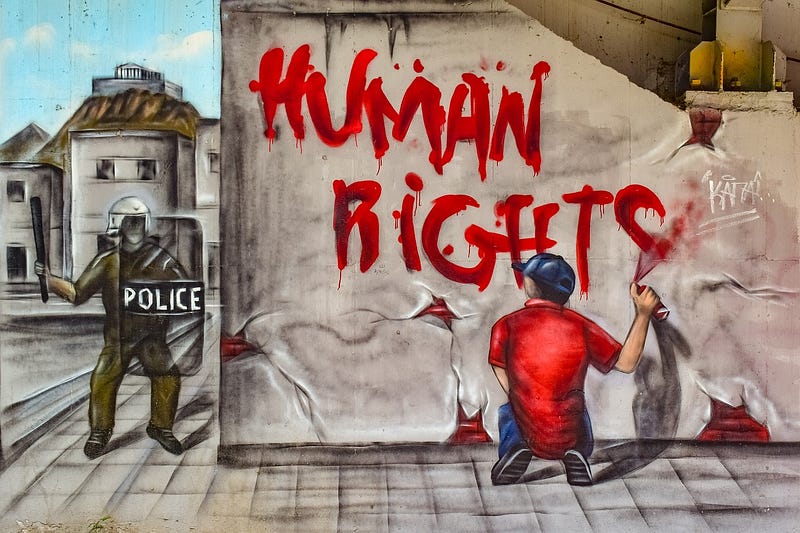
The landscape continues to change as South Africa moves into Day 52 of lockdown.
Let me repeat how I finished my previous story:
“Certain Ministers are revealing their lust for power and this begs the question — is an Iron Curtain descending on our freedom under cover of the Covid crisis?”
Security Forces
Although the WHO praised our country for implementing measures to contain the spread of Covid-19, the United Nations named our lockdown one of the worst for brutality.
The Army
On 7 May the family of Collins Khosa brought an application to court against the Minister of Defence and the chief of the South African National Defence Force (SANDF) among others.
The aim is to protect the public from abuse and ensure a proper investigation of Khosa’s death.
This tragic incident occurred on Good Friday, 10 April, two weeks into lockdown when two soldiers patrolling in Alexandra Township, next to the rich city of Sandton, entered his home without a warrant or invitation.
They beat him and others up for drinking beer inside their own yard — perfectly legal even though regulations since 27 March forbade the sale of alcohol.
Other SANDF soldiers joined in the assault.
As at 7 May, none of the soldiers alleged to have taken part had been suspended from duty.
SANDF soldiers have been caught forcing citizens into humiliating punishments for breaking the law, such as doing push-ups.
The Police
Police officers have committed several acts of violence.
On 9 May Members of Parliament asked the Independent Police Investigative Directorate (IPID) to continue probing the police’s excessive actions.
There are 376 complaints pending and allegations that 10 deaths resulted from extreme strong-arm tactics used by police in enforcing regulations.
The official numbers reported do not reflect the reality on the ground.
The lockdown should be a humanitarian intervention to protect lives, not terrorize citizens into submission.
Parliamentary committees have recommended a closer working relationship between IPID and the Military Ombudsman — is that wishful thinking?
Important News Update 15 May
The High Court has ruled in favor of Collins Khosa’s family.
“SANDF, SAPS and JMPD officers who were present when Collins Khosa was allegedly tortured and killed in Alexandra in April 2020 must be suspended and authorities must complete their investigations into his alleged killing by 4 June 2020.”.
Judge Fabricius has instructed authorities to issue and widely share a code of conduct to guide lockdown operations.
They must publicize their commitment to upholding the right to life, right to dignity, and right to not to be subjected to torture or unusual punishment.
Hunger
The Covid-19 Democracy Survey, conducted in April by the University of Johannesburg and Human Sciences Research Council released on 8 May, found that 34% of those interviewed had gone to bed hungry during the lockdown.
The plight is most dire in homes in informal settlements without a yard where 46% of respondents said they had gone to bed hungry, followed by 42% in backyard township rooms, and 40% of respondents in hostels or student residents.
The R500-billion stimulus package President Cyril Ramaphosa announced on April 23 included increases in social grants and provision of food parcels.
At the time of writing, there are still communities who have received no food aid — seven weeks after lockdown began.
There have been instances of corruption where food only reaches the politically favored.
Bureaucracy creeps in.
Every civil servant has to justify their job, so arm them with a pen, a stapler and a rubber stamp, and they’re in seventh heaven.
NGO’s, church groups and other community organisations who have been running soup kitchens and feeding scheme for years, now need the permission, in writing, of the Dept of Social Security to continue.
The Special COVID-19 Social Relief of Distress Grant went live for applications four days ago. This caters for those who fall outside the criteria of a child or elder persons grant and the unemployed who cannot claim from the Unemployment Insurance Fund.
THOUGH IT EXCLUDES UNDOCUMENTED FOREIGNERS AND REFUGEES.
Although the Social Security Agency allows for those who do not have an active bank account to use their mobile phone numbers for cardless withdrawals at ATMs, I read the story of a woman in Limpopo Province who left her village to visit the local offices at a nearby town to apply for the grant, only to be told she had to open a bank account.
That would entail her spending money she doesn’t have on a return taxi fare to a larger town which has a bank and to deposit money to activate an account. She returned home despondent, not knowing they had misinformed her.
Another story is of a mother with a 22-year-old disabled son who has been fighting for years to get a birth certificate without which she cannot apply for an Identity Document for him, without which he doesn’t qualify for a grant.
Overall, the policies in place are not sufficiently broad and inclusive enough to reduce rising levels of hunger.
Level 4 Lockdown
On 23 April our President announced a phased process comprising five Alert Levels.
On May 1, the country moved to Level 4, with an easing of restrictions and limited resumption of economic activity.
The approach has been irrational, and we are asking who is calling the shots?
You be the judge.
Alcohol and Tobacco
The prohibition on sale of alcohol continues but the announcement by the President of lifting the ban on tobacco products was reversed on the night of 30 April by the Minister in charge of the National Covid Command Council (NCCC) Dlamini-Zuma.
(Her tenure as AU Commission Chair from 2013 to 2017 was lack-luster and she lost the Presidency of the ANC and thus the country to President Ramaphosa in December 2017. She’s on a power trip in my view.)
Her argument was that she’d received 2000 objections from the public and the Council reached consensus.
This despite over 525,000 citizens signing a petition in favor of lifting the ban.
The illicit trade in booze and cigarettes has cost our National Treasury millions in lost and much-need revenue to prop up our economy.
We were in recession before the pandemic plus received the double whammy of down-grades to Junk status by ratings agencies at the start of lockdown.
Historically, it’s not the first time alcohol has been banned in South Africa. During apartheid black Africans and coloreds (mixed race) were prohibited from drinking spirits, wine and bottled beer.
This collapsed in 1962 as the police could no longer control the illegal trading.
Takeaways
Under Alert Level 5, we couldn’t buy cooked or fast foods. Restrictions eased but for online ordering with home delivery only.
A wonderful way to shorten the supply chain????
e-Commerce
Until the move to Level 4 on 1 May, online stores could only sell the same merchandise as allowed in retail shops.
The rationale of our Minister of Trade was to avoid “unfair competition”???????
This had no basis in common sense as many brick-and-mortar stores run online too and our economy is floundering.
At Level 5 “essential” goods comprised food, toiletries, cleaning materials, health products and medicines only.
Though we had to stay at home and only go out for essential shopping, you couldn’t buy toys for your children, nor computer equipment or phones to connect with family and friends.
And forget the microwave or kettle if yours packed up during lockdown.
Nobody could buy clothing — not even Mum’s with babies on the way or new-born’s. The Minister then revised the rules to allow the sale of any baby-related products.
With winter approaching, many of us were wondering when we’d be buying warm clothing for the chilly months ahead.
Legislation changed again for sale of stipulated clothes, blankets, throws, bed linen, pillows and duvets.
I still can’t buy a towel though that hasn’t stopped me from washing my hands!
I’ll return to the fashion (fascist?) storefront further on to share with you the ridiculous regulations introduced last week.
Things change so fast it’s difficult to keep up.
No wonder this confuses many citizens!
For instance, they added educational products and stationery to the Allowed list, but only included educational books.
As far as I know any books can now be sold, but I’m not sure!
This endless legislation promulgated by bureaucrats who have nothing better to do than cross their eyes and dot their tees, reminds me of the days of the GDR of East Germany, where social control was the order of the day.
The following two restrictions illustrate and confirm this desire for total obedience — or obeisance?
Curfew
The Government’s imposing a curfew from 2000 to 0500 shocked us.
Just because there’s a gradual easing of businesses allowed to open doesn’t mean we will go out visiting friends and family after work.
There was no curfew under our strictest lockdown, nor was there a need for it as we understood the need for social isolation, difficult though it may be for the underprivileged in our midst.
They tell us deploying an additional 73,000 troops is to aid the police in enforcing the curfew.
Why did we only need 2,300 soldiers in the first phase?
Outdoor Exercise
This is now allowed but in a narrow time window of 0600–0900.
This has led to crowding in towns and built-up areas. Coastal cities suffer morning congestion where you still cannot access the beach to walk or run. Neither can surfers ride the waves.
As the days are shorter, it’s dark at six o’clock in the Western Cape, making it unsafe to exercise alone.
What about those people who cannot walk or run early morning and still get to their jobs on time? More practical after work.
Both the issue of the curfew and the exercise period are being taken to court by our main opposition party, the Democratic Alliance.
The regime of the Covid-19 regulations is being questioned for its Constitutionality as South Africa is not in a State of Emergency — only a State of National Disaster.
We are questioning the legality of imposing laws without Parliamentary oversight.
Are they threatening our rights under a Constitution regarded as the most progressive in the world, with a Bill of Rights second to none?
Clothing
We were baffled by the bizarre lockdown rules introduced on Tuesday 12 May.
“These new clothing regulations are frankly mad and seem more at place during the 1980s under the Soviet Union than they do in a democracy like South Africa,” Dean Macpherson, the Democratic Alliance party’s shadow trade and industry minister, said in an emailed statement.
“There is simply no justification for the minister to be determining what clothes people can buy and worse, how they should wear them.”
Only closed-toe shoes may be sold — I still can’t buy my flip-flops!
For a laugh, though the legislators are dead serious, let me share:
“Shoppers may only buy crop bottom pants so long as they are worn with boots and leggings”
The fashion police have spoken!
“short sleeved knit tops — where promoted and displayed as worn under cardigans and knitwear”
“short sleeved t-shirts — where promoted and displayed as under garments for warmth”
“shirts, both long sleeved and short sleeved — where displayed and promoted to be worn under jackets coats and/or knitwear”
I kid you not!
A never-ending story
I’m delighted to report a successful action by civic society.
An organisation which I belong to threatened to take the Minister of Trade & Industry to court should he not lift the illogical restrictions on what goods may be sold online by 4.30 pm on Thursday 14 May.
He signed off the legislation amendments before the deadline, allowing for the sale of any merchandise, except for tobacco and alcohol products.
I can now buy my flip-flops — but only if I order online????
We may be caught up in a Kafkaesque bureaucratic nightmare, but the independence of our judiciary is still intact.
Long may it stay that way!
Every country is stepping into unknown territory as we try to find a balance between protecting the people’s health and their future livelihoods.
Never in history have we faced such a challenge.
What I pray for is that emotionally intelligent people lead the crusade into a more equitable world where nobody goes hungry and every man, woman and child has access to sanitation, water, health care and clean air.
Let’s not waste our energy debating what we can wear!
Related Reading:


