
South Africa Praised by the WHO for Swift Action in the Face of the Pandemic
News media rarely reports on what is happening in Africa
I guess we’re used to it, but I’m here to set that right.
Before delving into the story of our initial response to Covid-19 allow me to share the brilliant insights of the late Kenyan writer and LGBTQ activist, Binyavanga Wainaina, who wrote a stellar satirical essay in 2005 on How to Write About Africa.
He was due to travel to South Africa a month after announcing his engagement in April 2019 to his Nigerian partner. They intended to move to South Africa and marry there. He died on 22 May before he could fulfill that dream.
He’d made headlines in January 2014 when he announced his sexual orientation in an essay entitled ‘I am a homosexual, mum’, in which he imagined how a conversation in which he came out to his late mother would go. That was a very brave thing to do in a rampantly homophobic society.
The same year, he featured in Time’s list of Most Influential People in the World.
Would have been wonderful to hear his views on the current reporting whereby media praises countries such as Singapore, South Korea and New Zealand for their strategies in “flattening the curve” yet South Africa, which has been praised by the WHO for its quick action on containment, is ignored in most media.
The landscape changes as the days and weeks pass.
We have encountered both positive and negative outcomes from actions taken to slow down the spread of the virus in South Africa. This is a natural consequence of our being the most unequal society in the world.
In this story, I stick to the positive news covering the eight weeks from March 5 to April 30.
I am however working on another story which discusses the rising spectre of millions dying from hunger rather than Covid-19; the corruption, the anger and frustration of conflicting regulations and the brutality inflicted by the army and police on ordinary citizens.
For the record, as at May 6, we are in Day 42 of lockdown.
The report on 23 January that the source of Covid-19 had been tracked to Huanan Seafood Market in Wuhan, prompted me to write a story about it.
The reality of the coronavirus had not hit home.
It was something far away, somewhere else — a science-fiction movie unfolding in slow motion. I remember turning to my husband one evening saying I was sick and tired of the virus dominating every news channel.
Then our first case appears on March 5.
THAT hit home.
A terrifying prospect in a country where over 52% of our population lives in poverty and an unemployment rate of 29% — which rises to 38% if one includes those who have given up searching for work. Add to that a fragile public health system.
We could not allow the virus to spread among impoverished communities where many are already vulnerable with preconditions of TB and HIV. Millions do not have access to water, nor can they self-isolate in townships and informal settlements where eight to ten people may share a room.
Looking back on those eight weeks feels surreal. I’ve wandered through the days — sometimes with a clear mind, others in a haze wondering if this is a dream.
But I’m awake and know the world and how we lived will never return to before. We’ve opened the door to a new way.
Here is the timeline of key events in South Africa
March 5
The first case reported. A man from KwaZulu-Natal who was part of a group of 10 people returning from a ski trip in northern Italy. Contacts were tracked and traced.
Temperature screening implemented at airports.
South Africans are encouraged to wash hands regularly, keep social distance, cough into tissue or crook of the elbow, not touch face or other people — greet with elbows.
Government implements plans to install water tanks in vulnerable villages and settlements who have been without water for years, because they need to wash their hands.
(Author’s Note: As at April 29, while 16,000 of the planned 18 875 tanks have been delivered to all nine provinces across South Africa, only “more than half” according to the Minister of Human Settlements, Water and Sanitation tanks have been installed five weeks after the declaration of a State of National Disaster. Part of the reason is that up to 15 April, hardware stores remained closed. I will cover these anomalies and conflicting regulations in the next story.)
March 11
World Health Organisation declares Covid-19 a pandemic.
March 14
114 citizens flown in from Wuhan, China, the initial epicentre of the virus, by the SA Defence Force and quarantined at a resort in Limpopo Province for 14 days. (Now safely reunited with their families at home.)
March 15
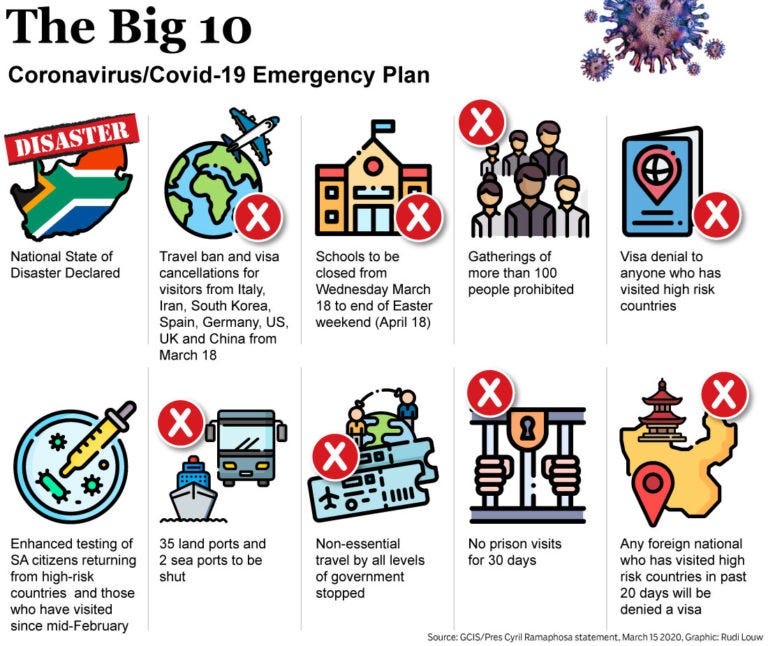
President Ramaphosa declares a National State of Disaster.
COVID Command Council set up to meet three times a week.
Tracking, tracing and monitoring systems put in place.
Daily reports from Health Minister — 51 cases.
Restrictions shown below:
March 17
I write a story to calm my nerves which you’ll find at the end.
March 23
As cases rise to 402, President announces 21-day lockdown to begin Thursday, March 27 through to April 16.
- No leaving home except to buy food, medicines, seek medical care or collect social grants.
- Sale of alcohol and tobacco banned.
- No takeaway food or food deliveries and grocery stores may not sell hot prepared food.
- All shops and businesses closed except pharmacies, labs, banks, essential financial and payment services, including the Johannesburg Stock Exchange, supermarkets, petrol stations and healthcare providers.
People necessary for the response to the virus exempted from the lockdown, including health workers, emergency personnel and security services (police, traffic officers, military medical personnel and soldiers).
Also exempt are those involved in the production, distribution and supply of food and basic goods, essential banking services, the maintenance of power, water and telecommunications services, laboratory services and the provision of medical and hygiene products.
Deployment of 2820 members of The South African National Defence Force (SANDF) to support the police in ensuring compliance by citizens will begin on the date of lockdown.
March 27
1170 cases. First death reported in Cape Town on day one of lockdown.
Police and army arrest 55 people on Day 1 for flouting regulations, sending a powerful message that compliance is essential.
April 1
Health Minister Zweli Mkhize officially launches 67 mobile sampling and testing units to be deployed nationwide to every district and metropolitan municipality to ramp up testing capacity in the public health domain.
10 000 field workers to visit homes in villages, towns and cities to screen residents for Covid-19 symptoms.
A dear friend in Johannesburg tells my hubby we are blessed to be in a rural area where we are safer than his family in the city.
I have ventured out once a week for groceries and am impressed by how fellow shoppers adhere to the regulations. We maintain a 2-metre distance, most of us wear masks and, being in a sparsely populated region, no massive queues waiting to enter the shops.
Sanitizers are available for hands and wipes for trolley handles. The cashiers wear masks and gloves; a Perspex screen gives them extra protection from customers. Decals on the floor show where to stand while waiting at the check-out.
We should remember that retail workers are real heroes too, putting their lives at risk every day so we can buy food and medicines.
Fast forward to April 20
President announces an extension of lockdown to April 30.
3300 cases. 1055 recoveries. 58 deaths. 114,711 tests.
Monday evening on radio and three television channels, Professor Salim Abdool Karim, chairperson of the Covid-19 Ministerial Advisory Committee, gives a three-hour presentation explaining the reasoning behind the government’s decision to extend the lockdown for a further two weeks.
Millions of South Africans sit glued to our screens as we learn, with the aid of graphs, what flattening the curve and R0 mean.
The Prof says we’ve retarded the spread. His words comfort us. He’s a clinical infectious diseases epidemiologist and global industry heavyweight who has for years led from the front in scientific contributions to HIV prevention and treatment.
I’m grateful our current President values scientific input, unlike President Thabo Mbeki (1999–2008) whose AIDS denialism delayed making antiretroviral treatment available in the public sector resulting in over 300,000 avoidable deaths according to two independent studies. It also resulted in an estimated 35,000 babies being born HIV positive.
High praise too for our Health Minister, Dr Zweli Mkhize, who has been a steady rock in a stormy sea, giving daily briefings in calm, measured tones. Here again, I cannot help but compare his professional stance to the amateur antics of the Health Minister we endured under Mbeki’s presidency. She recommended garlic, beetroot and African potatoes as a cure for AIDS!
Despite that, as in other parts of the world, many people are suffering from social distress and hunger. Food parcels are not reaching everyone in need.
Against this backdrop of potential food riots, President Ramaphosa announces increases in the child support grant and other social grants for a six-month period starting May.
April 23
National lockdown to end on April 30.
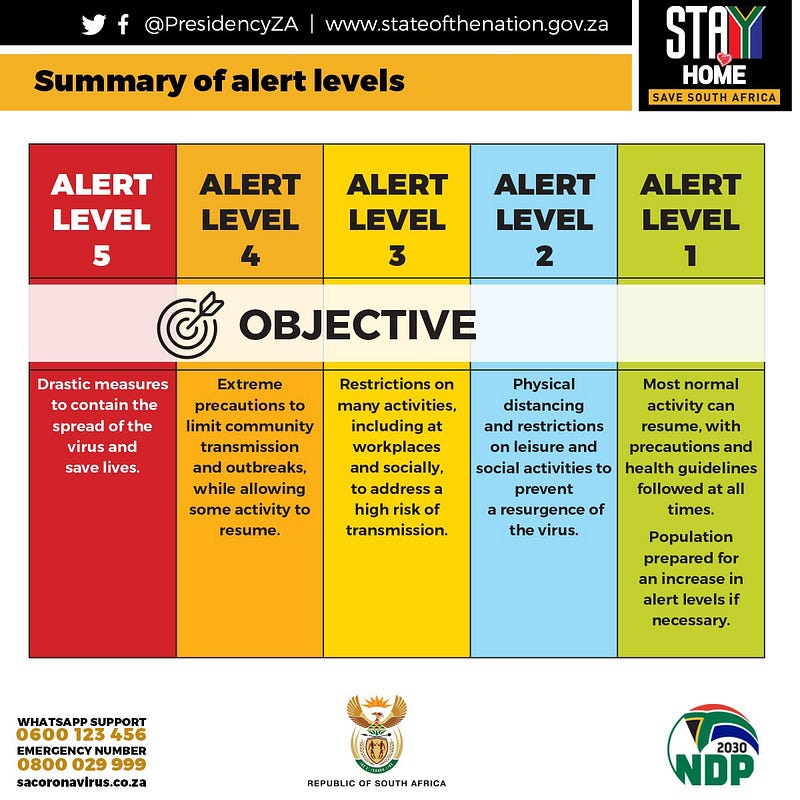
President says South Africans will go into a phased approach comprising five Alert Levels. We are currently at Level 5.
On May 1, the country will move to Level 4, easing lockdown restrictions with a resumption of economic activity.
April 30
5350 cases. 2073 recoveries. 103 deaths. 207530 tests.
The country waits and wonders whether life will be better or worse when Level 4 arrives on May 1 — Workers Day.
Everyone must wear a mask when they leave home
- Government will deploy an additional 72000 army troops
- A curfew will be in effect from 2000 to 0500
- The announcement of the ban on tobacco being lifted is rescinded
- Ban on sale of alcohol remains in place
- Outdoor exercise permitted between 0600 and 0900.
- Phased-in opening of businesses
- No restaurants or takeaways to operate except for home delivery
During this time millions of South Africans have heeded the regulations, made donations to the National Solidarity Fund and charitable organisations. Individuals, NGO’s, church groups and other community-based organisations have reached out to help those in need — but it’s not enough.
Certain Ministers are revealing their lust for power and this begs the question — is an Iron Curtain descending on our freedom under cover of the Covid crisis?
I will cover that in my next story.
In the meantime please stay safe.
Stay healthy.
Related Reading:


