
Where does B12 actually come from?
A meat eater's (attempted) defense of the consumption of livestock.
If I had a nickel for every time someone asked me where I get my b12 from, I’d be filthy stinking rich. I’m vegan. I have been for over two years now, and hey — I'm doing pretty darn good, considering my increased energy, brighter skin, and happier disposition among other things.
Unfortunately, most people are led to believe that b12 is a vitamin exclusively found in animal products and that vegans and vegetarians are simply destined for a deficiency in this essential nutrient. Well, it turns out that isn’t the case. Trust me, I was just as shocked as you are. Let’s break it down.
B12 is a bacteria that is naturally found in soil, but with commercial farming and the heavy, routine use of pesticides and others of the sort, any and all b12 in the soil is killed.
Cows and other grass-feeding animals that are bred to be killed can theoretically get b12 from grazing since it is found in the soil they are ingesting. (But as mentioned above, heavy pesticides kill the b12 in soil.) In commercial farming, the majority of animals are fed soy or corn food pellets in dark, crowded, enclosed spaces with cement floors and no grass to be found.
Knowledge about the widespread use of antibiotics (80% of its production) on livestock is fairly well-known by consumers who protest against their use and opt for labels that read “no added antibiotics.”
So if the majority of livestock are not actually grazing and surviving off corn and soy, then where does the b12 come from?
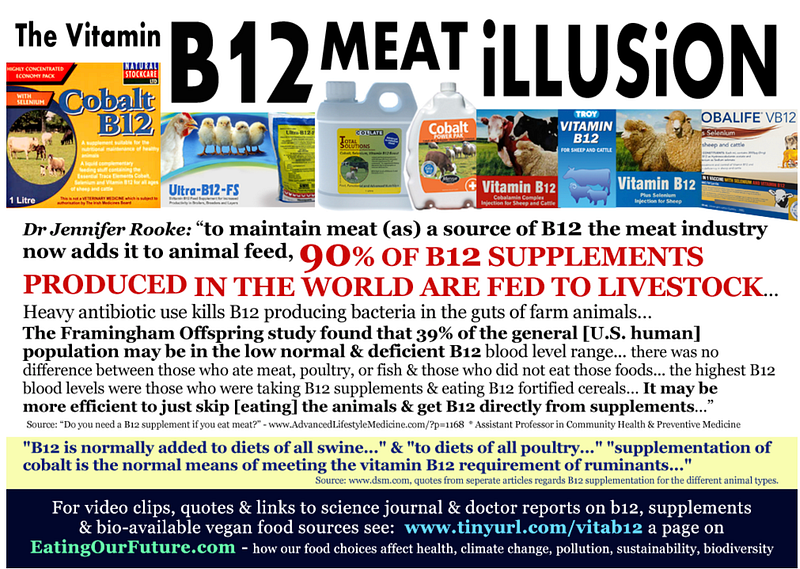
Supplements. Yes, the livestock you may consume is being supplemented with b12. They don’t naturally produce it themselves. Fun fact: 90% of the b12 supplements produced in the world are fed to livestock! Pesticides kill off the b12. Also, since there is such widespread use of antibiotics in livestock, this kills off the b12 producing bacteria in the intestines of these animals.
Where Do Vegans Get Their B12?
Well, there’s this thing we call “nooch,” better known as nutritional yeast, which can serve as the main ingredient for a cheese-replacement recipe in many cases. Nutritional yeast is a deactivated yeast, often a strain of Saccharomyces Cerevisiae.
It is sold as a commercial food product and exists as a good source of b12. About one tablespoon is enough for a daily serving. And whoever uses nooch knows that we don’t stop at one tablespoon of this stuff. It is sold as yellow flakes, granules, or powder and is widely available all over the world.
Side note: one serving of nutritional yeast also provides 9 grams of protein, and it is a complete protein.
Other foods that have b12 include nori (purple lavers), chlorella, certain mushrooms (shiitake, black trumpet & golden chanterelle) & fortified foods like fortified plant milks or fortified cereals, among others.
(It is becoming more common.) I choose to take a supplement to meet my daily b12 requirement. I recommend Mary Ruth’s Organics organic b12 spray as methylcobalamin. It is organic and suitable for people with the MTHFR gene. 1000 ug or 1 squirt per day 4 days a week and I have easily met my requirements.
What’s the Best Way to Get B12?
Not From Eggs: We can’t get the b12 in animals without also consuming stuff we don’t want like saturated fat, cholesterol, added hormones, antibiotics, and so on. To absorb an adequate amount of b12 from eggs, we would have to eat 200–400 scrambled eggs per day because its bioavailability is so low. Source: Dr. Michael Greger.
In addition to Dr. Greger, the Nutrients science journal states “The Vitamin B12 content is NOT high in whole eggs (approximately 0.9–1.4 μg/100 g), most of which is located in the egg yolk. The average bioavailability of Vitamin B12 from cooked eggs is 3.7%–9.2%.”
“There is nothing natural about the abomination of modern factory farming and its attempt to reduce living, feeling beings to machines. In choosing to use fortified foods or B12 supplements, vegans are taking their B12 from the same source as every other animal on the planet — micro-organisms — without causing suffering to any sentient being or causing environmental damage. Vegans using adequate amounts of fortified foods or B12 supplements are much less likely to suffer from B12 deficiency than the typical meat eater…”
Cows maintain b12 by eating supplemented foods, being exposed to bacteria-ridden manure, and drinking contaminated (or untreated) water. Some cows are given manure in their feed — poultry waste. That sounds pretty disgusting to me but to each their own. (Kidding, just another reason to go vegan because that’s fucking disgusting.)
What is B12 Deficiency?
Symptoms of b12 deficiency can include fatigue, dizziness, numbness, tingling, poor memory, poor coordination, etc. These symptoms are also called pernicious anemia. Genetic factors should also be taken into account in regards to the absorption of b12, regardless of whether you eat meat or not.
Speak with your medical healthcare provider about getting tested for a b12 deficiency. If you have one already, you can consider b12 injections. You can opt for multivitamins that have b12 in them or an individual b12 supplement, like the one I take.
These supplements are typically available as cyano or methylcobalamin. Cyano is cheaper, but may not be absorbed as well. I opt for methyl which is a bit more expensive since studies suggest it is best absorbed.
Tap into positivity at Live Life Now, my new blog✨If you liked this piece and wish to support me, you can buy me a kombucha here. : )