
Where Discrimination is Still Okay

Credentialism. It’s an old term, dating back to the 1970s. By strict definition, it is defined by Oxford as “reliance on formal credentials (particularly examination certificates) to make selection decisions.” It may be better known to the rest of us as “the way society operates.” A degree is listed as a requirement for many middle-income jobs that have no relevant correlation to a college education. Its importance is also often stressed to children as the only method for them to succeed.
Problem is, that system is broken, unintentionally discriminatory, and rewards no one. In short, it’s terrible. Why we’ve accepted it for decades now is beyond me. In reality, formal education is just one colossal, expensive barrier-to-entry acting as a ceiling on lifetime attainment for people born in less-than-ideal circumstances. Proponents will say it provides a skill or proves one’s tenacity and determination to future employers. Both those notions are easily countered, but that’s not my point here.
I could rail against college education all day. I’ve done so previously in pieces like this one and will do so again in the coming months. There’s so much to disagree with I can hardly contain it in one article. Even a series wouldn’t do it justice. Today, however, I want to focus on specifically how these barriers to entry act as a modern redline, preventing minorities and lower-income families from achieving upward mobility. Ironic, in a way, as liberal goals always focus on reducing income inequality and systemic racism, yet the same proponents are nearly universal in their acclaim for higher education. We’ll see that contradiction below.
Nonexistent correlations

Even the most ardent supporters of the collegiate landscape usually concede that there’s little correlation between raw intelligence and educational attainment. To be clear, we’re talking base intelligence and quickness here, not a studied quickness like knowing the elements on the periodic table or something.
Back when I was a department head at my organization, me and a senior manager for another department used to butt heads on this issue all the time in panel interviews. It largely worked out as the degree-holding candidates he wanted I was apathetic about or tentative to shell out money for, and the ones that interested me didn’t have enough credentials for him. We both got our pick. That said, even he admitted there was little correlation between intellect and education. It was a work-ethic theory for him.
Now if intelligence is rather random at birth, and I believe it is, then you’d expect a truly merit-based system to result in strong correlations between intelligence and educational attainment. After all, a merit-based system that supposedly rewards the brightest of our society should specifically target intelligent individuals. Yet, as we’ve said above, it doesn’t. There’s little correlation at all, if any. Grade inflation and people automatically attending college because “they have to” has reduced this to nothing.
So what does college correlate strongly to? Well, background, for one. The more wealthy the family you’re born into, the more likely you’ll have a college degree. We’re not talking statistical deviations here of say, 4%, either. We’re talking hundreds of percent more likely.
Of course, there are outliers such as scholarship students and those who take debt up to their eyeballs, but even they are somewhat dependent on their background. Fact is, if those students weren’t in good or at least average high schools, their odds of making it to college would have dropped. Still possible, but less likely.
For example, let’s say you’re going to a public school in Camden, New Jersey. 7.6% of these students go on to obtain a bachelors’ degree. 40% don’t even make it through high school. By contrast, at Colts Neck High School, also in New Jersey, 50% of students have earned college credits before they even graduate.
So what’s the difference? Well Colts Neck has a median household income of $154,000+ and Camden’s is $27,000. Oh, and Colts Neck High is 76% white while Camden is 99% minority.
A big barrier for no reason
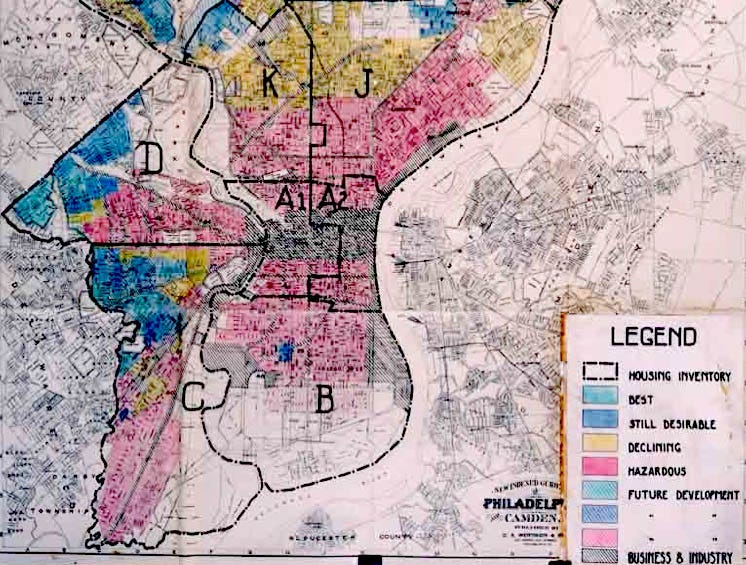
Assuming that children born in Camden have the same chance of being born intelligent as those in Colts Neck do, their subsequent surroundings in childhood and adolescence are to blame. The result is a majority of Colts Neck babies will eventually be able to apply to jobs listing a college degree as a requirement while babies born in Camden will not.
The first set of children will then have a reasonable chance to attain a comfortable lifestyle on their own, while the latter will not. The first set is largely white, the second set is not. You can see where I’m going here.
At the end of the day, taken on a larger scale, educational attainment among whites is significantly higher than that of blacks, and more than double that of Hispanics. Assuming again that intelligence is fairly random and equal across all groups, a college degree requirement on a job takes on a different meaning. It, in effect, excludes more intelligent minorities while leaving the door open to a larger percentage of white people. Unless equal opportunity employment actually means double employment for white people, I think we’re doing it wrong.
Naturally, that are a lot more intricacies to these points than I have time to explain in a short article. Expanding these numbers to include low-income whites, for example, would show they consistently get screwed over as well, though not as severely as minorities. Sorry, I don’t have a better term, either. It is what it is. Having the rest of your life determined by a birth lottery is really the definition of “screwed”, colloquially.
Of course, given the amount of blatant racism and life-or-death circumstances faced by many minorities, it’s easy to overlook this issue as there are more pressing matters at hand. Still, it’s worth mentioning. Even more so when you consider that a sizeable chunk of our political landscape seems to increasingly see education as the answer to everything. If we’re going down that road, we need to fix education first.
A prebuttal

College advocates are going to chafe at some of these points, as well as my made-up term in the headline above. Here’s the thing though — I’ve worked in the lending arm for four different financial institutions. If anyone should benefit from a finance degree or business management, it would be the banking industry, right?
Not once has a college graduate I’ve hired (or even an MBA holder or two) had a single idea of what goes on in lending, or what the requirements are for loans etc. None. Which is the exact same amount of high school graduates who had an idea as to how to do these jobs. They’re tied at zero to this day.
We’ve had to train them all from scratch unless they were coming from a similar position previously. Which is fine, I enjoy that part. But given a budget of $750,000 for labor for my department, I can get 12 MBAs who each feel entitled to $62,000+, or 15 high school graduates for $45,000. The high school crowd even leaves me with $75,000 for performance bonuses/raises and holiday gift envelopes stuffed with cash. This isn’t theoretical. I’ve really done this. Maybe that’s why my teams were always more varied culturally than the traditional vanilla white snowcone of the banking industry.
My department head peer, like many others, tacitly acknowledged they weren’t paying more for higher intellect. The argument, instead, was that college showed a willingness to commit, or perseverance of sorts, that would be translated to a valuable employee.
Maybe, sure. It definitely shows those traits to a degree. But I ask you this: What shows more perseverance? Attending classes (most of the time), studying, and cramming for exams with the expectation of a great reward at the end? Or working at a near-minimum-wage job that’s well beneath the skills you know you have, but showing up every day for 8 hours of grueling torment to put food on the table or pay rent? I’ll take the second individual all day, every day.
I’ve also never given one of my non-college associates a promotion or raise and seen them have an attitude of “well this where I should be anyway.” They’re grateful, they recognize the opportunity or responsibility. A few of my degree-holding friends have practically sneered come raise time.
Maybe we should stop putting such a massive portion of our faith into a system that’s wildly inaccurate, variable, and rigged against a huge chunk of our society. In order to be more inclusive to all, we need to stop putting up barriers in locations where they aren’t necessary.


