
It Is Well Past Time to Discuss the “Value” of College

I’m pitching to a hostile audience. Authors and the well-read tend to be more college-educated, by and large. Pieces on this platform, and others, seem to start life discussions with “after graduation…” as if it is a forgone conclusion. There is nothing wrong with this — if you had the opportunity to go to college, wanted to attend, and thought about your decision, good for you. I’m sure you’re better for it and (hopefully) proud of your achievement.
I’m here to represent the rest of us. And by “rest of us,” I mean most of us. 67.9% of the United States, to be exact, per the Census. Some of us didn’t want to attend college at all. Others were drawn to trades. More lacked the opportunity. Finally, a few decided it just wasn’t worth it. That last part is what I’m here to talk about.
I, like most all other Millennial children, was informed repeatedly over the years of my impending failure. Lack of study, middling grades; these were items guaranteed to cost you your college education. Without that, you’d be forever doomed to a life of poverty and toil. Or something along those lines. Sometimes such “guidance” was delivered in a grandmotherly way by concerned septuagenarian teachers. More often, the heavy hand of authority figures planted this idea firmly in our heads.
Yet, come high school graduation time, the country was in an (at the time) unprecedented financial crisis. Unemployment was rising, particularly among business professionals in the fields affected. Stories were swirling of recent grads finding it impossible to locate work, even those with the usually “practical” degrees in business and related fields. Somehow, in the face of this, tuition costs were still rising. Faced with a choice, I decided four years spent working towards promotions was a better bet than four years taking loans for the hope of a future payoff. My decision was made, die-cast. My story, however, is anecdotal. I seek only to inform why some of us decided against a degree. There are plenty of reasons, but I’ll focus on a few.
The Numbers on Graduates
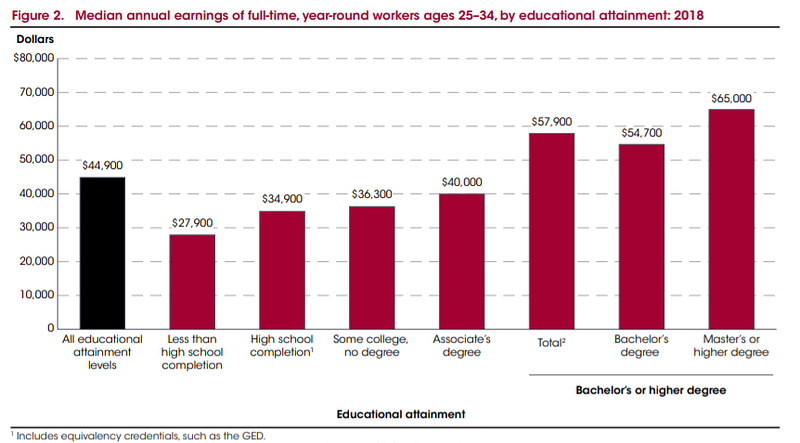
Well, first of all, there’s the cost. At an average of $35,720 per student per year, college is expensive and getting more so annually. This has always been justified by the additional earnings of graduates, a number I find to be heavily skewed but still worth exploring. The current estimates are around an increase of $900,000 in lifetime earnings for college graduates versus high school only.
So why do I say skewed? Well, let’s face it. The high school graduate numbers likely include quite a few folks who are less apt than the graduates. I’d like to ideally compare intelligent, hard-working high school graduates to intelligent, hard-working college graduates, but the facts aren’t there. I’d venture that the most apathetic among us aren’t in the college graduate category, so the high school figures are probably weighed down considerably. The high school figures also include people who returned at a later date for a GED. These folks likely did not spend the intervening years working their way up the company ladder.
For example, the median salary of $54,700 for a college graduate through age 34? There’s nothing wrong with that, but I have plenty of friends in the trades who didn’t spend the four years, an educational total of $140,000 to earn that salary. The average 7–11 general manager and golf course manager both clear that figure. They also both require high school education. Skilled trades or those who start contracting businesses can blow these figures away, but so can graduates who go straight to investment banking.
Let’s go back to that cost of college figure for a second, though. If that $140,000 (average) was financed through loans, the true cost is higher. Either way, that’s money coming back from that “improved” salary in the earlier years. An outperforming high school graduate can have a little more budget flexibility. The same high school graduate could use the four years others are in college to get a promotion or two and close that wage gap. That’s certainly what I did.
Using the lifetime earnings figure doesn’t account for the loan repayment or interest. Of course, some have college fully paid for by scholarships. Others have family foot the bill. Many have a combination of scholarships, loans, and families. Some pay cash as they go. All of this supports my base assumption that the figures we use are not reliable. A cash-paying student is not going to have loans. Then again, a $140,000 head start for a high school graduate who invests it all will be worth about $1.4 million in forty years with zero contributions. What was that about $900,000 again?
The Non-Quantifiable
There’s a lot on both sides of this argument that can’t be quantified, or that data doesn’t capture. I acknowledge that. The college “experience.” Exposure to new perspectives, people from different backgrounds, cultures, etc. The value of a lifetime’s learning. We high school grads have some non-quantifiable thoughts of our own, of course.
In my experience, the four years of professional, full-time work experience I acquired was worth more than the degree, at least nominally. The main issue is you lack the ability to prove your intelligence. Interviews are more of an uphill battle, particularly as you’re still building your resume. Company selection matters because internal promotion is going to be key for the early part of your career. Once you have your first nice position title, it gets easier. I have no education section on my resume. In the interview for my current job and the one before that, they either didn’t notice or didn’t care to ask.
We need to start portraying college as less of a necessity and more of a reasoned choice or a risk/reward. The risk you take by not going is that you may have a much tougher time in the workforce, particularly at first. You also risk some not-so-friendly conversations from parents and teachers, particularly if you’re intelligent and folks see “no reason” why you choose not to attend. There can be some miserable years early on while you take jobs beneath your skill level to prove your worth.
The potential reward is four years of earnings while other people are taking loans and saving yourself some serious costs and time. If you never took to formal education at all, like me, you may view it as literally earning back four years of your life that would have otherwise been lost. It varies from person to person.
There is absolutely nothing wrong with those who pursue higher education. It is a legitimate accomplishment with legitimate rewards. That said, it is still not for everyone. We would all do well, however, to recognize that some may not see the value in pursuing their education or may prefer to do it their own way. Making them feel like second-class citizens only leads to divisions and quarrels in our culture and politics, many of which we see today.
If you love the personal finance articles published in Making of a Millionaire, become a member of the community and get full access here.
This article is for informational purposes only. It should not be considered Financial or Legal Advice. Not all information will be accurate. Consult a financial professional before making any major financial decisions.


