
Ukraine War
Where are Putin’s Red Lines?
Even his media poodles don’t know, but it seems they have been stated — and some have been crossed
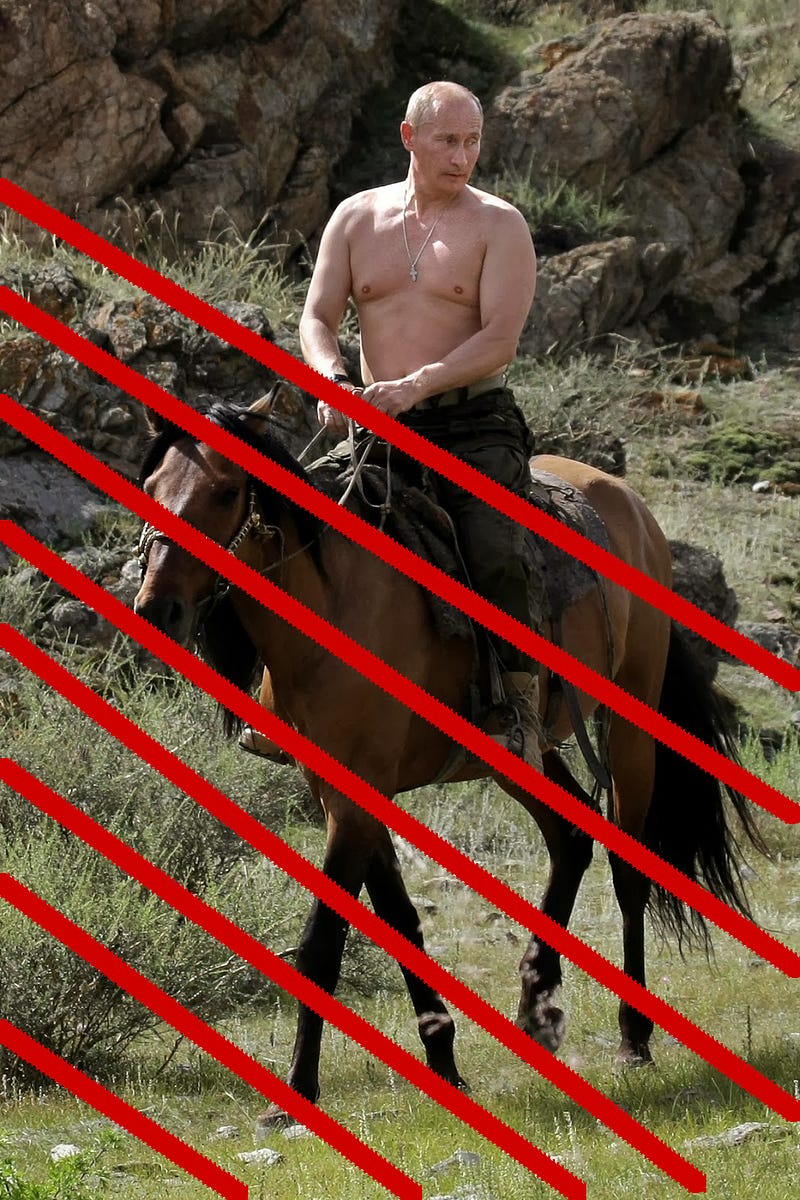
During my following of events in Ukraine over the last — almost — 500 days, I have noted that Putin has not stated what his so-called ‘red lines’ are, other than he would use nuclear weapons if there was an existential threat to Russia.
But I was wrong. I missed them.
And so, apparently, did the Mad Moscow Media.
They’re asking why nukes are not being used. To be fair, there is pushback from some of the studio guests who understand the risks don’t want to be cooked in retaliation.
Yes, the red lines have been stated.
He [Putin] has, for instance, made clear to the Russian people that Moscow’s red lines for the use of nuclear weapons, spelled out in its official documents, have all been crossed since the invasion. These include the claim that the very survival of Russia is at stake in the current struggle — and at last month’s Victory Day parade, Putin declared that the West’s “goal is to achieve the collapse and destruction of our country”. Another of Russia’s officially designated red lines is attacks “against critical governmental or military sites of the Russian Federation, disruption of which would undermine nuclear forces’ response actions”. Perhaps in light of this, Moscow has alleged that Ukrainian drones have struck strategic nuclear bomber planes inside Russia, and that Ukraine and the US are responsible for drones launched to assassinate Putin. All these claims, the real and the fabricated, are used to establish the pretext for Putin to use nuclear weapons. UnHerd.com
However, the definitions of the red lines do seem to vary and extend. They are a movable feast and that’s probably why there has been some confusion.
‘Red lines’ are mentioned by Russian diplomats in the same breath as HIMARS.
The United States has already crossed Russian President Vladimir Putin’s red lines in the Ukraine war, a Russian envoy to the United Nations has warned. — Newsweek
Raising the stakes in the game of nuclear poker
Reuters is reporting a conversation between Putin and Lukashenko (Belarus) on 9 June 2023 in which he said that “Everything is going according to plan,” when discussing the planned nuclear deployment over a meal at the Russian leader’s summer retreat in the Black Sea resort of Sochi.
Continuing: “Preparation of the relevant facilities ends on July 7–8, and we will immediately begin activities related to the deployment of appropriate types of weapons on your territory,” Putin said, according to a Kremlin transcript of his remarks.
The reason that Russia is building a nuclear weapons repository in Belarus (where it has already based 310 mile range Iskander-M nuclear capable missiles) is to minimise missile flight time and reduce the likelihood of interception. It could also be a ploy to pull Ukraine’s air defences to the north, away from the active eastern and southern fronts.
Russia could launch Iskanders from its own territory, but these would have to be launched from sites well back from eastern front lines. Increasing flight times.
Of course, if Russian missiles (nuclear or not) were launched from Belarus then that would almost certainly drag Belarus into the war. Indications are that Belorussian armed forces are very reluctant to get into a war with Ukraine and have resisted Lukashenko’s attempts to drag them in.
Lukashenko’s regime was preparing a ground invasion of Ukraine but did not persuade the army.
In December, all combat-ready units of the army of the Republic of Belarus were at the border and began to ask many questions to the command; they asked why the Ukrainian people suddenly became an enemy.
For almost a week, the KGB authorities blackmailed, intimidated, and communicated with the military — did nothing. And then they reported to the top management that the Belarusian army is not ready to conduct combat operations in Ukraine, — said the founder of the Belarusian Airborne Assault Group in the Armed Forces Valery Sakhashchyk. — United24Media on Telegram
Is Putin’s nuclear threat credible?
Yes, but it’s low probability.
Many Western experts say they take the threat of a Russian nuclear strike in Ukraine seriously, but make the mistake of asserting that the odds are low. Last month, for instance, Avril Haines, the US Director of National Intelligence, told a Senate hearing that Putin’s weakened conventional force would make the Russian President more reliant on “asymmetric options” for deterrence, including nuclear capabilities — but he also said it was “very unlikely” that Moscow would do so. Speaking at the same hearing, the director of the Defense Intelligence Agency, Lieutenant General Scott Berrier, also assessed the chances as “unlikely”. — UnHerd.com
Or is it?
And yet, there is strong evidence that Putin has resolved to use a tactical nuclear weapon in his war in Ukraine. In recent speeches and interviews, he has argued that Russia faces an existential threat — a situation, under Russian policy, that warrants the use of nuclear weapons. He has also reshuffled his military leadership, so that the three generals responsible for the employment of tactical nuclear weapons now command his “special military operation” in Ukraine. — UnHerd.com
The ‘existential red line’ raises its flag again.
With the early June 2023 developments including the Moscow drone attacks on the Kremlin and the elite enclave of Rublyanka, several of the other ‘red lines ‘ have been crossed too.
And Moscow Media goes mad.
Putin’s missile choices
Until now, Russia has not announced any nuclear weapon deployments outside its borders.
But Russia has SLBM Delta class submarines, soon to be replaced by the Borei class. But these are strategic nuclear missile platforms, not tactical. Outside their borders nevertheless.
Russian navy surface ships have the ability to launch nuclear-armed cruise missiles. But again the problem is that they have to stay out of range of Ukraine’s proven Neptune anti-ship missiles (remember the Moskva) and the antiship-missiles that the UK has supplied. Outside their borders in the Black Sea.
Kyiv is less than 200 km from the Belarus border as the crow — or missiles — fly, so there would be little time for Kyiv’s air defences to respond to a missile launch from within Belarus. But I doubt that Kyiv would be a target anyway — that would result in more deaths than even Putin would accept. The target would likely be a military site — perhaps an airfield.
Missiles launched from within Russian territory have a much longer flight time and are therefore much more susceptible to interception — launches have to be executed well back from the border, over the Caspian Sea in some cases, as the launch platforms are susceptible to Ukraine’s air defences. The Kinzhal wonder weapon is nuclear capable but it cannot be used as Patriots can down it. How stupid would Putin look if a Kinzhal with a nuclear warhead was shot down.
The weapon has to have the shortest possible flight time and maximum chance of success.
Probably the simplest, quickest way to use a tactical nuclear weapon would be to fire a nuclear artillery shell — if the Russian forces could successfully get one to the howitzer. So it’s not the most likely approach and it wouldn’t hook Belarus.
If Putin wants to launch a tactical nuclear weapon against Ukraine, it seems to me that his best chance of success is to launch from within Belarus and that would inevitably drag Belarus into the war.
Pressures on Putin
There are several pressures on Putin which make him likely to consider using a nuclear weapon:
- He is being pushed into a corner by failures on the battlefield and desperate need to demonstrate success in a ‘3 day special military operation’ which has cost well over a hundred thousand Russian lives with no end in sight;
- He is apparently paranoid about the physical threat to his life from within Russia — that is, a coup d’etat or assassination attempt and needs to counter this threat with decisive action;
- Many sections of the crazy Russian media are questioning why more aggressive action (i.e. use of nuclear weapons) is not being pursued and is implying that he is weak;
The economic pressure on the country as a consequence of the war is not a ‘nuclear inducing’ pressure as even he must see that Russia would be worse off after such an action. That is because one of the greatest pressures against using nuclear weapons is that China would be extremely unhappy about such an event. And Putin’s Russia is heavily reliant on China even though it does not overtly support his Ukrainian adventure.
The other factor working against the likelihood of Putin going nuclear is the fallout — not only diplomatic and Chinese, but radioactive. There’s no telling where the hot dust would end up. If he used a nuclear weapon then he would want to tell his Russian public about it. But even they know about fallout.
However, there have been recent comments about Putin’s body language lacking positivity and conviction.
Conclusions?
Putin’s putative red lines are:
- The very survival of Russia — the so called existential threat;
- Attacks “against critical governmental or military sites of the Russian Federation, disruption of which would undermine nuclear forces’ response actions”;
- Flavour of the week: HIMARS, Leopard Tanks, Storm Shadow cruise missiles and F-16s to come.
Will he, won’t he?
Putin’s dependence on China will be a powerful deterrent, but whether it will be enough when he’s considering his personal existential threat I don’t know.
When I started writing this piece I’d thought that Putin’s likely use of the nuclear option was 60/40, but now as I finish this story I’m thinking that it’s less likely and that his threats are empty.
But there is surely one red line — the elephant in the room — that will not be crossed by the West.
Nuclear weapons for Ukraine.
And now it seems that Cuba is sending special forces to Belarus.
What’s cooking?
Updates:
About me: If you follow me I guarantee variety in your inbox with some unusual perspectives! I write on a wide range of topics that interest me including humour, tech, space, geopolitics and travel.I also write about…
…nuclear poker

My novels are available at my Gumroad bookstore. Also at Amazon and Apple


