


Ukraine
Ukraine: UK Sends Anti-Ship Missiles. Why?
Ukraine anti-ship missiles will complicate Putin’s plans to attack Odessa and completely close off Ukraine’s access to the Black Sea. And he could see it as an act of war.
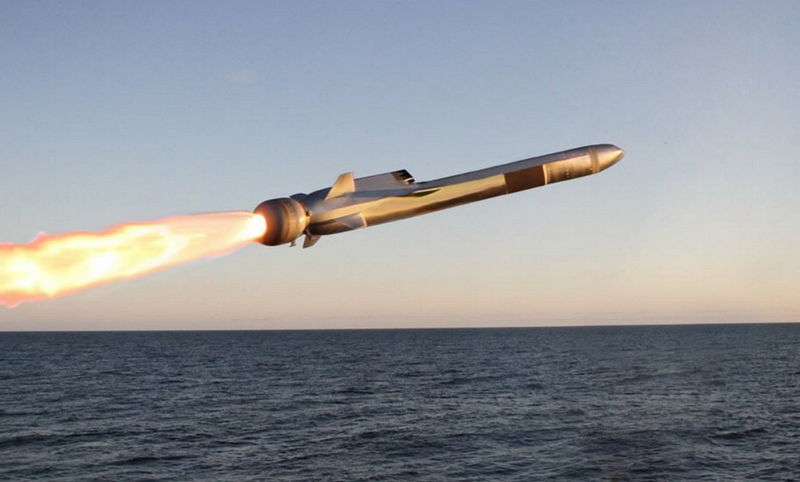
In late March 2022, a high-ranking U.S. official confirmed that NATO members may give Ukraine anti-ship missiles, giving Ukraine a new method to defend itself against Russia’s ongoing aggression.
“We have started consulting with allies on providing anti-ship missiles to Ukraine,” the official told Reuters. “There may be some technical challenges with making that happen but that is something that we are consulting with allies and starting to work on.”
In early February, Ukraine and the United Kingdom agreed on the delivery of an unannounced anti-ship missile; it could be the Naval Strike Missile (NSM), a highly sophisticated small anti-ship missile used by both British and American forces.
And on 9 April 2022 Boris Johnson, the United Kingdom Prime Minister, confirmed in a meeting in Kyiv with President Zelenskyy that the UK would indeed provide anti-ship missiles.
The details of which missile will be supplied are not specified.
The ‘technical challenges’ mentioned above are likely to involve the launch platform, which could range from ships to aircraft including helicopters. Whichever platform is planned, there would have to be a fit-out process.
My view is that ship-launched missiles are unlikely to be in the scheme as Ukraine’s navy is highly vulnerable and almost entirely confined to port, blockaded by the Russian navy.
For air-delivered anti-ship missiles, adapted hardpoints and firing systems would have to be installed. This would not be an overnight task and the timescale is likely to be at least a couple of months. When did the adaptation design process start?
As of early April 2022, Ukraine still appears to have a functioning airforce though details are obviously hard to come by.
But there is an anti-ship missile that can be launched from trucks.
Naval Strike Missile (NSM)
The NSM is in use by many NATO countries in their navies.
The state-of-the-art design and use of composite materials is meant to give the missile sophisticated stealth capabilities. The missile will weigh slightly more than 400 kg (880 lb) and have a range of more than 185 km (100 nm). NSM is designed for littoral waters (“brown water”) as well as for open sea (“green and blue water”) scenarios. The usage of a high strength titanium alloy blast/fragmentation warhead is in line with the modern lightweight design and features insensitive high-explosive. Warhead initiation is by a void-sensing Programmable Intelligent Multi-Purpose Fuze designed to optimise effect against hard targets.
NSM is able to fly over and around landmasses, travel in sea skim mode, and then make random manoeuvres in the terminal phase, making it harder to stop by enemy countermeasures. In 2016, it was confirmed by the Royal Norwegian Navy that NSM also can attack land targets. — Wikipedia
That appears to be a highly capable weapon.
And it can be launched from trucks.
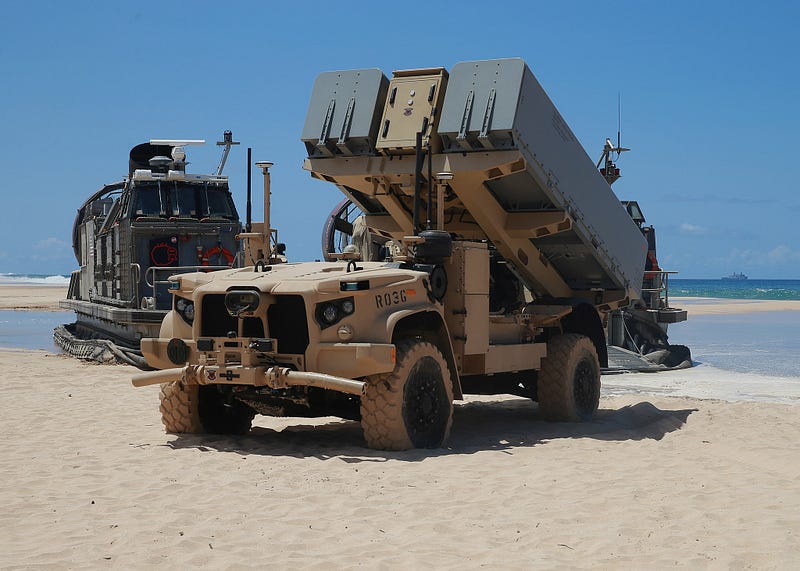
Above picture: A Navy Marine Expeditionary Ship Interdiction System (NMESIS) launcher deploys into position onboard Pacific Missile Range Facility Barking Sands. The NMESIS and its Naval Strike Missiles participated in a live-fire exercise as part of Large Scale Exercise (LSE) 2021. During the training, a Marine Corps fires (sic) expeditionary advanced base (EAB) sensed, located, identified and struck a target ship at sea, which required more than 100 nautical miles of missile flight (extract from text accompanying Wikipedia image).
NSM Potency
This is clearly a highly potent weapon. Anti-ship missiles proved their worth in the Falklands War when French built Exocets were used by Argentina to great effect against UK ships.
So serious was the threat to the Royal Navy that it was reported in a later book that Margaret Thatcher forced François Mitterrand to give her the codes to disable Argentina’s Exocets by threatening to launch a nuclear warhead against Buenos Aires— The Guardian.
That may seem far fetched, but it’s certainly a fact that major naval vessels represent a vulnerable concentration of investment, military power and national pride.
Russian reaction
And we know what Putin thinks about national pride. He started a war because of it.
If Ukraine were to have the NSM available on trucks (or other launch platforms), then that would be a major concern for Putin.
In fact, some defence experts are speculating that if a Russian capital vessel was sunk by an anti-ship missile then Putin would see this as an act of war.
A Nato-supplied anti-ship missile fired by Ukrainian forces in Odesa hits and sinks a Russian warship offshore in the Black Sea with the loss of nearly 100 sailors and dozens of marines. A death toll of this magnitude in a single strike would be unprecedented and Putin would be under pressure to respond in some form. — Frank Gardner, BBC Security Correspondent
On the other hand, Putin’s days may be numbered.
How will history be written?
I can only hope that sanity will prevail in those close to Putin.
‘Why send anti-ship missiles?’
That’s my headline question and I should answer it.
I think that sending them (in whatever flavour) is a carefully judged apparent escalation.
The missiles may be sent as a public gesture and a warning to Putin.
But the arming codes may well be withheld by the UK.
The lesson about the control of arming codes was learned by the UK in the Falklands War, 40 years ago.
Updated 14 April 2022
Ukraine is claiming that its Neptune anti-ship missiles have seriously damaged the flagship of the Russian Black Sea Fleet.
The range of the Neptune is of the order of 280–300km. The Neptune (RK-360) is an anti-ship missile which are truck launched.
More at:
About me: If you follow me I guarantee variety in your inbox! I write on a wide range of topics including humor, tech and travel, together with daily news events and the minutiae of my daily life living on a boat. I also write techno-thrillers…and about…
…madmen with red buttons
Or, if you just enjoy reading stories like these and want to support other writers and me, consider signing up to become a Medium member. It’s $5 a month, giving you unlimited access to incredible stories on Medium. If you sign up using my link below, I’ll earn a small commission at no extra cost to you.