
Where Are All the Transgender Men?
The lack of masculine transgender representation in media

Whenever the debate around transgender rights occurs, transgender men are often left out of the debate or are barely an afterthought. This is because many people don’t realize transgender men exist. I blame this on the lack of representation of transgender men in media.
How is the current representation of transmasculine people lacking?
Looking across the various forms of media, when there is any transgender representation at all, the character is often a transgender woman. Until recent years, transgender women were portrayed by either a cisgender woman, or a cisgender man in drag. It’s debatable whether having a cisgender person portray a transgender person is an accurate representation, but I’m considering all transgender characters regardless of the identity of the actor portraying them.
While transgender representation has only become noticeable in recent years, representation for transgender boys and men is lagging behind that of transgender girls and women. Please know that I do not mean to disparage or take away from transgender women. I applaud their representation, especially when it’s positive and portrayed by trans feminine actors. I would just like to see more transmasculine representation, especially by transgender male actors.
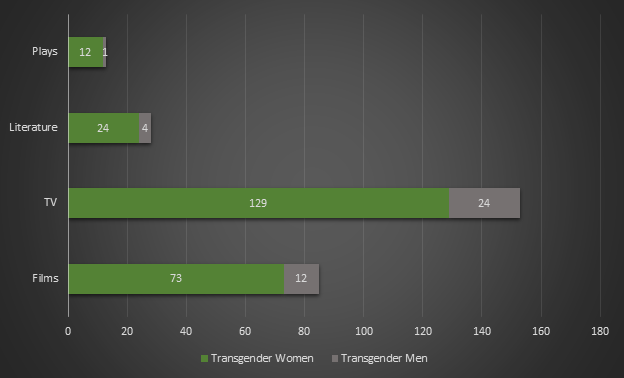
Taking data I found on Wikipedia, listing fictional transgender characters, I charted the current disparity in representation. Television has given the transgender community the most representation out of any form of media. Yet, even here, of the 153 occurrences of transgender characters, only 19% were portrayals of transmasculine people.
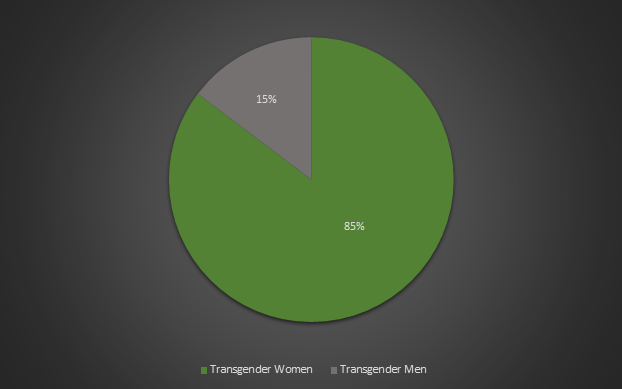
Overall, transmasculine characters only comprised 15% of all transgender characters. This gives the impression that most transgender people are transgender women, yet a Dutch study conducted in 2014 found that 1.1% of natal males and 0.8% of natal females reported an incongruent gender identity. This means that of the total population of transgender people they studied, 42% were transmasculine.
While it warrants more studies, this shows that there are clearly far more transgender men than are currently being represented in media.
Why do transgender men also need representation?
Finding accurate portrayals and representation in media for marginalized groups has long been a struggle. The immense impact that Nichelle Nichols had, starring as Lieutenant Uhura on the original Star Trek, on young Black girls in the 1960s, paved the way for many young women of color during the height of the Civil Rights Movement. Once again, Star Trek is leading the way by including both a male transgender character in Gray and a non-binary character in Adira on Star Trek: Discovery.
As a middle-aged transgender man, it took me far too long to come to terms with my gender identity, partly because this representation didn’t exist when I was younger. If I had known that transition was possible for someone like me, I would have done it much sooner.
Let me make this clear. Seeing transgender men represented in media did not cause me to become transgender. Long ago I came to terms with my gender incongruence and settled into an identity as a tomboy because I did not know transition was an option.
When I became aware it was possible, the only representation I saw were straight transgender men. I mistakenly conflated coming out as lesbian as a necessary step toward coming out as a transgender man. I couldn’t have been more wrong.
Not only is representation important for transmasculine people to see ourselves in media, it’s also important for the rest of society to see us as well. When some use the false narrative that transgender women are merely dressing as women so they can molest them in women’s spaces, they would not only force trans feminine people to use men’s bathrooms, which would increase their chances of being sexually assaulted, they would also force transmasculine people to use women’s bathrooms. What would you do if you saw someone who, from all outward appearances, looked like a man, walk into a women’s bathroom? Most people would try to stop them or call security.
Because of issues like this, we need more representation so we can raise awareness in society that transgender men also exist and require the same rights as our transgender sisters.
What should an increase of representation for transgender men look like?
The wrong way to represent transgender men is to hire a cisgender woman to portray a transmasculine character, as demonstrated by the backlash Scarlett Johansson received when she was cast as Dante “Tex” Gill in the movie Rub & Tug. She eventually stepped down from the roll and the movie has since been reimagined as a TV series. There is no word yet on who will be cast in the role of Dante “Tex” Gill, but I am hopeful they will cast a transgender man in the role.
A woman dressing in drag to portray a male transgender character is a poor way to represent transgender men. The message this sends to young transgender boys is that society views us as women playing dress up, and not as the men we identify as. Anyone who insists otherwise does not understand the transgender experience and conflates cross-dressing with being transgender.
One way to give transgender men representation would be to hire transgender male actors to portray transgender male characters. Not only does the character not need to be the focus of the story, like he would be in Rub and Tug, their being transgender also doesn’t need to be the central aspect of the character. The character of Grey in Star Trek: Discovery is intriguing in his own right. He’s not a main character, and the fact he’s also transgender is merely who he is, and not the key aspect of his personality.
Another way to give transgender men representation is to hire transgender men to play male characters. Not specifically transgender male characters either. For example, Chaz Bono, who is a transgender male actor, chooses not to portray transgender male characters. Instead, he’s only taken male roles, such as the character of Gary Longstreet in American Horror Story. This kind of representation is also important to show the world that transgender men are men and can be cast in any male role.
The fact is that transgender men exist and being trans isn’t the end-all, be-all of who we are as people. For representation to be authentic, our representation needs to be as complex as we are as people.


