When You’re Not “Dooming” Hard Enough
You can’t please all the people all the time with your climate change writing
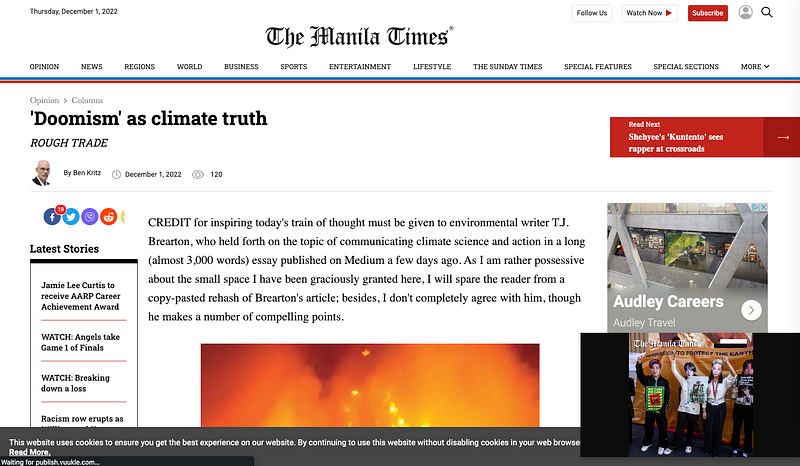
I woke up this morning and found a Google alert in my inbox: I’d been invoked in The Manila Times, the oldest extant English-language newspaper in the Philippines. A columnist named Ben Kritz claims I don’t go far enough in my dooming about climate change. Although he doesn’t reference the article by title, nor link to it, I am 99% sure it’s this one:
https://readmedium.com/what-if-doomism-is-the-climate-solution-3fdb12d97c47
In it, I criticize the media for not reporting on climate change earlier and with more frequency because it’s not been sexy or sensational enough. According to Kritz, I then suppose that if the media was more accommodating, and covered the crisis more widely, mankind would mobilize to defeat climate change.
I don’t remember ever quite thinking that. In the article, my point about media is that the attention economy plays a big role. We can (and do) cover issues in our infotainment ecosystem disproportionately. It’s not always the true gravity of the issue or consequence that merits how much attention it gets, but the nature of the idea’s transmissibility. Some contentious topics, such as abortion or transgender surgery, are relatively straightforward and so spread more easily. Climate change is complex, a “hyperobject” with many facets, an emergent phenomenon we have to understand as it develops. It’s harder to spread as a viral idea or meme.
It’s getting somewhat easier, though, as the effects of climate change turn up with greater frequency and urgency, as they will continue to do. Floods, wildfires, droughts, and hurricanes are easier for the media to cover, and easier to transmit among consumers of the media.
Although, science won’t make the claim that any one hurricane is the result of anthropogenic climate change, or its other incarnation, ecological overshoot. In this way, it’s still too ambiguous for the modern infotainment complex to truly grab hold of.
So the infotainment complex, which includes social media (which includes Medium), has done what it does best — take a complex issue and cut it down the middle. At least, to give it a spectrum. Are you a doomer or an optimist? Or, Where do you fall on the doomism-to-optimism scale? This makes the problem much more bite-sized, more internet friendly, and, frankly, distracts us from the real core of it.
I do think that the way in which the media has covered — or not covered, as it were — the topic of climate change, and the way we’ve designed our social networks to favor simple binaries and divisive content — has not helped advance the cause of spreading true climate awareness. It may have helped spread the cause of climate contention, though, giving us a way to deal with it in the manner to which we’ve grown accustomed — arguing about it online — and maybe that’s at least a dubious checkmark on the side of raising awareness.
But I think “doomists” and “optimists” — even as the phony, internet-generated distinctions those might be — need to come together on climate change, and end this false binary.
It might make sense that Ben Kritz takes a hard line on climate change: consider where he’s writing from. The Philippines could be underwater in as little as ten years, according to a Greenpeace report. That’s not “doomism,” but a blend of glacial geology and common sense. The earth is warming, the glaciers are melting, and as they melt, the world’s seas are rising. (There are other effects, too, such as ocean acidification, but for brevity, we’ll just stick with sea level rise.)
This means that all of our coastal cities are in jeopardy. As are our coasts in general, with one estimate that 60% of the world's population lives within 100km of the sea coast. Another estimate claims 3/4 of the world population lives within 50km of the sea. And, according to a research team at Queensland University in Australia:
Coastal regions are some of the most biodiverse and unique ecosystems on Earth, helping to sustain human life by providing fisheries, protecting against storms and capturing and storing carbon to slow climate change.
Needless to say, a significant sea level rise —even just a foot or two — would be absolutely devastating. Some studies predict one foot by 2050, while others are much less conservative, focusing on how the Thwaites Ice Shelf could fracture in just a couple of years, and pull the whole West Antarctic Ice Sheet with it, “flooding coastal cities worldwide.” This flooding would affect billions of human beings, ecosystems, food supply, and general civilization's infrastructure, touching every last one of us.
Nearly everywhere you look on the subject of ice sheet melt and sea level rise you find “accelerated rate,” “happening faster than predicted,” “could be considerably greater than this.” If emissions continue to rise unchecked, according to the World Economic Forum, the Arctic will be free of summer ice as soon as 2040. That’s just 18 years! And likely, as with so many predictions we’ve seen with climate change, it’s too conservative a prediction. Especially given that not only are emissions expected to continue rising, but we’re seeing increases in emissions and expect to keep seeing increases at least until 2050.
Does anyone see a problem here?
Do I sound optimistic?
My “optimism” is to merely suggest we need to do everything we can, RIGHT NOW, to reign in emissions, cut our super pollutants, and buy ourselves a little time. Things like marine cloud brightening to cool the poles or a competitive market for carbon dioxide removal are not “solutions” per se, but emergency stopgap measures. They don’t imply we can fix the problem and go about business as usual. Everything needs to change.
My optimism is that if we continue to talk honestly and openly about climate change, writ large, perhaps we have a better chance to mobilize and take action. At the very least, we can work with the influencer/attention economy and make climate change more reputational. As in, besides “canceling” people like Kayne West for anti-semitic remarks, we can threaten other influencers and moguls with their own cancellations — to the tune of billions of dollars — for not doing enough around climate change.
It is a crazy, weird, surreal time to be living in, and there are days I stick my head in the sand and get distracted, but then I come back around. Can we really fathom the loss of our coastal cities? The absolute devastation and human suffering? The loss of entire archipelagic countries such as the Philippines?
It’s almost too much to process. But what I think, what I hope, is that as climate calamities continue to provide the infotainment complex with more transmissible news items, the alarm will continue to grow, and people will demand action. We can’t wait for everyone to be directly affected before they’re incited. We need to scare the shit out of people NOW — so that’s the doom part.
We writers need to become not just chroniclers of climate change, observing the destruction of our planet and saying I told you so, but active “solutions journalists.” No, there is no panacea. No, we’re not going to reverse climate change. Yes, some very horrible things to come are at this point inexorable, but we CAN deploy emergency stopgap measures, we can try to use our infotainment complex to better serve our ecological and humanitarian needs, and we can advance mechanisms to underwrite stopgap measures and affordable low-carbon alternatives, to help both free markets and governments prioritize this global humanitarian emergency.
In fact, it’s not just a can, it’s a must.
P.S.
I shared the Manila Times article with my wife, a therapist, along with the Medium article Ben Kritz referenced. I think she sums it up better and in fewer words than I could manage:
I think your stance is just right. The answer has to be hope. It always has and always will. With the right inspiration and leadership, humans come to the right choices. We lack that leadership. The idea that humans won’t or inherently can’t rise to the benefit of mankind and life on earth is so sad and nihilistic. Even if it’s true, it’s not a place to lead from. The only hope is hope and belief in the good of humanity.