
What if “doomism” IS the climate solution?
Because the lies we tell ourselves are not helping the problem
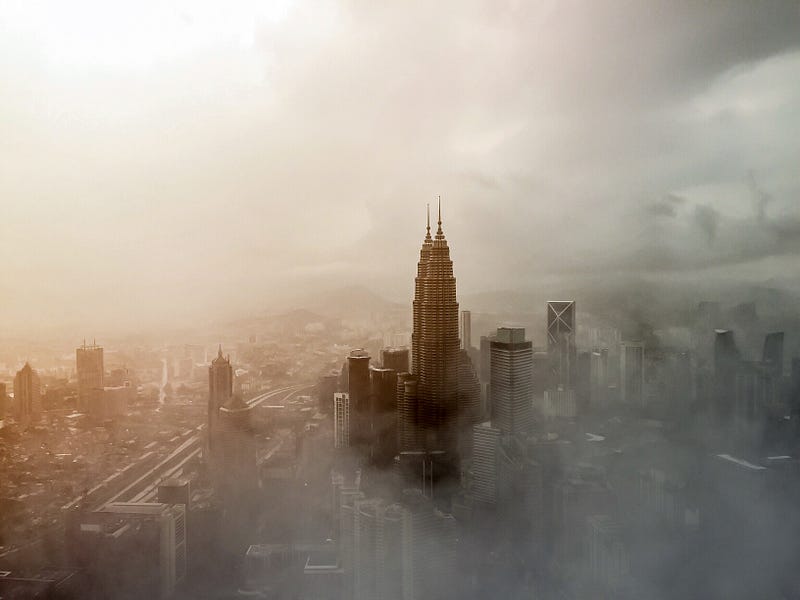
To some extent, it’s important to discuss how we discuss climate change. Communication matters, and there are all sorts of pitfalls with today’s infotainment complex and mass communication network.
What we call “the news” was once a network loss leader; the networks expected it to lose money; they’d make their bones on TV dramas and sitcoms. Newspapers used to be subsidized by the classifieds and other ad revenue, but the internet changed all of that.
This competition and loss of revenue turned news outlets toward sensationalism — “if it bleeds it leads” — which can distort a proportional sense of things. It’s been bad for climate change — in the days climate change was less visceral and more about science and numbers, it was a “ratings killer.” Today, natural disasters and ecological devastation are getting more coverage, as they’re eye-popping on their own.
But this extra coverage can also lead to the pushback that climate change is “fake news.” It doesn’t help that the national political news media turned partisan; businessmen such as Rupert Murdoch saw the profit opportunity to tell half an audience what they wanted to hear as opposed to telling a whole audience something anodyne and even-handed. Right wing news seems to cover climate change far less.
Social media deepened the fracture of civil discourse. Binary relationships precede Twitter and Facebook, of course, but those algorithms exacerbated the tendency for humans to divide into cultural tribes. It’s been proven that Facebook’s algorithm promoted divisive content. And it’s been studied how misinformation travels farther and faster than factual information on social media.
All of this is to say, the for-profit news model, the bifurcation of information, and the spread of misinformation are certainly important when considering an issue as all-important and all-encompassing as climate change. We have to be sure we’re not seeing things through distortion filters.
Aside from this, in the general discourse, we seem to have come quite a long way. I still see the occasional climate denier pop up here and there — as recently as this week, in the comments section of a NY Times article on climate change, someone wrote the tired, debunked line “The climate is always changing!” But, anecdotally anyway, the people I know who are culturally, politically right of center have come to accept climate change is happening.
The new division seems not to be between human-caused climate change and climate deniers (primarily between the sociocultural left and right), but an argument being had mostly in the center and on the left. And it’s been happening for at least several years. At first, it was whether climate “alarmism” was appropriate or counterproductive; now, alarmism has become “doomism,” and its detractors are saying the same: it’s unhelpful.
How we talk about climate change is still unsettled, to say the least.
I’d like to do what I can here to help settle it.
I think the vast majority of people who wish to believe that we can solve climate change (or at least that we can really avoid the worst of it), haven’t yet really seen the way to do so. That’s okay, though — they’re asserting a positivism that just because we don’t know how to make things better yet at scale, doesn’t mean we won’t; it’s certainly possible that we will. And being negative about it doesn’t help.
Through some combination of switching to renewables, like wind and solar, and eating differently, like eating more plant-based foods; eating more local, sustainable meat and dairy; through carbon capture and decarbonization, plus some copious amounts of “sciencing the shit out of it” — like transplanting coral polyps to grow back the coral reefs, and thus, repopulate the dying oceans, or putting a solar shield in the atmosphere to block some of the more harmful rays of the sun — we’ll fix this thing.
I do think people expect some loss of amenities, but they’re maybe not exactly sure what. Perhaps their favorite items aren’t available for a short time. Perhaps things get kind of expensive due to shortages and supply chain issues. So they think, “I’ll have to cut back a little.”
Maybe someone who considers themselves an optimist really does think things will get worse than that, but ultimately, they will get better; it’s just a matter of time, and hard work, and positive thinking (and science).
What all of this optimism is protecting is the idea that life as we know it won’t change all that much. We’ll meet each challenge and we’ll adapt, but it won’t be too different from what we’re experiencing now. Our children will go to school, grow up, have families of their own. We’ll have food on the table each night, water from the tap. Maybe the food will have come from some cool new company that’s made quinoa into a delicious ersatz steak, maybe the water will be from our own rain catchment and filtration system, but it will pretty much look like life does now, with the stuff hidden in the walls and behind the scenes just a little differently arranged.
There will be solar panels on our roofs. Electric cars parked in our driveways. We might not even need to use the car all that much anyway, since we’re going to work remotely right from our home, using our VR headset or holographic Zoom. And at night, when the day is done, we’ll watch some streaming TV with our partner, some cool new show, and then toddle off to bed. And if anything happens causing us to hurt ourselves, or be sick, all the usual medical stuff will be there (it will be even better!) to serve us and keep us whole.
Taxes may be high, food may be a bit expensive, relatives and loved ones may occasionally be at risk of a wildfire, hurricane, or flood in some other place, but basically, life will be okay. We’ll always be keeping a wary eye on the degrees-above-normal global temperatures, but we’ll know that we, and everyone else, are doing our utmost to keep that puppy knocked down between 2 and 3 degrees centigrade above pre-industrial levels. We’re buying less shoes, eating more leftovers, and we held onto our old iPhone for an extra year. So far, so good!
That’s the optimistic view, as far as I understand it. I don’t know of anyone, or think there can really be anyone so Pollyanna as to think we’re going to reverse climate change, let alone keep to the 1.2 degrees above pre-industrial levels we’re at right now, but I think the people who call others “doomers” and suggest a more positive approach think something along these lines. And who can blame them? I want to think along these lines, too. I have three children, ages 18, 10, and 7. I’m 47 and want to spend the second half of my life writing books and getting old with my wonderful wife and traveling.
But I don’t think that’s going to happen.
It’s important to keep an open mind, but thinking about climate change the way I described above really isn’t going to help me, or anyone. I can hope that what I described is the case, yes. But the issue is, what to do now. And what to do now is, I really think, born out of taking a real hard, sober look at things. At being willing to admit something no one wants to admit.
Climate change isn’t just a greenhouse gas problem. It isn’t just a deforestation problem or a habitat loss or species extinction problem. It isn’t just about pollution and fossil fuels.
Climate change is also a population problem. It is also a capitalism problem; an economic growth problem. And it is a mental paradigm problem. We’ve gotten so used to the idea of limitless growth, so used to the idea of progress, so used to thinking that each of us (in the “industrialized” world, anyway) can have a house, a car, three kids, and fill our carts with groceries every week and go to big box stores that sell us everything we could possibly need or want, that we’ve mistaken this for some kind of default reality.
We can go to football games and enjoy parades. We can dress our kids up in pre-fab Halloween costumes and buy copious Christmas presents. We can keep building skyscrapers and roads and bridges and schools and repaving roads and hauling massive containers of goods across the oceans in our transatlantic ships dragging those invasive species along with them.
As if life was always supposed to be this way, instead of the unsustainable existence beyond our means it really is.
We say we understand that, but what we say and do seem very different.
That’s why really thinking, each and every day, that this way of living is truly no longer sustainable— this is the first step. That even if we really start pumping the brakes now, and our governments get their shit together and double down on their climate pledges, we’re already in the midst of triggering five key climate tipping points, events that rearrange the entire system with feedback loops and knock on effects.
So then, what is it? How do we fix this and make modern life sustainable?
According to Wes Jackson and Robert Jensen, authors of An Inconvenient Apocalypse, what we need now is:
“A down-powering (of society) on a global level with the goal of fewer people living on less energy, achieved by means of democratically-managed planning to minimize suffering.”
Phew! Say that again?
“A down-powering (of society) on a global level with the goal of fewer people living on less energy, achieved by means of democratically-managed planning to minimize suffering.” (emphasis added by me)
And they note how exceedingly daunting this task truly is. That, basically, we can’t.
We can’t make modern life, the way it is now, sustainable.
To put it how Kim Stanley Robinson does in his book The Ministry for the Future: “It is easier to imagine the end of the world than the end of capitalism.”
Zing!
Here’s the thing: detractors of “doomism” or “alarmism” say that it doesn’t focus enough on solutions. But there are two problems with this. One, this criticism assumes that there are such “solutions” to get us to a situation I described above, where we all are basically carrying on with life as we understand it now, just with different stuff powering us in the background.
That assumption itself needs to be questioned. And that’s what doomism does. And that’s why I think it’s not only valuable, but the most important thing we can be doing right now.
No, it is not a solution in and of itself, but it is setting us up for the right mindset to understand we cannot continue life on planet Earth the way we have been by doing some one-to-one swap for renewables. Or that, after enduring a decade or two of shortages, a decade or two of bad weather, things will improve and get mostly back to normal.
Not even close.
We waste time playing the blame game, too, with the other binary in the climate discussion — whether it’s the consumers or producers of modern goods and services that are more culpable.
The producers are not going to change, not en masse, not enough, anyway; they’re the ones who drive the “we can fix it!” narrative anyway, so that they might get in on the profit potential of “climate conscious” products. Yes, that sounds cynical and yes there are some earnest do-gooders out there, but again, it’s just nowhere near enough. It could never be enough.
As Jackson and Jensen put it:
“Just by living ‘on the grid’ in the affluent industrialized first world, we are in some sense contributing to the destruction of ecosystems, as is likely everyone reading this book.”
Because we’re culpable does not mean the onus is on us to fix the problem.
Assigning this “blame” is meant to underscore the fact that merely by our living the way we do, the way we’ve come to view as “normal” is itself the problem.
Yes, the corporations are part of this. Yes, the governments should do better. But — do you see? The problem of billions of people all living beyond the carrying capacity of a system is not something that can be fixed. It just can’t be.
It has to change entirely. The whole she-bang has got to go. And that’s not an edict, that’s a prediction: It WILL go.
I’m not saying human extinction. I’m saying that the dream of living life the way we do now with some background tweaks is not going to be the case. Your neighborhood will never look the same again; it will soon be filled with climate refugees. (Unless you lived somewhere riven with wildfires and floods and hurricanes and so had to move yourself: Welcome, refugee.)
There won’t be solar panels on your roof that’s made of asphalt shingles. There won’t be screens all through your house streaming endless content 24/7. There won’t be grocery stores where you can rush out and grab something for tonight’s dinner because you’ve been so busy at your job running the art gallery, or performing legal services, or construction, or cooking in the restaurant. You’re not going to hop in your car — electric or otherwise — to zip off wherever at the drop of a hat. You’re not going to have the world in your pocket at all times, telling you where to drive, who invented the watch, how long it would take one photon to travel around the globe, what your heart rate is right now.
I’m being a bit tongue-in-cheek because predictions do get squishy in here. We don’t know exactly what things will look like by 2100, or 2050, or even 2030, and it won’t be the same for everyone.
But I’m utterly persuaded that things are going to be worse and faster than our more tempered predictions. I expect global crop failures soon, maybe in just a few years. I expect that the next time diesel is running out, there’s not just “more on the way.” I expect more and more to disappear from my grocery store in the coming years and prices to continue soaring, and wealth inequality to get exponentially even worse, and regulatory capture even more disgusting as our political system continues to implode at the same time it attracts more TV personalities and celebrities to its ranks.
I expect these current tipping points — glacier melt, permafrost melt, coral reef die offs, weakened Labrador Sea convection — along with changes to the jet stream that lead to increasingly erratic weather — are all going to make things exponentially worse now and in the very near future.
I expect that our current self-imposed limit to burn no more than 500 more gigatons of carbon in order to stay under 2 degrees is not going to be met, but exceeded. And greatly.
And that, as the UN suggests, even 2–3 degrees of warming will lead to “endless suffering.”
But mostly, above all, I just do not see the current system in any way, shape, or form able to maintain itself. That is, everything built with industrialization: the atomization of the individual family with its house, two cars, and myriad conveniences, its annual vacation to somewhere warm, its quotidian appetite for meat and dairy, its expectations that the children will go off to college and get jobs and carry on in the same way.
It. Will. Not. Happen.
And there is no Plan B.
We built this hydrocarbon dream on dense energy. We can’t even expect to just reverse course to a time we lived with far less. There is no infrastructure to transition us there. Not mechanical, political, or societal. It is a complete and total non-starter. It may even be woven into the fabric of existence: we do not go backwards.
What will change will be forced, change that will disproportionately cause some people worse suffering than others, but it will touch all of us, even the superrich.
There are no solutions, per se. There are mitigation efforts and we should do everything we can with all hands on deck to implement those efforts. But it does no one any good to push this idea that we will “get through this,” that climate change is some global equivalent of a power outage in our neighborhood — the power will pop back on after a period of minor inconvenience.
We will instead see a complete revolution of how we are able to live on planet Earth.
It truly is an apocalypse, in this way. It is the sunset, or “doom” — not of all human existence, necessarily — but of a way of life we’ve come to take for granted. What we’ve come to expect. It is the end to a life beyond our means, one that uses ancient sunlight to sustain a limitless growth paradigm which could never, let’s face it, last forever.
We are all — particularly those in the west living off the spoils for these past hundred or so years — going to have to make do with a lot, lot less.
Why wouldn’t’ you want to mentally prepare yourself for that? What scrap are you holding onto to convince yourself it will be otherwise? And why?
There is a saying in Latin: memento mori. The idea is, remember that you’re only here for a short time. Remember that you die.
This isn’t to be morbid, or depressed — the opposite. This is so you appreciate every moment.
This is to awaken you, to sharpen your senses.
Climate doom means to stop believing the fantasy that we will “live forever,” i.e., that we can keep on with this way of life indefinitely.
We cannot, and the bell has tolled.
TJB
10–31–22