avatarMichelle Marie Warner

Free AI web copilot to create summaries, insights and extended knowledge, download it at here

4536

Abstract

ight. With this straight privilege comes a certain kind of sacrifice. I’m unintentionally hiding out in the open.</p><blockquote id="8bac"><p>Bisexual erasure plays a critical role in reducing the community’s visibility, and in turn reducing access to the resources and support opportunities bisexual people so desperately need. — <a href="https://www.glaad.org/accordionview/bisexual-erasure">gladd.org</a></p></blockquote><p id="fccb">How do those of us on the nuanced sexuality spectrum claim our identities in a society that still denies them? My first and only girlfriend was threatened by my bisexuality, assuming I’d leave her for a man because her ex did the same. Although it was personal for her, others believe we’ll leave a woman eventually because it’s “just a phase.” Even my lesbian ex-girlfriend made assumptions about my sexuality being transitional.</p><p id="2f6e" type="7">Sexual orientation isn’t a phase. Bisexuality is an identity that won’t change over time or with the choice of a gendered partner. As with any other LGBTQIA+ person, I was born this way.</p><p id="7309"><b>Because my attraction includes more than one gender, you won’t see me only with women. Don’t erase me as bisexual because of the relationship I choose.</b></p><p id="f1d1">Coupled with our sexual orientation is also our <a href="https://www.medicalnewstoday.com/articles/types-of-gender-identity#definition-of-gender-identity">gender</a>. I identify as a <a href="https://www.health.com/mind-body/lgbtq-health/what-is-cisgender">cisgender</a> woman, which means my gender aligns with the female sex assigned to me at birth. I also present as a female, so others expect me to be one.</p><blockquote id="7797"><p>Gender is different than sex. Although genetic factors typically define a person’s sex, gender refers to how they identify on the inside. Only the person themselves can determine what their gender identity is. — Veronica Zambon, <a href="https://www.medicalnewstoday.com/articles/types-of-gender-identity">Medical News Today</a></p></blockquote><p id="a2a4"><a href="https://www.usd.edu/diversity-and-inclusiveness/office-for-diversity/safe-zone-training/spectrum-model">Gender and sexual orientation lie on a continuum</a>. Gender is socially constructed and fluid, so how could they assume they know what that means for an individual?</p><p id="4d5a">A non-binary, transgender, or gender fluid person identifies according to how they feel inside. They may not always look like the gender with which they identify. It’s not for anyone else to speculate.</p><p id="7507">According to Jennifer Tzeses, in her article, “<a href="https://www.psycom.net/gender-identity">What Is Gender Identity</a>?” gender identity threatens the idea that we only have two genders, male and female:</p><blockquote id="b519"><p>“It’s not really an anatomical conversation,” Nichols says. “It’s about emerging sex and gender identities and the fact that they all threaten heteronormativity: the idea that there are two genders, male and female, that men and women are only attracted to opposites, and that women are inferior,” she says. “Basically, trans/nonbinary people, like gay people, threaten the institutional structures that uphold the patriarchy.” — Jennifer Tzeses, <a href="https://www.psycom.net/gender-identity">psychometric.net</a></p></blockquote><p id="754d"><a href="https://www.healthline.com/health/what-is-bisexual#overview">Bisexual</a> means we’re attracted to someone of two or more genders, whereas <a href="https://www.glaad.org/blog/what-pansexuality-4-pan-celebs-explain-their-own-words">pansexual</a> is an attraction to people regardless of gender. Either of those labels applies to me. Queer used to be considered <a href="https://www.juiceboxit.com/blog/reclaiming-queer">derogatory</a>, but many of us are reclaiming it. Saying I’m queer feels most inclusive for me right now.</p><p id="5928">I stumbled upon an excellent blog called <a href="https://www.juiceboxit.com/blog/reclaiming-queer">juiceboxit.com</a>, and they shared more about reclaiming “queer.”:</p><blockquote id="644d"><p>Today, Queer is an umbrella term for sexual and gender minorities who are not heterosexual and/or not cisgender (meaning a person whose sense of personal identity and gender does not correspond with their sex assigned at birth). — <a href="https://www.juiceboxit.com/blog/reclaiming-queer">juiceboxit.com</a></p></blockquote><p id="8596">If we’re attracted to different genders, we’re open to being with a variety of humans. I

Options

happened to be with cisgender men for most of my dating life. That doesn’t mean I don’t love other humans of varied genders.</p><p id="ef96">When we stop assigning gender and misgendering folks, there’s a chance we can also stop erasing the vast continuum of sexuality. When you see me holding hands or kissing someone, you won’t question our gender or classify my sexual orientation. Then I’ll be visible without having to prove who I love and why.</p><blockquote id="3b6b"><p>Every day is a day you can support people who identify as bisexual, pansexual, fluid, queer, non-monosexual, no labels, pomosexual, bi-romantic, pan-romantic, polysexual, multisexual or any of the several dozen “labels” the bisexual community celebrates and supports as equally valid and equally brave. — <a href="https://www.glaad.org/bisexual/bierasure">gladd.org</a></p></blockquote><p id="7037">Our culture dictates what we perceive as a particular gender. We express it according to gender norms, or we go against them, and the rest of society sees it as a challenge.</p><blockquote id="6106"><p>Gender is socially constructed and a result of sociocultural influences throughout an individual’s development (Schneider, Gruman & Coutts, 2005). — <a href="http://www.personal.psu.edu/bfr3/blogs/applied_social_psychology/2011/10/the-social-construction-of-gender.html">personal.psu.edu</a></p></blockquote><p id="4bda">Our culture also determines our sexuality to an extent. When you see a couple and classify their gender, you subsequently assume what kind of couple they are based on your observations.</p><p id="4b1d">When you observe what looks to be a heterosexual couple, you’re doing that because our society shows us more examples of heteronormativity. When we drop our assumptions about what people are “supposed to” look like, we’ll be open to accepting a plethora of relationship combinations.</p><p id="9b31">When we’re able to accept that people don’t come in tidy preconceived packages, maybe we’ll stop erasing someone’s sexuality. Maybe you won’t make me stay in some obscure closet until I’m over my “phase.” Maybe then I won’t have to wonder how I’m going to come out every day. I’ll already be out and proud to be authentically me.</p><p id="17cd"><b>Related reads:</b></p><div id="64e9" class="link-block"> <a href="https://psiloveyou.xyz/when-you-dont-recognize-your-straight-privilege-until-you-want-to-kiss-her-in-public-5d71bbc95c23"> <div> <div> <h2>When You Don’t Recognize Your Straight Privilege Until You Want To Kiss Her in Public</h2> <div><h3>And then you remember how it feels to be queer in the US</h3></div> <div><p>psiloveyou.xyz</p></div> </div> <div> <div style="background-image: url(https://miro.readmedium.com/v2/resize:fit:320/0*IJdn6mtrEN5e7zDG)"></div> </div> </div> </a> </div><div id="c461" class="link-block"> <a href="https://readmedium.com/what-my-first-girlfriend-taught-me-about-being-bisexual-e436b592ac9a"> <div> <div> <h2>What My First Girlfriend Taught Me About Being Bisexual</h2> <div><h3>And my straight privilege in a gay relationship</h3></div> <div><p>medium.com</p></div> </div> <div> <div style="background-image: url(https://miro.readmedium.com/v2/resize:fit:320/0*yLQNkDpvoYiSqO8V)"></div> </div> </div> </a> </div><div id="1463" class="link-block"> <a href="https://readmedium.com/the-best-way-to-learn-about-gender-diversity-66e663cdc089"> <div> <div> <h2>The Best Way to Learn About Gender Diversity</h2> <div><h3>Be willing to keep an open mind and practice inclusive language</h3></div> <div><p>medium.com</p></div> </div> <div> <div style="background-image: url(https://miro.readmedium.com/v2/resize:fit:320/1*[email protected])"></div> </div> </div> </a> </div><p id="c53a"><i>Let’s stay in touch. You can find me on <a href="http://twitter.com/gratefulone11">Facebook</a>, <a href="http://twitter.com/gratefulone11">Twitter</a>, and <a href="https://www.linkedin.com/in/michellemariewarner/">LinkedIn</a>. Thanks for reading.</i></p></article></body>

LGBTQIA+ & RELATIONSHIPS

When You’re Bisexual & Straight Passing Most Of The Time

Bi erasure doesn’t feel like privilege
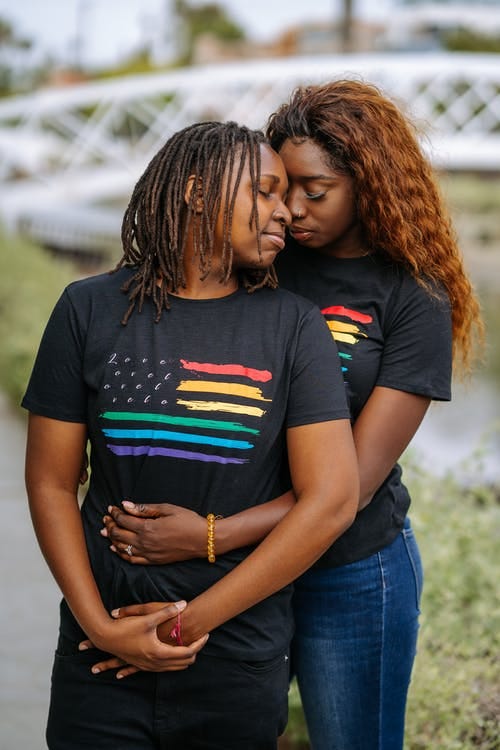
Photo by RODNAE Productions on Pexels

It’s common to experience bisexual erasure in a heteronormative society. Sometimes it’s as simple as not looking like we’re bi. Although the “B” in LGBTQIA+ stands for bisexual, we don’t always appear to be a part of the community.

According to gladd.org, bi-erasure is defined as follows:

Bisexual erasure or bisexual invisibility is a pervasive problem in which the existence or legitimacy of bisexuality (either in general or in regard to an individual) is questioned or denied outright. — gladd.org

If we’re in a relationship with someone of the same gender, people make assumptions about our sexuality. A bisexual woman with a man or male-presenting human isn’t any less bisexual. A bisexual man with a woman or female-presenting person isn’t any less bisexual.

And yet, people routinely erase our identity when they can’t see it. Others think they know more about someone’s gender or sexual identity than we do. We’re the only ones who can determine our gender or if we’re bisexual/pansexual.

A recent online conversation revealed that people still believe a bisexual person in a heterosexual relationship was “just going through a phase.”

Assuming we were only in a phase serves to invalidate our experiences and erase our bisexuality. Why do we need to prove our sexuality to anyone?
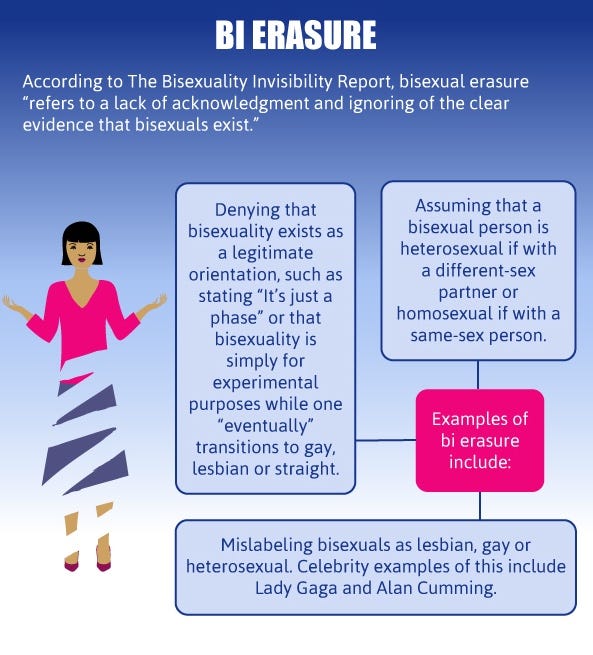
Infographic courtesy of Bisexual Resource Center, shared on gladd.org

I recognize I’ve carried some level of straight privilege. I’m aware that I can express my feelings for a man or male-presenting person without judgment and violence from ignorant homophobes. That doesn’t make me any less erased as a bisexual person. When I openly express my feelings for a woman, my privilege disappears, and so does my bisexuality.

Being straight passing is a hindrance to expressing my attraction to a woman. It’s harder to find a girlfriend when she doesn’t know I’m attracted to her. Unless I’m on a dating app or visit LGBTQIA+ spaces, I pass as a heterosexual woman everywhere else.

Living in Eugene, Oregon, has its perks in that regard. There seem to be a lot more LGBTQIA+ folks around here. But I still need to go out of my way to show women and femmes that I’m interested. I’m also a single parent. People assume (correctly) that I had babies with a man. Again, that doesn’t make me any less bisexual.

I want people to see me as a queer woman. Being bisexual/pansexual and primarily dating men, I haven’t had many chances to show that I’m attracted to people besides cisgender men.

I sometimes feel like I’m hanging outside the doors of the LGBTQIA+ community.

I’m a card-carrying member, but it’s like I need to prove I’m queer enough to get inside. Do I need to be more obvious? Maybe a tee-shirt that says, “I’m here, and I’m queer” would help. I’m only partly joking.

It might sound absurd to those of you who had to fight to be accepted. Why would I put myself through that? I have LGBTQIA+ friends and family who had to hide their true selves for years until they bravely came out. Plenty of folks have to play down their queerness to stay safe.

I’ve had the privilege to be out in public without experiencing discrimination. But it recently dawned on me that I’m still in a strange kind of closet where most people can’t see that I’m bisexual. Unless I have a girlfriend on my arm, I appear straight. With this straight privilege comes a certain kind of sacrifice. I’m unintentionally hiding out in the open.

Bisexual erasure plays a critical role in reducing the community’s visibility, and in turn reducing access to the resources and support opportunities bisexual people so desperately need. — gladd.org

How do those of us on the nuanced sexuality spectrum claim our identities in a society that still denies them? My first and only girlfriend was threatened by my bisexuality, assuming I’d leave her for a man because her ex did the same. Although it was personal for her, others believe we’ll leave a woman eventually because it’s “just a phase.” Even my lesbian ex-girlfriend made assumptions about my sexuality being transitional.

Sexual orientation isn’t a phase. Bisexuality is an identity that won’t change over time or with the choice of a gendered partner. As with any other LGBTQIA+ person, I was born this way.

Because my attraction includes more than one gender, you won’t see me only with women. Don’t erase me as bisexual because of the relationship I choose.

Coupled with our sexual orientation is also our gender. I identify as a cisgender woman, which means my gender aligns with the female sex assigned to me at birth. I also present as a female, so others expect me to be one.

Gender is different than sex. Although genetic factors typically define a person’s sex, gender refers to how they identify on the inside. Only the person themselves can determine what their gender identity is. — Veronica Zambon, Medical News Today

Gender and sexual orientation lie on a continuum. Gender is socially constructed and fluid, so how could they assume they know what that means for an individual?

A non-binary, transgender, or gender fluid person identifies according to how they feel inside. They may not always look like the gender with which they identify. It’s not for anyone else to speculate.

According to Jennifer Tzeses, in her article, “What Is Gender Identity?” gender identity threatens the idea that we only have two genders, male and female:

“It’s not really an anatomical conversation,” Nichols says. “It’s about emerging sex and gender identities and the fact that they all threaten heteronormativity: the idea that there are two genders, male and female, that men and women are only attracted to opposites, and that women are inferior,” she says. “Basically, trans/nonbinary people, like gay people, threaten the institutional structures that uphold the patriarchy.” — Jennifer Tzeses, psychometric.net

Bisexual means we’re attracted to someone of two or more genders, whereas pansexual is an attraction to people regardless of gender. Either of those labels applies to me. Queer used to be considered derogatory, but many of us are reclaiming it. Saying I’m queer feels most inclusive for me right now.

I stumbled upon an excellent blog called juiceboxit.com, and they shared more about reclaiming “queer.”:

Today, Queer is an umbrella term for sexual and gender minorities who are not heterosexual and/or not cisgender (meaning a person whose sense of personal identity and gender does not correspond with their sex assigned at birth). — juiceboxit.com

If we’re attracted to different genders, we’re open to being with a variety of humans. I happened to be with cisgender men for most of my dating life. That doesn’t mean I don’t love other humans of varied genders.

When we stop assigning gender and misgendering folks, there’s a chance we can also stop erasing the vast continuum of sexuality. When you see me holding hands or kissing someone, you won’t question our gender or classify my sexual orientation. Then I’ll be visible without having to prove who I love and why.

Every day is a day you can support people who identify as bisexual, pansexual, fluid, queer, non-monosexual, no labels, pomosexual, bi-romantic, pan-romantic, polysexual, multisexual or any of the several dozen “labels” the bisexual community celebrates and supports as equally valid and equally brave. — gladd.org

Our culture dictates what we perceive as a particular gender. We express it according to gender norms, or we go against them, and the rest of society sees it as a challenge.

Gender is socially constructed and a result of sociocultural influences throughout an individual’s development (Schneider, Gruman & Coutts, 2005). — personal.psu.edu

Our culture also determines our sexuality to an extent. When you see a couple and classify their gender, you subsequently assume what kind of couple they are based on your observations.

When you observe what looks to be a heterosexual couple, you’re doing that because our society shows us more examples of heteronormativity. When we drop our assumptions about what people are “supposed to” look like, we’ll be open to accepting a plethora of relationship combinations.

When we’re able to accept that people don’t come in tidy preconceived packages, maybe we’ll stop erasing someone’s sexuality. Maybe you won’t make me stay in some obscure closet until I’m over my “phase.” Maybe then I won’t have to wonder how I’m going to come out every day. I’ll already be out and proud to be authentically me.

Related reads:

Let’s stay in touch. You can find me on Facebook, Twitter, and LinkedIn. Thanks for reading.

Relationships
LGBTQ
Sexuality
Bisexual
Love
Recommended from ReadMedium