
The Best Way to Learn About Gender Diversity
Be willing to keep an open mind and practice inclusive language
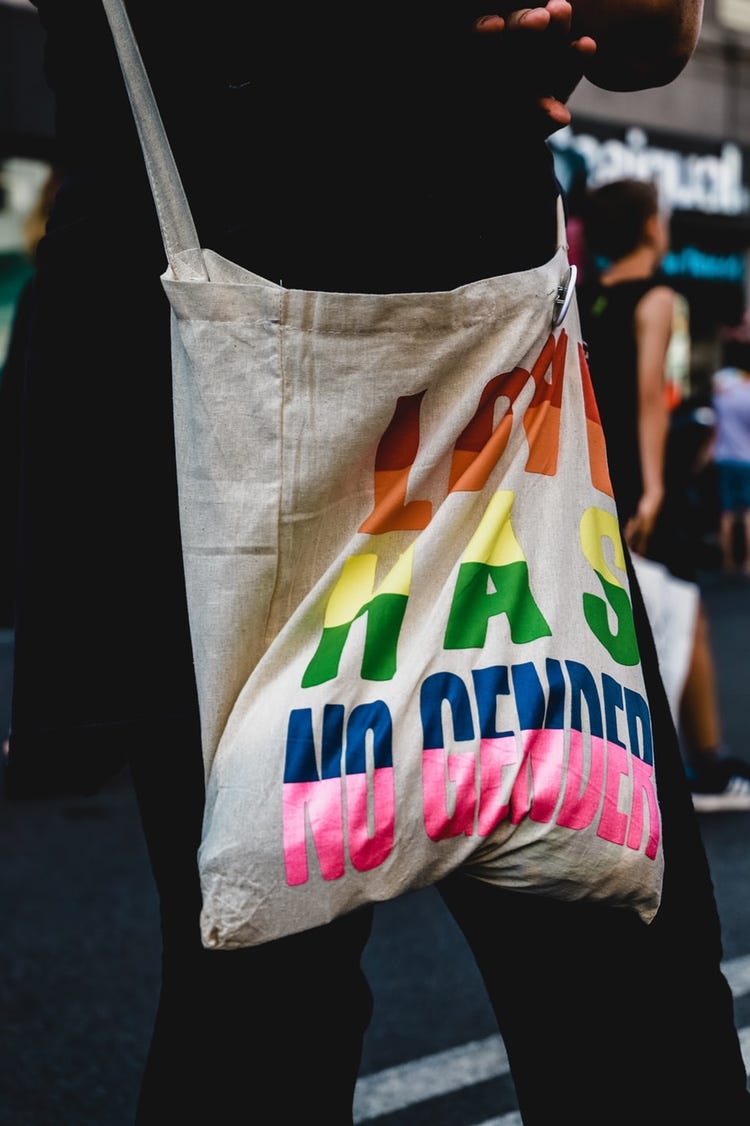
Sometimes boys grew up to be women. And girls grew up to be men.~Leah Raeder
Humans come in a wide range of gender variations. We don’t always meet the criteria of the standard male/female binary system. There’s plenty of gender diversity in our world. Gender diversity encompasses anyone who identifies as transgender, non-binary, genderqueer, gender fluid, agender, or gender non-conforming.
Want to know how someone identifies? Ask them, “What gender pronouns do you prefer?” If I’ve never met a person, I use “they” until further notice. It’s a simple thing to practice and shows you care.
The importance of “they”
If you don’t know a person or don’t feel comfortable asking, use the singular ”they” pronoun. This signals respect for the individual’s right to claim whatever gender resonates. When you refer to someone as “they”, you show that you’re not making assumptions about who they are before they tell you.
I typically use gender-neutral pronouns everywhere I go. I make a concerted effort to remember this on the playground. Not only do I honor the kids who are gender diverse, but I also show cisgender kids that we all come in different gender variations.
Most of us experience gender conditioning so young — research shows it begins in infancy — that we misunderstand the relationship between nature and nurture, culture and biology, fitting in and being oneself.~Thomas Page McBee
Gender is a social construct
Gender roles have been created by our society. We’ve been conditioned to see ourselves and others in a particular role based on societal expectations. Determination of sex and gender at birth has been complicated, especially in US culture. Babies born with ambiguous genitalia get assigned a gender that might not be accurate.
Some infants undergo surgery to “correct” their anatomy. Years ago in a gender studies class, I learned about the horrific practice of genital mutilation. It’s done here in the US under the guise of gender reassignment surgery, performed without consent. I don’t know if doctors still do it.
Later in life, intersex individuals may discover that they’ve been misgendered. If you were born intersex, don’t you think it would be important to know? Many children grow up confused and uninformed.
Intersex is a term for someone born with a variety of sexual anatomy combinations. A baby might be born with a vagina and testes. Others are born with a uterus and a penis.
Isn’t it wonderful that we have such variability? Let’s talk more about that.
Most babies still have their gender determined by looking at their genitals. Parents and medical staff make an assumption that their gender is matched with their biological sex organs. That’s not necessarily an accurate assessment.
Accepted social gender roles and expectations are so entrenched in our culture that most people cannot imagine any other way. As a result, individuals fitting neatly into these expectations rarely if ever question what gender really means. They have never had to, because the system has worked for them.~Nicki Petrikowski
Exploring the gender spectrum
I have friends and acquaintances who identify as genderqueer, non-binary, and transgender. Their gender assignment doesn’t match how they feel.
Here’s what these terms mean:
genderqueer — a person who doesn’t identify with their gender assigned at birth, who hasn’t had and may not want gender reassignment surgery. People identifying as genderqueer might also identify as non-binary.
non-binary — a person who doesn’t identify as male or female. Binary means one or the other, and these folks don’t identify with either.
transgender — a person who doesn’t identify with the gender assigned to them at birth. They might experience gender dysphoria, but not always.
gender dysphoria — Some trans people experience discomfort with being misgendered or their bodies not matching their gender identity. They have a deep desire for congruency.
cisgender — a person whose gender matches the one they were assigned at birth
I identify as cisgender, which hasn’t changed over time.
If you’re curious or confused, ask someone in the LGBTQIA+ community. In case I’ve missed anything, I’ve included this amazing video, produced by trans and gender diverse folks.
Exploring the sexual orientation spectrum in relation to gender identity
Sexuality and gender aren’t the same things. Someone can be trans without being gay. But I include this here because I’m pansexual. That means I’m attracted to people who might be trans or gender diverse.
Last year, I took a moment to reflect on my queerness. When I first came out, I considered myself smack dab in the middle, equally attracted to both men and women. I identified as bisexual.
bisexual — a person who feels attracted to two or more genders
I came out as bi in the mid-90s, I had very little knowledge about being transgender or any other gender identity. I only knew about “hermaphrodites”, who are now known as intersex. The former is now considered derogatory, so I don’t recommend using that descriptor.
I’m about 57% queer at the time of this writing. I occasionally pick a number for fun, and to illustrate that percentages are arbitrary and malleable. I happen to be attracted to a man right now, or that percentage might change.
Being pansexual has really opened up my world to the idea that I’m attracted to people, not their specific gender.
pansexual — a person attracted to people regardless of their gender identity.
Learning about gender diversity starts at home.
Last year I had a conversation about gender with my then 3-year-old. She had a Highlights Hello book with children on the back waving goodbye. I made assumptions based on their style of hair or dress, but decided to use “they” to describe them aloud. Noa told me that one particular child was a “she”. I asked her how she knew, and she told me “she” is wearing a dress and has “her” hair up.
I reminded her anyone can wear dresses, and maybe that child is a boy or neither or both. I told her I don’t know, so I’m going to call them “they”. Incidentally, all three children in this book have typical “boy” names. We had such a great dialogue. I feel like I can support my gender diverse siblings by continuing to educate my children about gender.
Noa currently identifies as a girl when I ask. My oldest, Orion, identified as a boy a couple of years ago for a month or two. She now strongly identifies as a girl.
I know I have straight privilege.
I’ve been straight passing all of my life. I’m aware that my friends and family don’t have it so easy when it comes to sharing about their sexual orientation or gender identification.
Willingness to use inclusive language fosters acceptance. Embracing gender diversity cultivates understanding and compassion.
I’ve been supported and loved no matter what, and have been out as whatever I feel like for years. For those of you who weren’t so lucky, I see you. I support you for being exactly who you are.
Related reads:
Let’s stay in touch. You can find me on Facebook, Twitter, Instagram, and LinkedIn. Thanks for reading.