
When Vicious Language Leads To Violent Behavior
And what to do about it. An old model guides us to speak out against new (and not-so-new) threats.
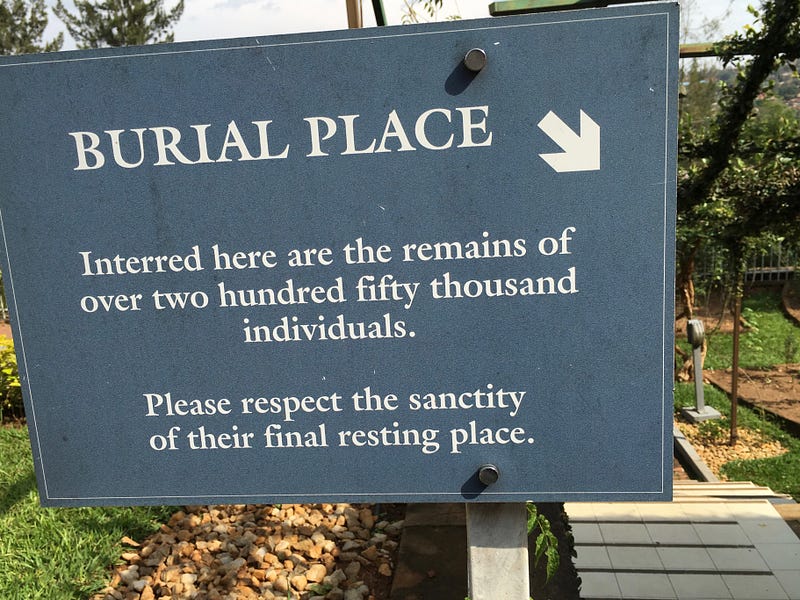
WORDS
Words are powerful little things. They inspire us, they motivate us, they connect us to one another. They educate, they influence and persuade. They preserve our history and promote social change and progress. They also cut, divide, denigrate and destroy.
Prejudicial language, jokes, and images have profound negative effects but many people — particularly those in dominant groups — tend to ignore or downplay this. They excuse this language in the U.S. by pointing to the First Amendment. Commonly, people also see it as harmless. “Sticks and stones may break my bones, but words can never hurt me” may sound good, but modern psychology shows that’s a bigger lie than the tooth fairy. The algorithms of social media and artificial intelligence (AI) can intensify bias and its negative impacts.
In her recent essay on how racist language perpetuates violence, writer and scholar Allison Wiltz lays out historical, current and evolving examples of racial epithets and stereotypes. She connects them to the disproportionate violence that Black people face in the U.S.
Wiltz’s examples are part of a bigger picture: interwoven narratives, images and ideologies that constitute what author Joe Feagin calls the white racial frame. The white racial frame is a worldview constructed not just of stereotypes and bigotry but also of supporting stories, interpretations and theories that shape our daily lives, sometimes out of our conscious awareness. It has, for four centuries, ensured the maintenance of systemic racism and violence in the U.S.
This is exactly what we’re NOT supposed to be talking about according to many politicians and state legislatures, and not just in Texas, Kentucky and Florida. This is why diversity, equity and inclusion (DEI) are under attack in business and higher education across the country. This is why books are being banned, why trans kids are targeted and why it is no longer ok to teach African American studies or race, gender and sexuality content in schools. This is why the “War on Woke.”
THE SCALE OF PREJUDICE
In 1954, renowned American psychologist Gordon Allport (1897–1967) published his five-stage Scale of Prejudice. He defined these stages as antilocution, avoidance, discrimination, physical violence/attacks and genocide.
- Antilocution is a specific form of “speaking against.” It includes negative language, jokes, slurs, images and stereotypes used to talk about certain people or groups but not necessarily spoken to them. It divides people into “us” and “them.” Hate speech and hate symbols are forms of antilocution.
- Avoidance is the act or practice of keeping away from something. With regard to prejudice, it refers to the separation of “in-group” or dominant group members (us) from those perceived as “out-group” (them). Avoidance can be an individual choice or seen in larger patterns like where we live, work and go to school.
- Discrimination puts prejudicial avoidance into action. It means actually treating members of out-groups differently than by denying them opportunities, access to resources or services and/or basic rights. For example, a dominant group may use legal or political power to deny voting rights, civil rights or citizenship to those it determines to be “other.”
- Physical attacks and violence may be directed at members of out-groups or at the entire disenfranchised group. Personal and material harm is normalized. Any protections against such harm are eliminated, formally and informally, by the dominant group.
- Extermination or genocide is the fifth step in Allport’s original scale. Atrocities, war crimes and mass killings escalate rapidly. The aim of the in-group in this stage is to obliterate or eliminate the undesired group of people from society.
Allport’s model shows how each stage paves the way for the next. It’s a slippery slope. By its negative and prejudicial nature, antilocution starts a process that’s hard to stop and leads, often quickly, to more drastic harm.
Allport used examples from the then-recent Nazi extermination of Jewish people known as “The Final Solution” to illustrate the five stages. Genocides through time, like — to name but a few — the genocide of indiginous peoples in the United States and those in Armenia (1915–16), Cambodia (1975–79), Rwanda (1994) follow the same pattern.
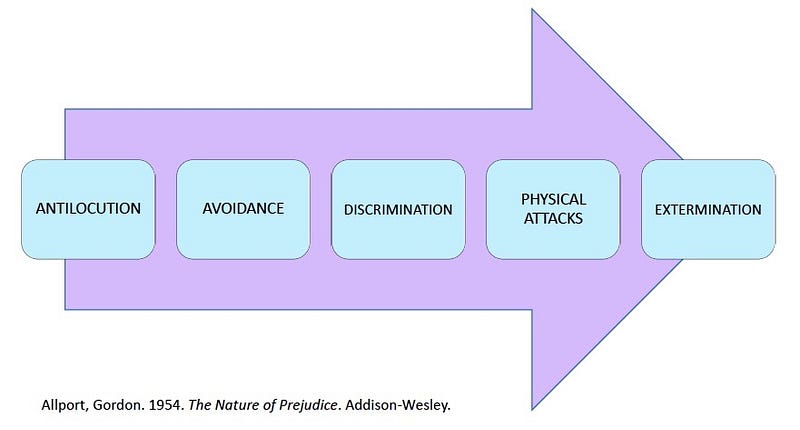
The Scale of Prejudice was originally published in Allport’s seminal book, The Nature of Prejudice. In the 70 years since, genocide has become a subject in its own right. Many colleges and universities offer courses, majors and even advanced degrees in genocide studies. New models, like the non-linear 10-stage model of genocide developed by Dr. Gregory Stanton at George Mason University and Genocide Watch, say these stages can occur simultaneously. These models are used to predict, interrupt and prevent genocide.
Dr. Stanton’s model lists denial as “the final stage that lasts throughout and always follows a genocide.” Here, wrongdoing is denied and evidence destroyed. Stanton says denial is one of the surest indicators of continuing violence and genocide.
VICIOUS AND VIOLENT
Often, those in U.S. majority groups think genocide happens elsewhere. In his book, Hitler’s American Model: the United States and the Making of Nazi Race Law, however, author James Whitman described how U.S. race laws shaped both Hitler’s thinking and the Nuremberg laws that defined the racist Nazi state.
The Nuremberg citizenship law reduced Jews to second-class status. The blood law criminalized interracial marriage and social relationships. Both drew heavy inspiration from Jim Crow laws. However, the Prussian Memorandum — the most radical Nazi manifesto backing harsh new laws for these “race crimes” — said laws in place in the American South were too severe to be adapted to Nazi use. Let that sink in.
“American Law,” Whitman said in a 2016 interview with Bill Moyers, “hard though it might be for us to accept now, was a model for everybody in the early 20th century who was interested in creating a race-based order or race state.”
Banning books, prohibiting DEI programs and outlawing curricula like African American studies and civil rights history sure seem to fit the description of denial, don’t they?
STOPPING THE SLIDE
The times in which we find ourselves are characterized by a flood of negative language from politicians at all levels; from corporate media, billionaires, boards of directors, white supremacists and — sometimes — colleagues, neighbors or family members. This language has been amplified by algorithms into which human biases are routinely programmed and by AI, which aggregates information so quickly as to present an existential threat to humanity according to a recent missive from an international group of doctors and public health officials.
With words, we are separated from and set against one another. Divided into us and them, in-groups and out-groups. Algorithms and AI continue to pick up and repeat the bad stuff and bury the things we really need to hear and know. The slope is so damn slippery that the slide feels almost inevitable.
But if we believe that, we’re dead. Scales of prejudice and genocide studies suggest and affirm strategies to resist, intervene, stop and prevent.
Start with words. It is incumbent upon each of us to use our words: to speak up. We need to counter antilocution by naming it, calling it out, questioning assumptions and countering misinformation. We change the environment when we say where we stand. We can do that as an individual, group or institution. Make a comment. Write the letter, email or blog. State the policy. Enforce it. Show up for the parade, the protest, the hearing. Put the rainbow in the window. Don’t take the merch off the shelves. Put more on.
Keep educating ourselves. The more we know, the more confident and effective we can be when we speak up and take other actions. What questions do you have? What are your blind spots and what resources will help you see into them? How can you become more alert to nuance and new developments? Until I read Wiltz’s article, for example, I had no idea that the term “jogger” referred to Ahmaud Arbery’s 2020 murder by white supremacists as he exercised in a suburban Georgia neighborhood and that this word was being used in place of the n-word to have racist conversations where they might not be accepted.
Invite and join with. Be an ally. Stand with those who are under attack. Invite others to stand with you and keep learning together. Consider joining more formally with those who know more than you do and with groups who are doing the work of countering vicious language, prejudice, restrictions of rights and threats/realities of violence. Learn how to best be a participant, partner and accomplice in deconstructing systems of oppression. There is safety and solidarity in the community. And power.
We stop the slide by letting nothing slide.
“Democracy dies in silence but you’ve raised your voice for democracy today. Silence is over. We will shout.” — Former Polish prime minister and president of the European Council Donald Tusk on the 34th anniversary of the first democratic elections in Poland, where an estimated 500,000 people marched to protest attacks on the rights of women and LGBTQ people. Source: Heather Cox Richardson, Letters From An American. June 4, 2023.


