
When the FBI Polygraphed Me to Ask If I Was Gay
Last vestige of the Lavender Scare
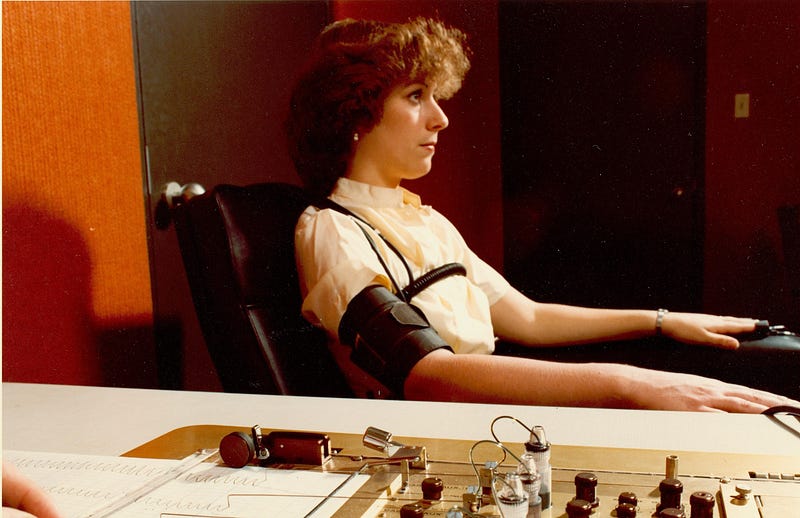
The FBI agents didn’t shine a hot light in my eyes, but they might as well have. The examination room was so small and stifling I felt like I was being grilled in a scene out of a bad movie.
Agent: “You told us during pre-examination that being mean to your sister as a child was the thing you are most ashamed of in life. Were you telling the truth?”
Me: (struggling to keep my breathing under control) Yes.
Agent: “Have you ever had contact with an enemy agent of the United States that you have not reported to the proper authorities?”
Me: (relieved to get an easy question) No.
Agent: Do you love your country?
Me: (relieved again) Yes.
Agent: Have you ever had sexual contact with another male, no matter how slight?
Me: (heart racing, sweat running down my forehead as I lie) No.
Agent: Have you ever had sexual contact, no matter how slight, with any male member of the U.S. military?
Me: (struggling to remain still as instructed, knowing I was close to vomiting, still lying) No.
I wasn’t allowed to turn my head to look at the autopens tracing on graph paper, but the FBI agent’s wide eyes told me everything. Houston, we have a problem.
Brian Fehler reminded me of the little-known Lavender Scare in his fascinating essay about the Purple Pamphlet, part of a failed 1964 Florida legislative effort to surveil “homosexuals.”
According to Dr. Fehler, “The Florida Legislative Investigative Committee, in publishing the Purple Pamphlet, sought to promote legislation called the Homosexual Practices Control Act, legislation that would, in their words, ‘serve both as encouragement to law enforcement and officials and as a deterrent to the homosexual hungry for youth.’”
According to historian and archivist Judith Adkins writing in the National Archives, the Lavender Scare, which took place during the same time frame as the better-known Red Scare, “has been much slower to make its way into public consciousness, even though it lasted far longer and directly impacted many more lives.”
I should know. The Lavender Scare impacted my life as late as 1988 when the above interrogation scene took place.
Adkins sketches out the basics: “Beginning in the late 1940s and continuing through the 1960s, thousands of gay employees were fired or forced to resign from the federal workforce because of their sexuality.”
What she lays out more indirectly throughout her analysis is that Scare fallout continued to harm LGBTQ people much later than the 1960s. I celebrated in 1995 when President Bill Clinton ended the last vestiges of the Lavender Scare with a stroke of his pen, but by then it was too late for me. For better or worse, the Scare had changed the course of my career and life.
This is what happened:
As a high school student, I was confused and adrift. I knew I was gay, but barely admitted it to myself. My friends in the drama club knew me as passionate about art and theater, but my teachers experienced me as an ambitious science and engineering nerd.
I knew “for a fact” that gay boys like me loved literature and theater but that gay boys wore targets on their backs, so if I wished to extinguish the spotlight of sexual suspicion , I’d better like math, science, and all things masculine. I could enjoy high school drama club, but no way could I study anything “soft” in college.
My family had no extra money for college, anyway, so I knew I had to earn scholarships and find other ways to pay.
I did.
I joined the Marine Corps reserves and secured a competitive naval ROTC scholarship. This meant I would study engineering and start a professional military career as soon as I graduated.
I would have to stay closeted, but that didn’t feel like a burden. Where I lived in the American heartland in the late 1970s, gay people were nearly always closeted. I accepted that as unquestionably ordinary. Lying about my life didn’t trouble me at all.
How else could I have survived?
As graduation neared and I decided to join the Air Force, my sexual orientation loomed as a critical obstacle. I had decided to accept an offer that involved a year of graduate-level studies and an intelligence job as a Soviet specialist.
My faculty advisor, a retired Army colonel and historian, raised an eyebrow when I told him my choice. “You’re going to have to maintain a top secret security clearance,” he said. “For years, decades even. Do you see any reason why that might be a problem? Any reason at all?”
He hacked out a delicate cough and arched an eyebrow.
I swallowed hard as I remembered a wild kegger from freshman year. I remembered Charlie. Handsome, sexy, charming, sweet Charlie. My advisor had obviously heard all the stories; everyone else had.
I’m in a back bedroom in the ROTC frat house in Ames, Iowa. I’m 17 and this is my first kegger. My first trial with beer bongs and drunken straight boys.
Drunken, gorgeous straight boys. My thoughts are racing and my skin is buzzing. I need to get away from the stereo and from expectations.
I need not to throw up.
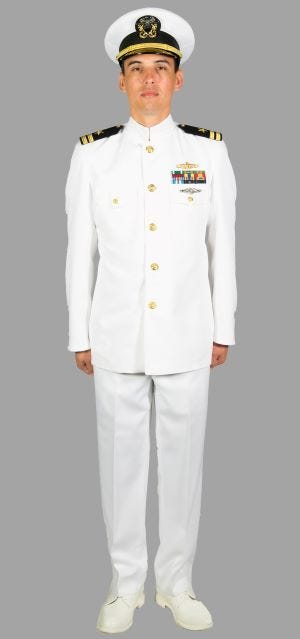
When Charlie walks in the room, I want to jump out the window. He’s the coolest of the cool. Strutting around campus in his dress whites, he’s so dazzling I can’t bear to look at him.
And pretty? As unacceptable as that word is, Charlie is so damn pretty I could cry. And here he is in sweat pants and a white tee staring at me as I curl up on the floor, totally done with this party, totally wishing I could be home with blankets pulled tight over my head.
“Hey,” he whispers, kneeling down. “What’s the matter? Can I help?”
“Just too drunk,” I manage to stammer. Those were the first words either of us spoke to each other.
I don’t remember exactly how it happened, but I ended up with my head nestled on Charlie’s chest. He whispered soothing nothings into my ear and told me everything was going to be OK.
I suppose I have your “Me Too” hackles up now.
You’re supposing this a traditional but sad narrative, that Charlie is going to take sexual advantage of poor drunken, teenage me. But he didn’t. We did end up having hot sex — days later after I’d sobered up and gotten over my hero worship.
Charlie was a sweet guy. Was he gay or bisexual? I guess. He had a girlfriend, and years after our torrid little fling he married her. He ended his career (yes, I followed it) as the XO of an Aegis cruiser in the Mediterranean.
He would have needed a security clearance as badly as I did. And neither of us was eligible for one (even though we both lied to get one) until 1995, five years after I left the Air Force.
In 1988, years after I graduated Iowa State, two FBI polygraph examiners shocked me. They grilled me with real hatred and aggression. It was an odd moment in history. Educated people had long accepted gay sexuality as normal, but the federal government had for decades asserted that “homosexuality” disqualified civilian employees and military officer from holding security clearances.
Oddly, this remained the case despite findings of the U.S. Navy’s 1957 Crittenden Report , which found “no sound basis for the belief that homosexuals posed a security risk,” concluding that “No intelligence agency, as far as can be learned, adduced any factual data … that homosexuals necessarily pose a security risk.”
Ironically, the Crittenden report itself remained “top secret” until 1976 when civil rights attorneys learned of its existence and obtained a copy through a Freedom of Information Act request. The Pentagon rejected its conclusions and continued to deny security clearances to LGBTQ military personnel until the dawning of the 21st century.
In 1988, beautiful Charlie and sexy Don filled my thoughts
I hadn’t seen Charlie since freshman year ended, and my affair with Don was over. I was stationed in West Berlin at Tempelhof Central Airport, which before the Pentagon was the world’s largest building — going by square footage. Once a temple to Nazi domination, Tempelhof had — to Berliners at least — become a symbol of hope and freedom from Soviet domination.
Don was an Army helicopter pilot, like me the possessor of a top secret security clearance, like me as queer as the proverbial three dollar bill. Like Charlie, Don later married a woman, but in Berlin, he and I were more than an item. We were a torrid romantic bonfire.
One day at work, rumors started to fly —
The FBI was coming. Time for routine lie detector tests. I didn’t care. Sure, I remembered my first days in the Air Force when I filled out my clearance questionnaire. I remembered swearing that I was straight, that I had never had “sexual contact” with another man, “no matter how slight.”
I remembered my high school and church friends writing to me. “Dude! The FBI knocked on the door and they had some really weird questions. I hope you’re OK.”
I guess I was, because I got my clearance.
I thought nothing of it again until 1988 when two (gorgeous) FBI agents invaded Tempelhof. When I entered their interrogation chamber, I was all confidence and smiles. I’d earned medals for excellence. I had a technical paper accepted for publication with the NSA. I was a model Air Force officer with a solid track record contributing original thinking to the US intelligence community.
When the agents arrived, they smiled back at me
They shook my hand as if I were their equal. That ended fast. By the time those FBI men in their gleaming white shirts and cropped hair ushered me out of their interrogation chamber, they were eying me with disgust. They didn’t shake my hand as I left.
I have no idea why they asked me questions about my sexuality. Comparing notes with friends and colleagues, I learned that wasn’t common.
The lead examiner summarized his findings so me: “We believe you told the truth throughout most of the examination. But you clearly were not telling the truth on two particular questions. I have no doubt you know which questions I mean. You will be hearing further from your chain of command.”
I never heard a word.
I lived in fear for the next few months
I had no concerns the Air Force would or could discharge me for being gay. I knew standards of evidence applied and that I could never be convicted in a court martial or non-judicial punishment. Hell, my superiors in Berlin KNEW I was gay and clearly didn’t care.
But my security clearance was a different matter entirely. It could be pulled on a whim and my career would end.
Did I spend the next few weeks rather pickled at the officers club? I’d be lying if I said no. I was scared out of my mind. Worse, I was deeply ashamed of myself. I knew the base commander and my wing commander had been briefed about my polygraph failure. I knew gossip was circulating around base.
My internalized homophobia was impossible to overcome
In 1990, I had to decide whether to stay in the Air Force. My superiors urged me to re-up. The Air Force offered me a signing bonus that closely approached 50,000 dollars.
But I couldn’t see anything but the looks of disgust in those FBI men’s faces. I couldn’t feel anything other than the fear that had overwhelmed me in the months after that polygraph examination.
Am I upset about being hounded out of the US military for being gay?
No, I’m not. I landed in New York City, quickly joined Queer Nation and Act Up, and ended up despising US military ideals and aggression. But to this day, I still think like an intelligence analyst. I still value the rigor and academic discipline.
I still wonder if had I stayed in whether I would eventually have become a whistleblower. I’ll never know, because as late as 1995, gay women and men were hounded out of government positions that required security clearances. Worse, we were often treated with active disgust, as I was by those FBI agents.
I still think fondly of beautiful Charlie
And you know what? Even today in the US military, according to friends I know who serve, being gay or trans is often hush-hush, top secret information, especially in the combat arms.
Just look at the first thing Donald Trump did after assuming office. He issued an executive order banning transgender people from serving in the military despite a Pentagon report that had already concluded trans people were good for the military, denying observed reality and the wishes of the military, just like the Crittenden Report.
I wonder how many other LGBTQ people feel like me
For years, I didn’t think to be outraged at how those FBI examiners treated me. I felt guilty. I’d broken the rules. I’d lied. I’d promised I wasn’t gay when I knew I was.
Today, I know those men asked me questions they had no moral right to ask. I know my military service was exemplary and had nothing to do with my sexual orientation. I’m shocked that as late as 1995 I could be shamed and punished for the meer fact of loving other men.
I want to tell my story so people understand how recent inequality ruled our land. I want to tell my story in the hopes somebody official hears and apologizes.
All LGBTQ people deserve apologies for how we were abused during the Lavender Scare. We deserve compensation for ruined careers too, but that’s a story for another day.
James Finn is a long-time LGBTQ activist, an alumnus of Queer Nation and Act Up NY, an essayist occasionally published in queer news outlets, and an “agented” novelist. Send questions, comments, and story ideas to [email protected].


