The Purple Pamphlet — A Shadowy History in the Sunshine State
Legislative surveillance of citizens.
Just last week, for the first time in US history, the Supreme Court ruled in favor of workplace protections for LGBTQ people.
The decision was based on Title VII of the landmark Civil Rights Act of 1964. Despite that Act’s prohibition of sex-based discrimination, LGBTQ people in 1964, and for decades thereafter, would continue to be fired for their sexual identity.
In the decade before Title VII’s enactment into law, 1950s America saw the rise of related panics, the Red Scare focused on Communists and the Lavender Scare focused on queer people.
The Lavender Scare, less well known than the Red, lasted far longer and reached deeper. Eventually, hundreds of queer people were fired from their jobs in the federal government on the grounds that they were susceptible to blackmail and generally immoral.
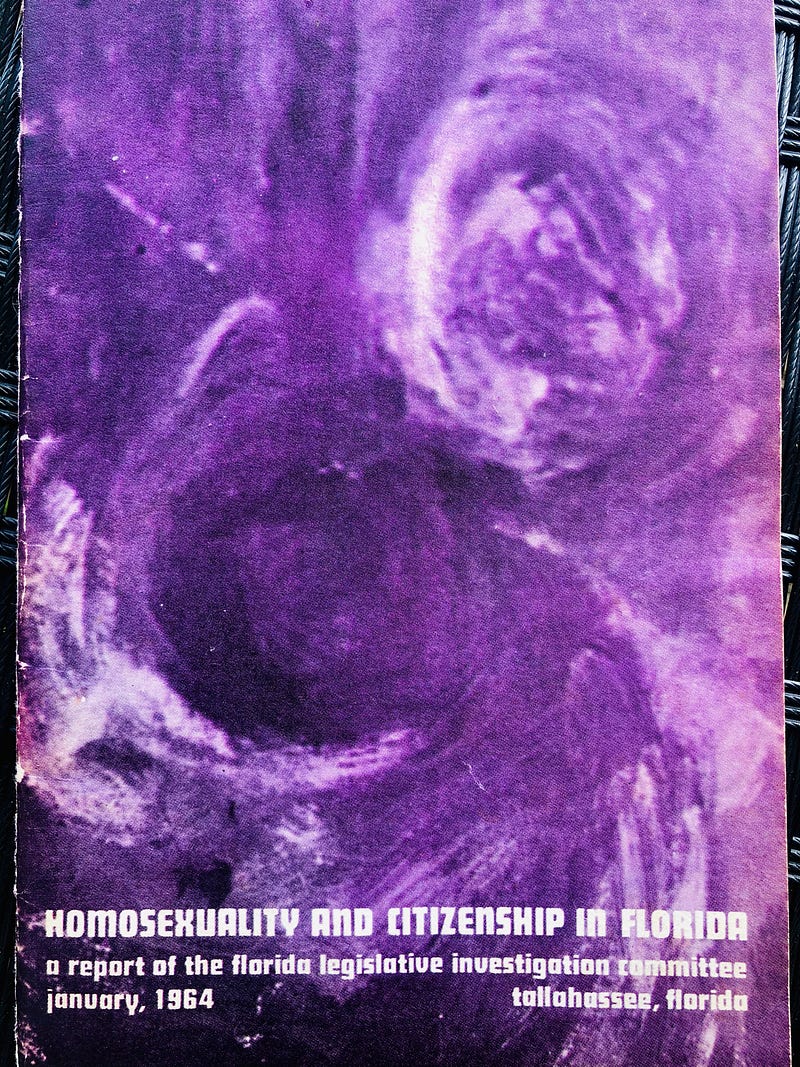
Anti-gay action was not limited to the federal government, however. In 1964, the same year the Civil Rights Act was passed, a legislative committee in Florida published the virulently homophobic “Purple Pamphlet.”
What Is the Purple Pamphlet?
Beginning in the mid-1950s, state legislative committees in the Sunshine State began to investigate the extent of homosexuality in Florida. By 1964, the Florida Legislative Investigative Committee, led by state senator and former governor Charley Johns, set its eyes, quite literally, upon gay sex.
The committee set out to “understand and effectively deal with the growing problem of homosexuality” and presented its findings in a fifty-page booklet called Homosexuality and Citizenship in Florida: A Report of the Florida Legislative Committee (known informally as the Purple Pamphlet because of the color of its cover).*
Features of the Purple Pamphlet
The Purple Pamphlet attempts to present, at least superficially, an air of objectivity. The document, for example, provides an extensive list of references and cites studies by fair-minded scientists and social scientists, such as Alfred Kinsey, and some of the language written by the committee looks, at first glance, reasonably objective, even sympathetic, in regard to its subject.
The committee, for example, quotes at length a letter from a young lesbian who wrote that she leads a “quiet, and apparently normal, life. I have a well paying, responsible job, I own my own home, I am active in church and community affairs and I command the respect of those who know me.”
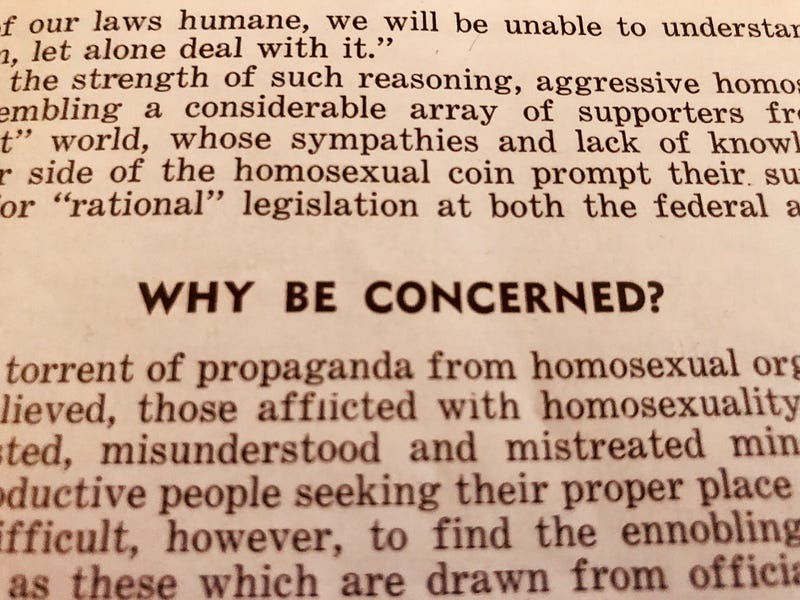
Beyond acknowledging the acceptability and respectability of some LGBTQ people, however, the Johns Committee was quick to frequently condemn most queer people, especially gay men, whom the committee believed represented the “other side of the homosexual coin,” and who were “a threat,” and whose organizations and publications such as ONE Magazine and The Mattachine Review were described as “propaganda.”
The committee, searching for an appropriate definition of homosexuality, settled on this: “We would…suggest that that the Biblical description of homosexuality as an ‘abomination’ has stood well the test of time.”
Throughout the Purple Pamphlet, the committee rehearses two old prejudices against gay men: 1) equating homosexuality with pedophilia, and 2) arguing that gay people insidiously recruit “normal” children.
Homosexuality and Molestation Even today, gay men are often unjustly accused of being the equivalent of or no better than pedophiles. The Purple Pamphlet explicitly drew this equivocation but went even further, writing that gay men are more monstrous than “normal” child molesters.
“The child molester attacks, but seldom kills,” the committee writes. “The outlook for the victim of molestation is generally good…The homosexual, on the other hand, prefers to reach out for the child at the time of normal sexual awakening and to conduct a psychological preliminary to the physical contact” and is thus a particular danger.
Recruitment The first and all-consuming goal of gay men, the committee reports, is the recruitment of “normal” children, to turn straight kids gay.
The longest single piece of evidence quoted in the Purple Pamphlet is an interview with an unnamed “veteran investigator” who sounded this alarm: “The homosexuals are organized,” he said. “The persons whose responsibility it is to protect the public, and especially our kids, are not organized in the direction of combating homosexual recruitment of youth…We must do everything in our power to create one thing in the mind of every homosexual, and that is: Keep your hands off our children!”
Recommends Tracking Gay Men The Florida Legislative Investigative Committee, in publishing the Purple Pamphlet, sought to promote legislation called the Homosexual Practices Control Act, legislation that would, in their words, “serve both as encouragement to law enforcement and officials and as a deterrent to the homosexual hungry for youth.”
Much of gay life was proscribed in 1960s America. Even private, consensual sex between men was a crime in all states but Illinois, and same-sex dancing, public affection, and cross dressing were illegal acts throughout the country.
With the Homosexual Practices Control Act, the Johns Committee hoped to further increase the penalties for the crime of being gay.
Among the committee’s recommendations:
- That all teachers found to be gay be fired from the public schools and their teaching certificates revoked.
- That all men on parole or probation for “homosexual acts” (such as sex in public bathrooms) be assigned to a psychiatric center for ongoing evaluation.
- That every “homosexual offense” for which a man was charged, beyond the first time, be conducted in a felony court.
- That a central records repository be created and all files of those charged with “homosexual offenses” be open for perusal by the public, including employers.
Fortunately, the Homosexual Practices Control Act never passed into law in Florida. Had it been enacted, gay life would have fallen under the most severe state-wide surveillance ever practiced against a single group of citizens in the US.
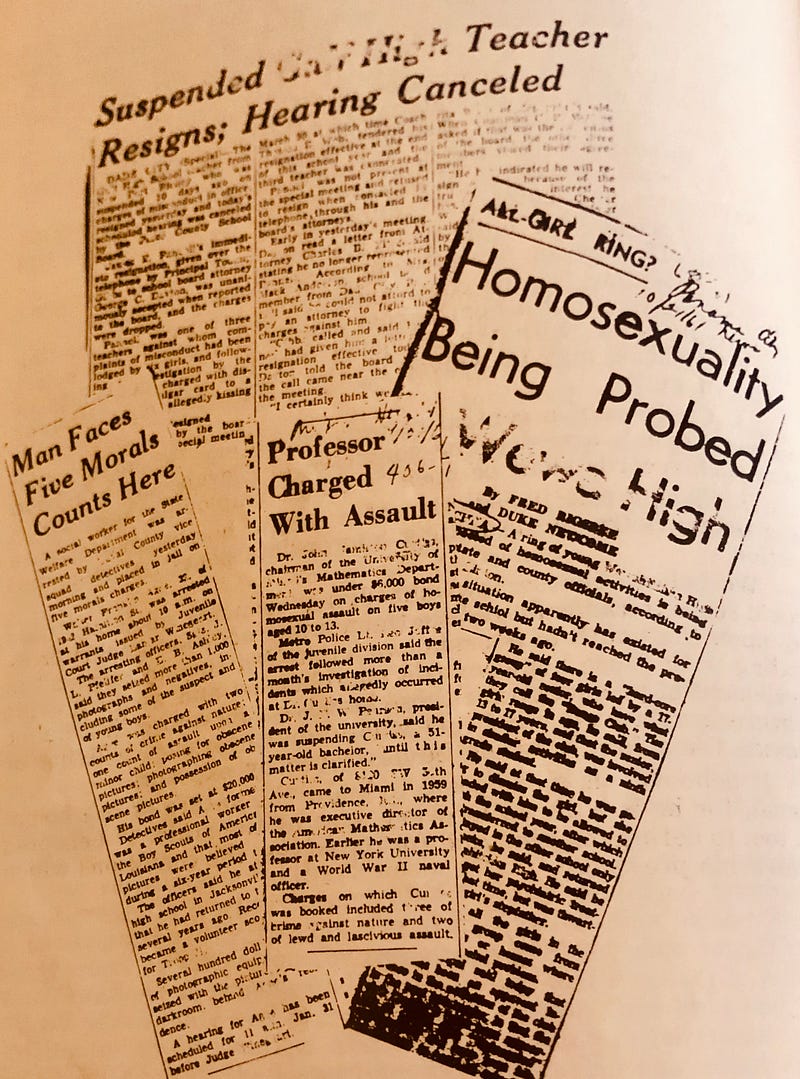
However, though the act never became law, individual acts such as sodomy, cross dressing, and same-sex dancing did remain illegal in the state for many years. What’s more, the Johns Committee directed the state’s Board of Education to investigate teachers suspected of being gay. In the 1960s, scores of teachers were fired in Florida under the directive.
Backlash Against the Purple Pamphlet
Perhaps surprisingly, backlash against the Purple Pamphlet was swift and severe. As soon as it was published, citizens and government officials in Florida began calling for the Johns Committee to be disbanded.
Did Floridians object to the intense homophobia presented in the report?
Sadly, no.
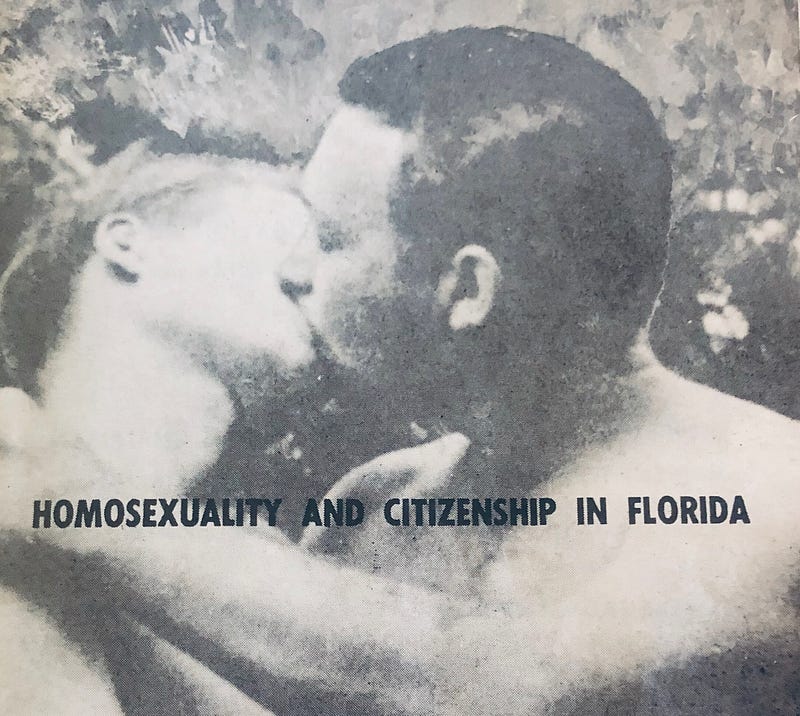
Instead, people were outraged that public money had been spent to issue a report that included (albeit in a limited way) photographs of men having public sex and a sheet of underwear-clad little boys seized from the home of a pedophile. Some people were even outraged that a glossary had been included of gay slang (with phrases such as trick day or gay dirt).
Florida’s Attorney General, prompted by constituents, ordered the Johns Committee to cease distribution of the Purple Pamphlet and in the next legislative session the committee, allocated no new funding, was dissolved.
So, was the disbanding of the committee a victory for gay people?
Perhaps in one sense, yes, as the Homosexual Practices Control Act never passed into law or even became fully drafted. The victory was probably at best a Pyrrhic one, though. Sodomy remained a criminal offense, even in the privacy of one’s home. And the jobs and careers and housing of LGBTQ people in the state remained at risk, especially for teachers.
What’s more, in disbanding the Johns Committee, the legislature also ordered all the committee’s papers and records be sealed until the year 2028 — not to protect the privacy of gay people interviewed but because those interviews and descriptions of gay life were so odious to the average Floridian in 1964.
* All quotations and photographs are from Homosexuality and Citizenship in Florida: A Report of the Florida Legislative Investigation Committee, Tallahasee, Florida, 1964 (the Purple Pamphlet). The records of the Johns Committee were unsealed early, and its (redacted) documents have been available for review by scholars and others for almost thirty years.