
When Students Went Back To One-Room Schools
An actor remembers using mail-order catalog pages for toilet paper at his Iowa schoolhouse
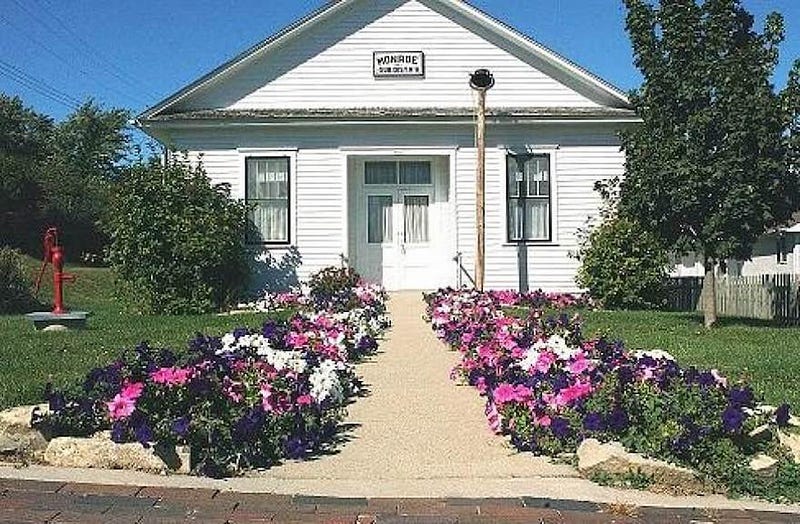
One-room schoolhouses began disappear from America when motorized school buses arrived in the 1920s, and only about 400 exist today, typically in remote areas of the West or Alaska.
In Iowa, the last closed in 1967, and their students included the late actor Richard Willis, who played Asa Buchanan’s butler, Nigel, on the soap opera “One Life to Live.” Willis recalled his years at the small white Aurora Schoolhouse in Long Gone (Greenpoint, 2007), a memoir of growing up on a family farm in Marengo, Iowa, in the 1930s and ‘40s.
Here’s part of what he says about his education:
“Our school was heated by a big, jacketed stove placed a little off-center in the room. Midwest winter temperatures dropped to twenty, sometimes thirty, degrees below zero. A teacher’s quality was sternly tested when it came time to bank the fire so that it would hold the night. Only a real veteran could keep a fire going over the weekend. When the fire burned out, as it often did, kids coming to school after a freezing walk of a mile or two found the place icy cold. While the room warmed up — it seemed to take forever — the youngest of us sat with our feet up on a railing around the base of the stove, but older pupils had to endure (proudly) the chill at their desks. Ink froze solid, and all of the work had to be done in pencil until the schoolroom warmed up …
“Sanitary arrangements were primitive. Two outdoor privies were set at the edge of the schoolyard. They smelled bad. The older boys told me that if you carried any food into a privy (I couldn’t imagine why anyone would want to do that) it would be poisoned.
“Regular toilet paper was a luxury our school district couldn’t afford. We made do with discarded mail order catalogs, the softer index pages much preferred over the stiff coated-paper pages. One of our neighbors stocked his privy with a crock full of clean corncobs instead of paper — I am not making this up — but things were never that bad at school.”
Read an excerpt from Long Gone that deals with medical and veterinary care in the 1930s and ’40s in archives for Ducts.org.
You might like three of my other stories about education:
© 2023 janiceharayda