
More U.S. Schools Should Offer Girls Flag Football Teams
High schools and colleges hurt female athletes by excluding them from a fast-growing sport
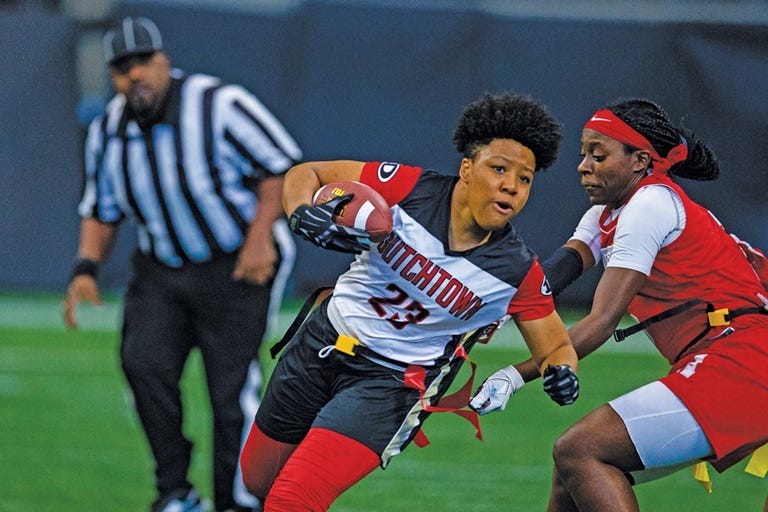
Tackle football for girls has always been a tough sell in the United States. Girls have had a right to play the sport on their own or boys’ teams — if they have the interest and ability — since Title IX became law 50 years ago.
But high-profile concussions and other injuries have raised questions about whether even boys should play, and never mind girls. Who wants to see a female athlete carted off the field like the Miami Dolphins quarterback Tua Tagovailoa after he took a hard sack in a game against the Cincinnati Bengals?
There’s a safer, cheaper, and more promising alternative that schools should offer girls: flag football programs.
Nobody gets tackled in games
Flag football players don’t tackle others. In order to end a down, they remove a flag or flag belt from the ball carrier. A player, whether male or female, needs little gear except for an inexpensive uniform, a flag belt, and a mouthguard. Flag football is typically a fall or spring sport, but can be played year-round in favorable climates.
Why should schools add the sport if they offer girls other athletic pursuits?
The obvious answer is: Schools without a flag program are sidelining girls who want to play football and whose abilities may uniquely suit the sport.
Interest follows opportunity in girls’ sports
Too many schools assume that if female students haven’t asked for a sport, they have no interest in it. That idea has long since been disproved by Title IX of the Education Amendments of 1972, which banned sex discrimination in federally funded education programs.
Title IX showed that in sports, interest follows opportunity, not vice versa. Soccer went from a sport with 700 female participants in 1971–1972, about one quarter of one percent of girls who played high school sports–to nearly 400,000 in 2018, about 12 percent of the total.
The swift expansion of non-federally funded camps and club programs has strengthened Title IX’s lesson that interest follows opportunity in girls’ and women’s sports.
Something similar is happening today with flag football.
Pro teams are lending their stadiums to girls’ flag players
The National Football League launched its NFL FLAG initiative for boys and girls in the mid-1990s, and since then, schools nationwide have added the sport. Professional teams like the Atlanta Falcons have opened their stadiums to them.
The number of U.S. high school girls playing flag football has doubled in the decade that led up to 2018–2019. And that figure is likely to grow exponentially in the next year or two.
Last month the southern section of the California Interscholastic Federation voted to make flag football an official girls’ high school sport. The state federation is expected to take up the issue soon. If it approves it, flag football would become an official sport in California.
Five states already have programs sponsored by member associations of the National Federation of High Schools: Alabama, Alaska, Georgia, Florida, and Nevada. The National Association of Intercollegiate Athletics has approved flag football as a college sport.
That rapid march toward athletic justice is overdue.
Girls’ participation in school sports still trails boys’
Nationwide, girls still lack full equality of opportunity in school sports. About 60% of girls participate in a sport, compared with 75% of boys, according to a report by Women’s Sports Foundation, prepared to mark the 50th anniversary of Title IX on June 23, 2022.
One of the easiest ways to close that gap is for more schools to embrace flag football.
But the sport has a value that goes beyond any balance it adds to the scales of social justice. It offers girls and women many of the benefits that other sports do: It can build confidence, enhance physical fitness, teach lessons in discipline and teamwork, and create a sturdier on-ramp for college. Schools that lack programs risk falling behind in the drive for equal opportunity in girls’ sports and, at the college level, may lose potential students who want to play.
Flag football today is where soccer was in 1972 but with a deeper and broader following. Perhaps the most striking aspect of its recent growth is that it’s occurred at schools in progressive states, like California, as well as in more conservative ones, like Alabama. It’s time for others nationwide to start their opening drives toward another victory for equality.
Helpful resources besides those linked to in the article include:
The National Association for Intercollegiate Athletics flag football facts
The National Football League’s NFL FLAG website
“50 Years of Title IX: We’re Not Done Yet,” a Women’s Sports Foundation report
Jan Harayda is an award-winning journalist in Alabama, whose work has appeared in many major print and online media.
You might like another of my stories about college sports: