
When Public Defenders Run For DA
Electing progressive district attorneys is a new and creative strategy for criminal justice reform
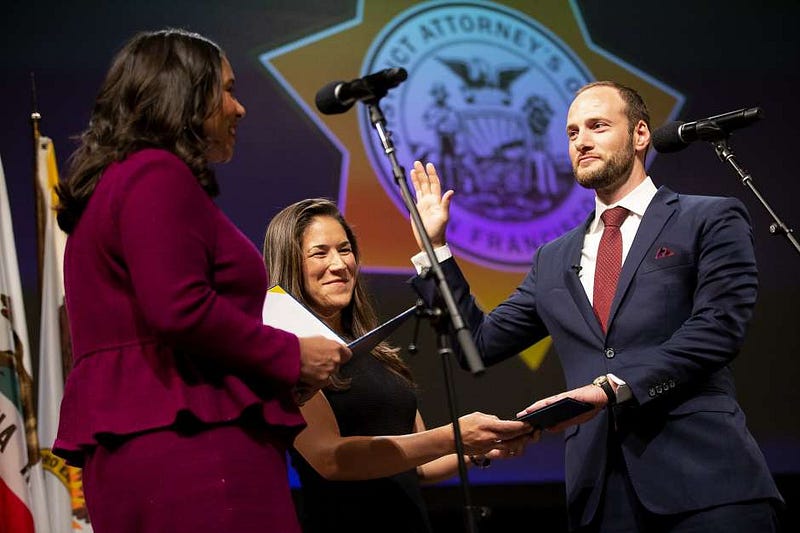
San Francisco’s new district attorney Chesa Boudin came to the election directly from the Public Defender’s office, despite the fact that the two offices are opposed in court. He was sworn in at City Hall on January 8, 2020, fired several assistant DAs a few days later, and replaced many of them with attorneys from the public defender’s ranks. Five months later, he’s reduced the SF jail population by forty percent.
Boudin has appointed a civil rights activist to head the Independent Investigations Bureau; co-sponsored a resolution asking the Civil Service Commission to prohibit SFPD from hiring officers with a history of misconduct; and required prosecutors to evaluate all available evidence before bringing charges of resisting arrest or assaulting an officer, since “sometimes the victims of excessive force and police violence are themselves arrested.”
He’s also established significant policy reforms including:
- Declining to file possession of contraband charges in cases where an officer uses a minor traffic infraction to pull over and search a motorist
- Ending the use of California’s Three Strikes law and related provisions, and
- Ending the use of sentence enhancements based on alleged gang affiliation
The press release pointed to a broad progressive agenda.
The reforms were among a slate of new, evidence-based public safety policies to reduce documented racial disparities in San Francisco’s criminal justice system and address mass incarceration.
District Attorneys decide who goes to jail
But just as important as the public policy changes is what goes on behind closed doors. As local rabble-rouser BrokeAss Stuart wrote during Boudin’s campaign, “The District Attorney plays a central role in deciding what sort of cases get prioritized for criminal trials. This elected official calls the shots on whether prosecuting people who have a little crack cocaine is more important than prosecuting cops who kill unarmed civilians.”
Boudin isn’t the first progressive to go after the normally conservative job of district attorney. In 2017, Larry Krasner was elected DA of Philadelphia in a landslide while promising criminal justice reform.
“He likes to say that he wrote his campaign platform — eliminate cash bail, address police misconduct, end mass incarceration — on a napkin,” Jennifer Gonnerman wrote in a New Yorker profile, where she also reported that the president of the Philadelphia police union called Krasner’s candidacy “hilarious” at the time.
With a 30-year history as a civil rights attorney, including probono cases for groups like Occupy Philadelphia and Black Lives Matter, Krasner’s campaign drew strong resistance from prosecutors and police and no big endorsements when he first decided to run. (Later, George Soros got on board with a major contribution.) Yet he won 75 percent of the vote. And he’s been remaking Philadelphia’s justice system ever since.
Progressives have to step up their game
Krasner’s win was a happy revelation, since Left-wing activists are often so lame. Right wing activists, on the other hand, are frequently masterful in working the system to realize their plans.
One example shouts out from a recent Twitter post. More than 100,000 people had died from coronavirus across the U.S. Protests against racism and police brutality were raging in every state — all 50 states in agreement! — and Senate leader Mitch McConnell was standing in a near-empty chamber, pushing forward confirmation of his personal pick for a federal judgeship.
“Leave no vacancy behind,” is his motto for this catastrophic year.
McConnell — the man who malevolently maneuvered to deny President Obama his (and all America’s) rightful appointee to the Supreme Court— shows heartless cynicism in his dogged pursuit of self-serving political goals in the midst of two national calamities. And I’m not saying progressives should do the same. But too often the Left seems naive and impotent in the struggle for systemic change.
Some progressives, at least, are coming up with new ideas. Krasner’s run for DA was a brilliant and effective strategy for criminal justice reform in Philadelphia. Boudin’s election will continue to bring reform to San Francisco. And despite being a lifetime prosecutor, District Attorney Rachel Rollins in Suffolk County, Massachusetts is pushing similar progressive goals of decriminalizing low-level offenses. But other cities need to get on board. Luckily, the idea is spreading, and not just among the “liberal elites” who read the New Yorker.
Here’s rapper and Internet celebrity Cardi B urging her mostly young, often politically disengaged followers to vote in off-year elections when glamour contests like president are not on the ballot. Significant changes can be accomplished by voting in progressive mayors, judges, and district attorneys, she says, if we don’t let “redneck” voters dominate the ballot box.
The plan for a better world
When progressives like Krasner and Boudin win office, conservatives love to pronounce them “soft on crime.” But San Francisco’s new district attorney doesn’t want to let criminals run amok. Like a lot of America right now, he just wants to see all people treated fairly. And while both Left and Right have the same ultimate goal — to live in a peaceful society — they differ in how to achieve it. People like Boudin think reining in the police is part of the solution.
In a campaign interview with The Appeal, Boudin laid out his plan.
One of my absolute priorities will be to ensure that we enforce the law equally against everyone, regardless of the color of their skin, regardless of their job title, regardless of whether they are civilian or sworn employees. That means looking very, very closely at every single allegation of police misconduct, particularly involving use of lethal force.
The police do have a dangerous job and they do have to make difficult quick decisions and not every police use of force is a crime, to be sure. But, sometimes the police do commit crimes and the fact that we virtually never see them prosecuted — at least not in state court — is something that undermines the integrity of the entire criminal justice system. My goal is not to go out there and go after police. My goal is to make sure that the law is enforced equally against people whether they are civilian or law enforcement, whether they are white or Black, whether they are rich or poor. And, right now, that is not happening.
Rampant crime is imaginary
But while Boudin works to let more people out of jail, President Trump wants to throw more in, riling up his base with terms like “American carnage” and warning them of imaginary boogeymen. The fear trickles down.
When I went to see an apartment for rent in San Francisco last month, the property owner railed against Boudin, whose radical parents were in the Weather Underground and spent his childhood in jail. (His 75-year-old father is still there.) “He’s turning over all the records to the criminals! It’s just like Chicago in the ‘30s,” said my potential landlord, who was complaining about car break-ins, which are a problem citywide.
But the whole truth is, crime has been steadily declining across the United States since the 1990s, while at the same time, incarcerations have exploded, giving the U.S. the dubious distinction of having the most people jailed per capita in the world.
And Guardian columnist Rebecca Solnit makes perfect sense when she points out that crime against property is of an entirely different order than violent crime against human bodies. So it follows that prosecuting people who commit the first (e.g. windshield smashers) while letting others commit the second without consequence (e.g. police) is wrong.
If you don’t believe American police are doing grave bodily harm to citizens, then you aren’t paying attention. Besides the death of George Floyd (and Ahmaud Arbery, and Breonna Taylor, and the multitude who went before them) which instigated nationwide protests that have since spread across the world, the Twitter feed is flooded with first-person reports via phone camera videos of unprovoked police attacks on peaceful protestors. Here’s one that doesn’t contain graphic images. There are many others that are much worse.
Multiple strategies are needed to effect change
America is at a pivotal point in her history.
Impassioned protests across the country are demanding change to a rigged criminal justice system that particularly endangers black lives. Electing progressive district attorneys is a new and creative strategy for bringing it about. Donating funds, writing letters, and signing petitions are old methods being used for new ends.
When I first saw a petition to defund the Minneapolis Police Department, I thought it sounded too radical for me. But then I read comments on Twitter about how the police are equipped with military-grade weapons and tanks and full protective regalia while healthcare workers can’t even get masks, and I thought, Why not?
Every strategy now in play brings us closer to a society that works for everyone, not just the privileged class. And hopefully, we’ll come up with more. Because now’s the time to do something. Anything. With her citizenry roused and her wounds broken open, America is ripe and ready for change.
So write a letter. Sign a petition. Call a representative. Show up at a protest. Speak to your family and friends. Let people know that you stand with the protestors— that you care about justice. For ideas about how to help move us toward a better future, check the list below.
Patsy Fergusson is also the editor of Fourth Wave. For more by this author, try:


