
When Persisting Is a Dumb Idea
Life will give you a sign. Make sure you notice it.

One of the most difficult places you can find yourself is at The Fork in the Road.
You can go left or you can go right. The decision can freeze you into inertia — especially if you’re hurting inside.
Take, for example, one of my closest friends. Working for a toxic boss in a job she dislikes, she’s obsessed with quitting. She’s so racked with emotional pain, she struggles to eat and sleep. But she wavers between hanging in there and telling her boss where to shove it.
Another friend is stuck in a dead-end marriage. Finding a way to freedom consumes her every thought. At home, she walks on eggshells. At work, she spills out her troubles to anyone who’ll listen.
They’re both stuck at the place that forces you to choose: Will I stay or will I go?
Several times, I’ve found myself at a key decision point. To move forward, I’ve always relied on a core strategy: planning and controlling.
As a young girl, I inherited a steadfast, rigid determination from my father. He frequently reminded me, “If at first you don’t succeed, try, try again.”
As a result, I’ve always checked the boxes, stuck to plans and schedules, gotten stuff done. Look up “responsible” in the dictionary, and you’ll see my picture.
And, for awhile, the strategy worked. Soon I had a solid resume and a wallful of marathon medals to prove it.
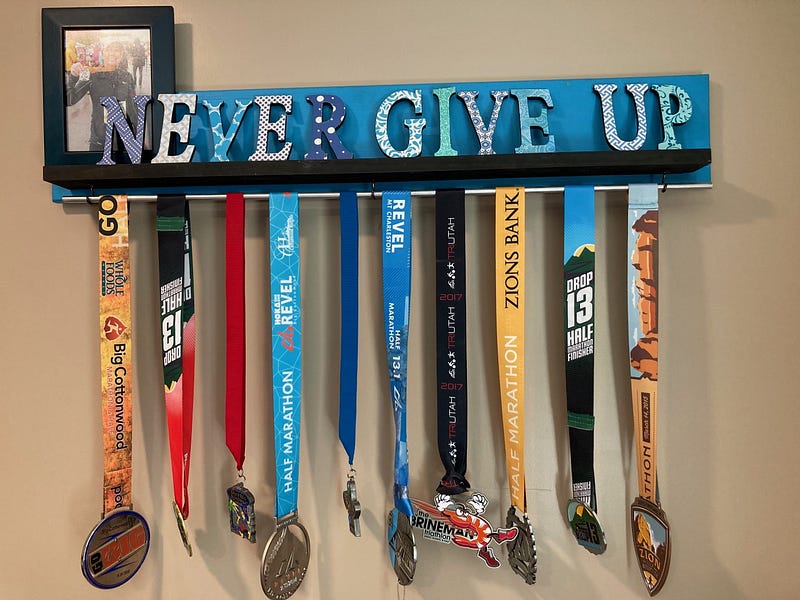
Little did I know, my preference for hanging on was holding me back and limiting my opportunities.
I was strolling through a charming, old shopping district when it suddenly started to rain. Planner than I am, I was prepared. I put up my umbrella.
Passing a dress shop window, I spied a cute outfit and decided to step in. The store’s wooden door had a large glass pane and an old-fashioned, jiggly brass knob.
Holding my umbrella in my left hand, I turned the knob with my right. But the door wouldn’t open.
Through the glass, I noticed a woman inside, head down, folding clothes. Recalling how old doors stick in wet weather, I tried again. This time, I turned the knob and shoved my hip against the door.
The woman jerked her head up with a startled look. Which seemed odd, but I quickly dismissed the thought.
I returned to my task with renewed vigor. I turned the handle and gave the door a full-blown, hearty hip bump.
BAM! That’s when it all unfolded, like a B-grade, slow-motion movie.
Through the half-opened door I watched as a rack teetered and swayed. It tilted slightly, hanging in mid-air, as if considering its options. Then it toppled like a giant Sequoia.
As it fell, it knocked over its neighboring rack…which knocked over its neighbor…which repeated like a game of giant dominoes.
Then silence.
I couldn’t believe the scene. The floor of the dress shop had transformed into a sea of fabric. Clothes hangers poked through the waves like little plastic sharks.
I froze motionless, half inside the doorway, half out. The avalanche had kicked up a dust bomb, turning the right side of my face into a raccoon’s.
For several long seconds, the woman stood with her mouth open. Oh hell, I finally realized, she’s the shop owner, and I’ve just destroyed her entire life’s work.
“I am so sorry!” I cried out. “Can I help clean up?”
The owner screamed, “JUST GET OUT!”
As I turned to go, I couldn’t help noticing a sign on the door — the very door I’d pushed against with such focus and determination.
The sign said: “Please use the other entrance.”
Fortunately for me, I left the shop with nothing worse than a bruised ego. But similar scenarios can play out with serious results.
Scientific studies have shown “never-say-die” attitudes can lead to critical health problems. In one study, psychologists followed 90 teenagers for a year, some relentless by nature and others more relaxed.
Psychologists found those who walked away from untenable situations had lower levels of inflammation called C-reactive protein (CRP). CRP is linked to several serious diseases, including diabetes and heart disease.
In addition to physical problems, excessive persistence can lead to emotional misery. People stuck in rigid patterns waste untold time, simply because they’re afraid of the unknown.
“We must be willing to let go of the life we planned so as to have the life that is waiting for us.” — Joseph Campbell
That was me. I spent years in a marriage long dead. I labored for a decade on a bad novel. I hung onto a career in a toxic environment, hoping it would become something it couldn’t.
So how to know when hold ’em, versus when to fold ‘em?
If I were to give advice to my friends — the one frozen in a loveless marriage and the one handcuffed to an awful job — I’d say:
Quitting doesn’t mean you failed. At times, we’re all forced to make tradeoffs. We abandon certain dreams and take up new ones. Sometimes the most courageous thing to say is: “I just can’t do this to myself anymore.”
Don’t rely on a single decision strategy. Always choosing the door that requires you to blast through obstacles makes no more sense than always choosing the door that’s a certain color.
Pay attention to the signs in your life. You can put all your sweat and tears into a project, and that’s admirable. But if your efforts aren’t in service of your goals, let them go. Trust yourself to move in the direction that feels right to you.
Staying alert to the signs in your life is key. It will let you know when to push through the doors that stick, and when to move along to another entrance.
And that’s a useful skill to have — in life, as well as in dress-shopping.
Thanks for reading! If you enjoyed this story, please comment, clap (up to 50 times!), and join my free mailing list to get an email whenenever I publish. You can support me and other writers by becoming a Medium member. You can also visit my profile to find a whole lot more, such as this post:


