
Kick Your Bucket List
Sometimes the best way to conquer your to-do list is to trash it

When I turned 60 — too young to retire, too old to continue sprinting on the corporate hamster wheel — my sister gave me a birthday present I’ll never forget.
It was a book called My Bucket List.
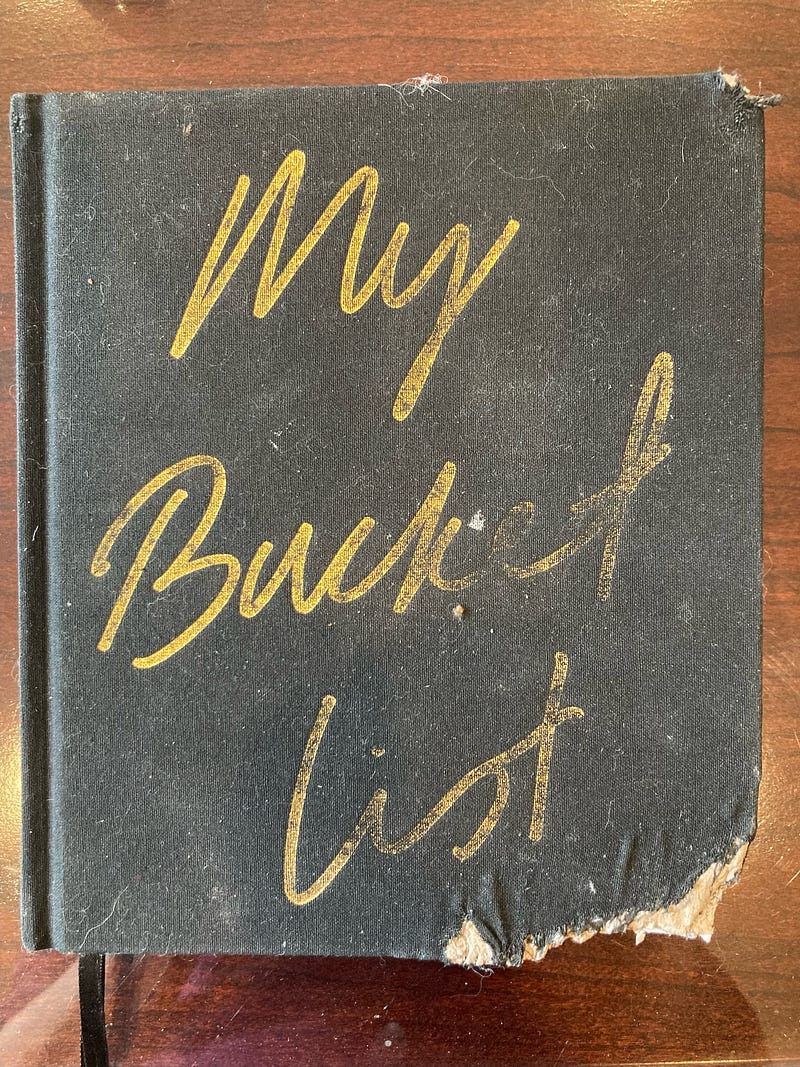
The introduction read:
My Bucket List is designed to catch all your dreams, desires, and ideas to make sure you live your life to the absolute fullest! So open your mind, throw off your bowlines, and sail away from the safe harbor — it’s time to decide how you want to spend the rest of your life, it’s time to insert YOUR story!
I was hooked. The notion of planning adventures outside the demanding confines of my work life was intoxicating. Soon, the pages filled with my dreams and visions.
Go on a health retreat! Get a hole-in-one. Start a nonprofit for kids. Finish my novel. Travel through Alaska by sled dog. Bet $1000 on red. Compete in a poetry slam. Experience zero gravity! Drink wine in France.
Prior to making my bucket list, my number-one retirement goal had been a literal snoozer: Sleeping in.
But now, life was going to be so much better than I’d ever imagined. And I knew that accomplishing my goals would make me perfectly happy.
Trashing the Bucket List
While I was busily putting my plans to paper, Harvard Business School professor Arthur C. Brooks was drafting his book From Strength to Strength, which trashes the bucket list.
Brooks says that while listing your goals may ensure you don’t reach the end of your life regretting you failed to do something specific (such as drinking wine in France), a bucket list is hardly an effective strategy for happiness. Here’s why:
- Bucket lists reinforce unhealthy attachments.
Chances are, you don’t really want that exotic vacation or skydiving experience. Most likely, Brooks says, you’re driven by external attachments, such as status, prestige, money, or power.
There’s nothing wrong with worldly rewards or dreams that push your limits. But you should ask yourself why your goals are important to you. True purpose and meaning are good. Wanting others to admire or envy you is not.
2. Bucket list results are fleeting.
The Rolling Stones song “(I Can’t Get No) Satisfaction” is a rock-and-roll classic that captures an enduring truth: Many of life’s contentments are short-lived.
That’s because of homeostasis: the process that living things use to maintain stability. Homeostasis regulates physical conditions such as temperature or oxygen levels, and the same principles work on our emotions.
For example, Brooks says, if you base your self-worth on worldly rewards, you’ll go from victory to victory just to get a brief high. That’s what social scientists call the hedonic treadmill. You run and run but make no real progress toward your goal.
3. Bucket lists cause stress.
Bucket lists focus on getting, owning, and doing more and more. Plus, Brooks says, the improvement you’re seeking is not just personal. You’re also trying to outperform others.
The result is a competitive pressure cooker — a never-ending to-do list, peppered with a sense of urgency. You know the feeling. It’s like that darn hamster wheel at work.
The Solution: Reverse Your List
Instead of chasing a conventional bucket list, Brooks suggests crafting a reverse bucket list. While a regular bucket list adds more and more tasks, the reverse version takes them away…leaving only the things that give your life its unique purpose and meaning.
How to make a reverse bucket list? Brooks suggests:
- List your weaknesses and attachments (such as money, power, pleasure, or admiration).
- Imagine yourself five years in the future as a perfectly happy person. Identify the forces of your joy (such as family, friends, faith, community service, and meaningful work).
- Go to your bucket list and consider how each goal might compete with the forces of your joy for your time, attention, and resources.
- Pare down your list. Commit to the items that will bring you real satisfaction and happiness.
Off the Treadmill
Building a reverse bucket list helped me clarify my life goals. Items I moved up the list: Those supporting health, relationships, home, and community. Items moved down or off: Exotic travel and chasing adrenaline highs.
The exercise also helped me better understand that the secret to happiness and satisfaction is not to add. (That’s the treadmill formula.)
The secret to happiness and satisfaction is to subtract. That is, as Brooks says, stop seeing your life as a canvas to fill, and start seeing it as a block of marble to chisel away and shape something out of.
My goal for each year of the rest of my life should be to throw out things, obligations, and relationships until I can see my refined self in its best form.
— Arthur C. Brooks
Amping up your personal level of happiness is not a bad payback, especially for a simple four-step exercise.
And it might be just the ticket you need to prove ol’ Mick Jagger wrong: You can get real, long-lasting satisfaction.
Thanks for reading!
Please follow me, and connect with me here on Medium. You can get an email every time I publish by going here: https://kathleen-murf.medium.com/subscribe.
If you liked this story, here are some others you might enjoy:


